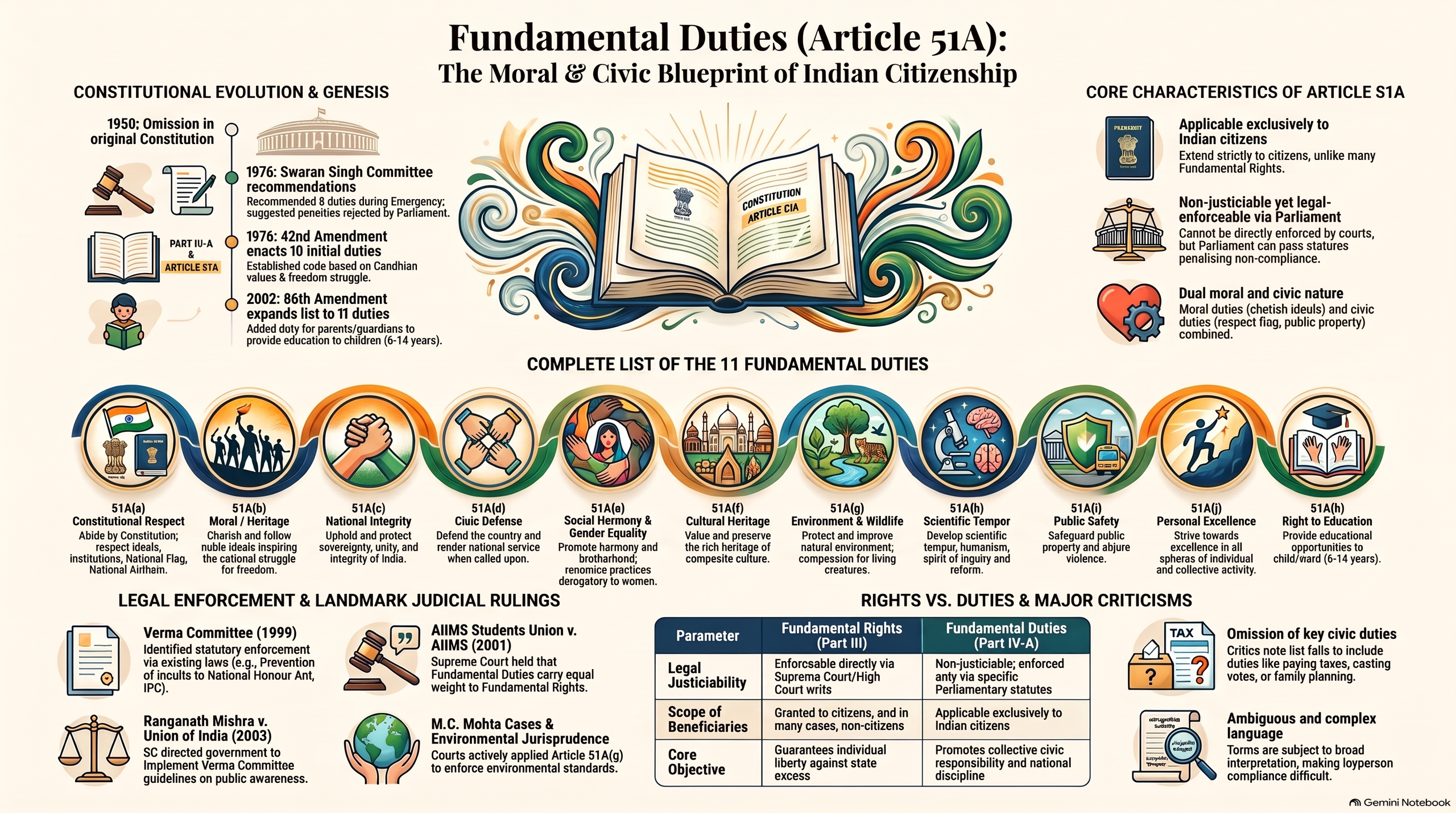
Fundamental Duties
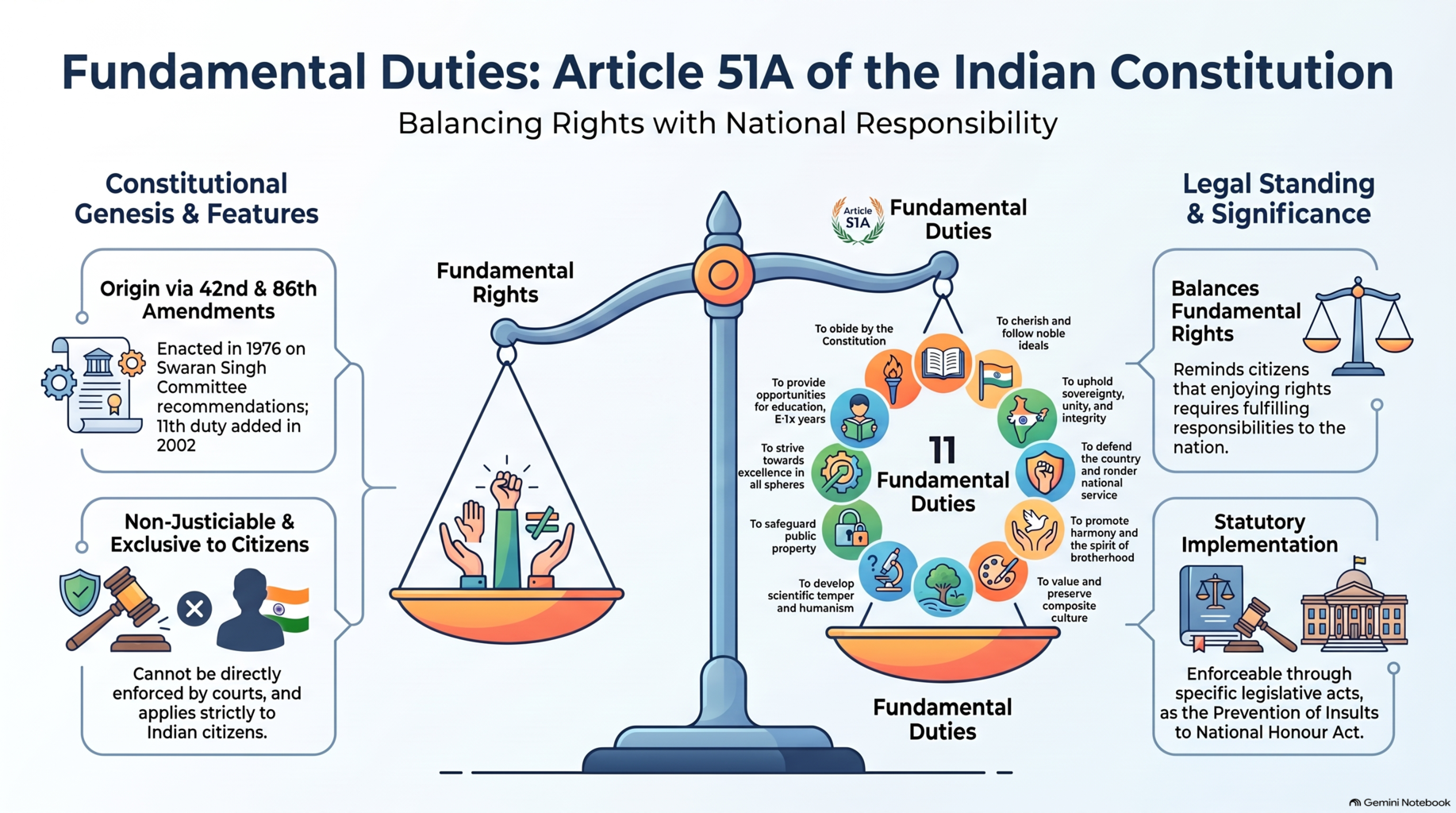
Fundamental Duties enshrined in Article 51A and Part IV-A of the Indian Constitution, which serve as civic and moral obligations for citizens. Although these guidelines were absent from the original 1950 constitution, ten duties were subsequently incorporated via the 42nd Constitutional Amendment Act of 1976 following suggestions from the Swaran Singh Committee. An eleventh duty concerning children’s education was later introduced by the 86th Constitutional Amendment Act in 2002. While these standards are non-justiciable and cannot be directly penalized through the courts, the Parliament maintains the authority to establish statutory laws for their enforcement. Ultimately, these principles function alongside fundamental rights to foster patriotism, safeguard national unity, and guide societal behavior.

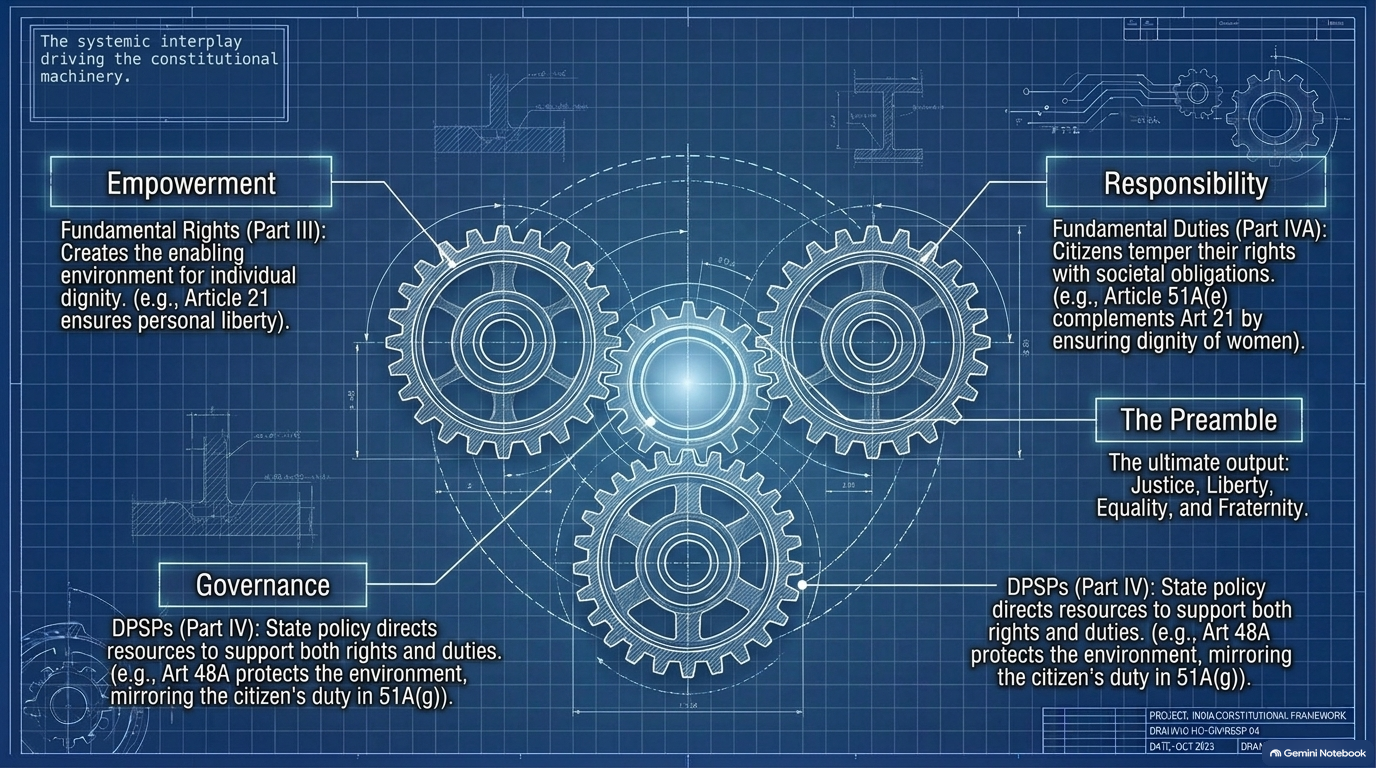
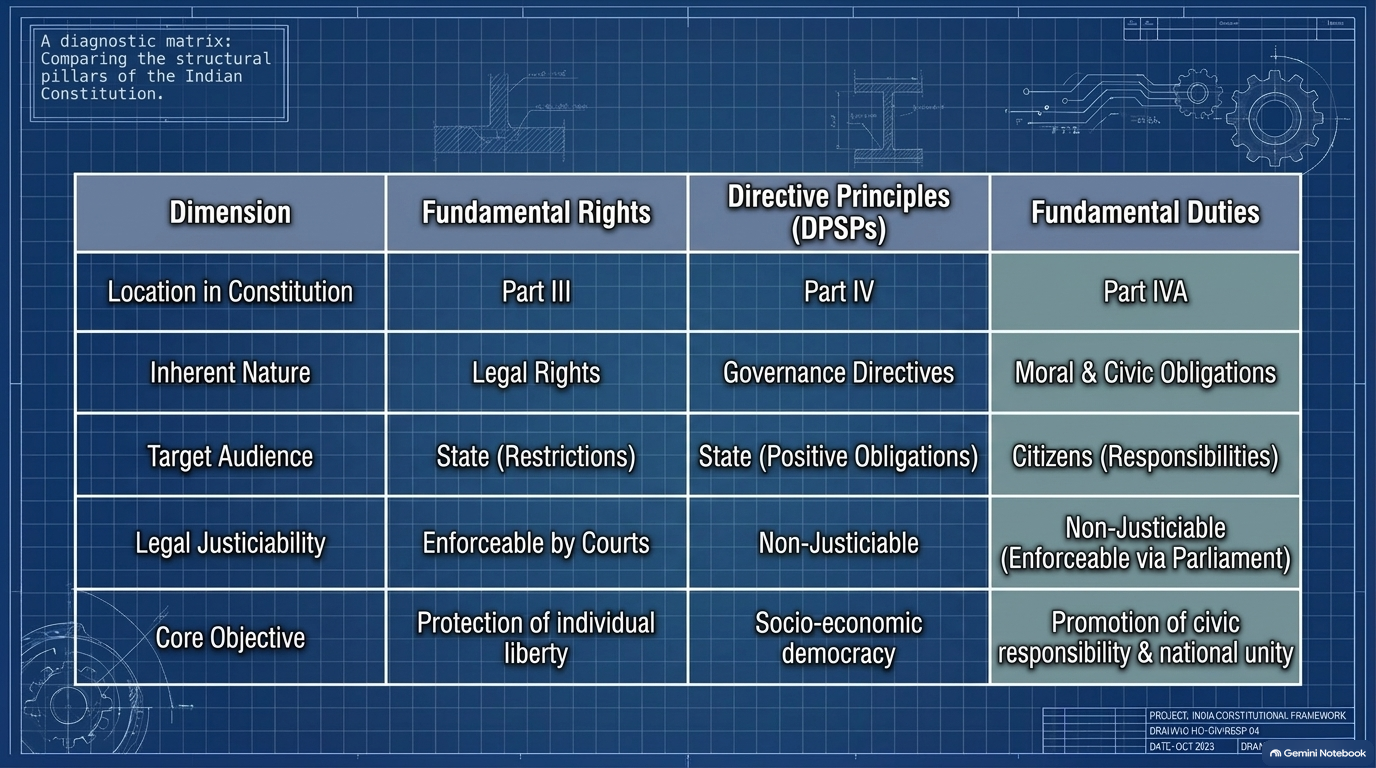


In a democratic framework, Fundamental Rights (Part III) and Fundamental Duties (Part IVA, Article 51A) operate as two sides of the same coin, serving a correlative and complementary purpose[1][2]. While Fundamental Rights protect individual liberty and guarantee freedoms against state power, Fundamental Duties establish civic accountability and moral responsibility toward society and the nation[3].
1. Complementary and Inseparable Nature
- Creating an Enabling Environment: Individual rights cannot exist in a vacuum; the performance of duties by citizens creates the peaceful, orderly environment necessary for others to exercise their rights[1][2].
- Democratic Balance: Former Prime Minister Indira Gandhi observed that the purpose of Fundamental Duties is not to smother rights, but to establish a “democratic balance” by ensuring citizens remain as conscious of their responsibilities as they are of their rights[4].
- Preventing Misuse: While rights grant liberty, duties serve as a reminder and moral deterrent against anti-social or anti-national actions, such as destroying public property or inciting communal disharmony[2].
2. Direct Constitutional Correlations
The Indian Constitution embeds direct parallels between specific Fundamental Rights and Fundamental Duties[8]:
- Freedom of Expression vs. National Integrity: The right to freedom of speech and expression under Article 19 is balanced by the reasonable restriction and corresponding duty under Article 51A(c) to protect the sovereignty, unity, and integrity of India[8].
- Right to Dignity vs. Respecting Women: The right to live with human dignity under Article 21 is complemented by the duty under Article 51A(e) to renounce practices derogatory to the dignity of women[1][8].
- Right to Education vs. Duty of Parents: The fundamental right to free and compulsory education for children aged 6–14 under Article 21A requires the active participation of citizens through the fundamental duty under Article 51A(k) imposed on parents and guardians to provide educational opportunities[1][8].
- Protection Against Forced Labor vs. National Service: Article 23(2) permits the state to impose compulsory public service, matching the duty under Article 51A(d) to defend the country and render national service when called upon[8].
3. Judicial Interpretation and Equal Significance
- Equal Constitutional Status: In AIIMS Students Union v. AIIMS (2001), the Supreme Court ruled that Fundamental Duties hold equal significance to Fundamental Rights, noting that both being designated as “Fundamental” underscores their equal importance[9][10].
- Harmonious Reading: Courts read Part III (Rights), Part IV (Directive Principles), and Part IVA (Duties) together when evaluating constitutional validity. If a law seeks to give effect to a Fundamental Duty, courts generally view it as a reasonable restriction on Fundamental Rights[2].
4. Justiciability and Statutory Enforcement
- Legal Distinction: Fundamental Rights are justiciable (directly enforceable by courts through constitutional writs), whereas Fundamental Duties are non-justiciable moral obligations[5].
- Statutory Reinforcement: Although duties cannot be directly enforced by courts on their own, Parliament retains the power to enact legislative laws enforcing specific duties—such as the Prevention of Insults to National Honour Act (1971) or the *Protection of Civil Rights Act (1955)*[4]
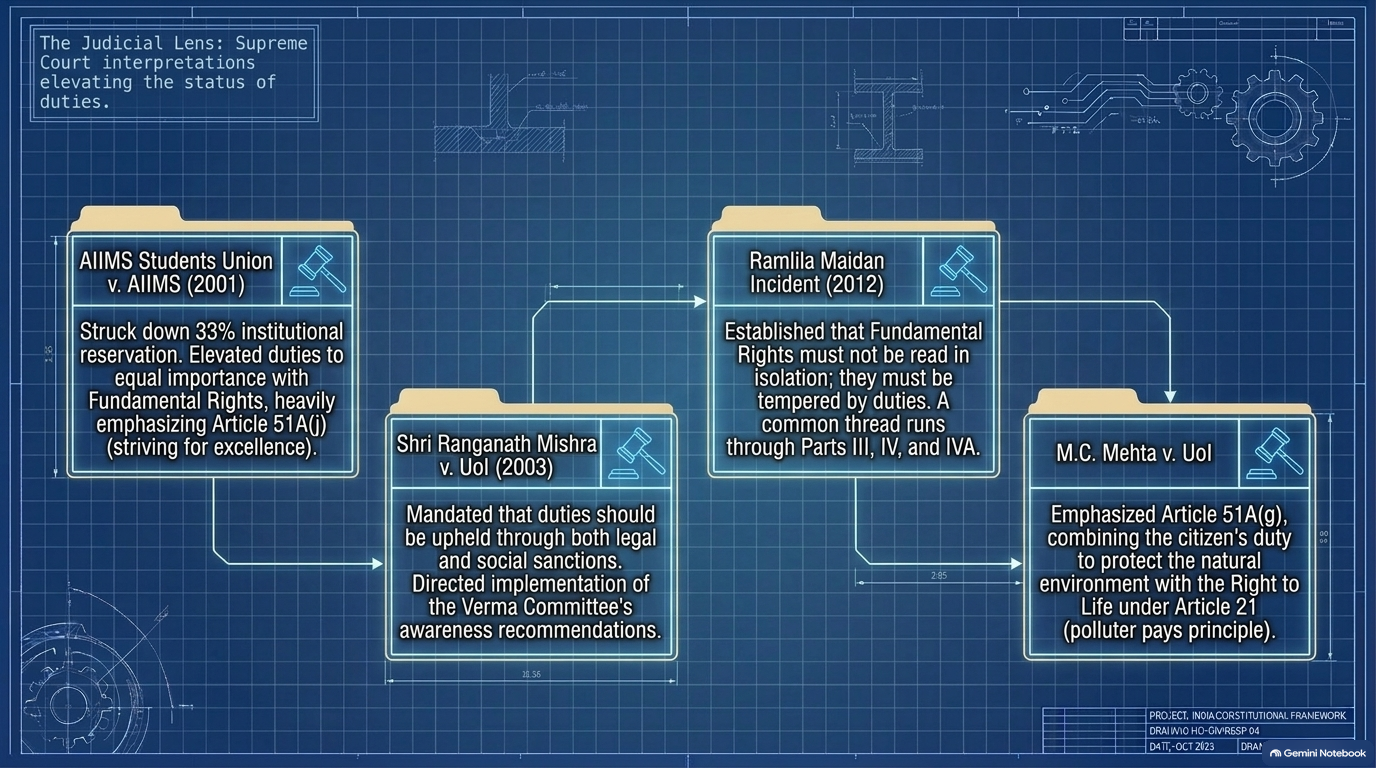
The Indian judiciary has frequently relied on Fundamental Duties (Article 51A) to interpret constitutional provisions, balance personal rights with civic responsibilities, and evaluate the validity of statutes. Key Supreme Court landmark judgments include:
- AIIMS Students Union v. AIIMS (2001): The Supreme Court ruled that Fundamental Duties hold equal constitutional significance to Fundamental Rights, noting that both being designated as “Fundamental” underscores their importance[1][2]. In striking down a 33% institutional reservation in AIIMS as violative of Article 14, the Court emphasized Article 51A(j) (striving towards excellence in all spheres) and observed that the collective duty of citizens becomes the duty of the State[2].
- Mohan Kumar Singhania v. Union of India (1991): The Supreme Court held that Article 51A serves as a guide for courts to interpret ambiguous statutory provisions in line with overarching constitutional goals[3].
- Ranganath Mishra v. Union of India (2003): The Court held that Fundamental Duties must be enforced through social sanctions as well as legal sanctions[1][4]. It directed the central government to implement the recommendations of the Justice J.S. Verma Committee to promote widespread public awareness and education regarding Fundamental Duties[1][4].
- In Re Ramlila Maidan Incident v. Home Secretary (2012): The Court observed that a common thread links Part III (Rights), Part IV (Directive Principles), and Part IVA (Duties), emphasizing that Fundamental Rights should not be read in isolation but must be tempered by civic duties[3][4]. It specifically urged citizens to respect and protect public property pursuant to Article 51A(i) while reviewing state action[4].
- M.C. Mehta v. Union of India: In environmental jurisprudence, the Supreme Court invoked Article 51A(g) (the duty to protect and improve the natural environment) to interpret the right to a clean and healthy environment under Article 21 and applied principles such as “polluter pays”
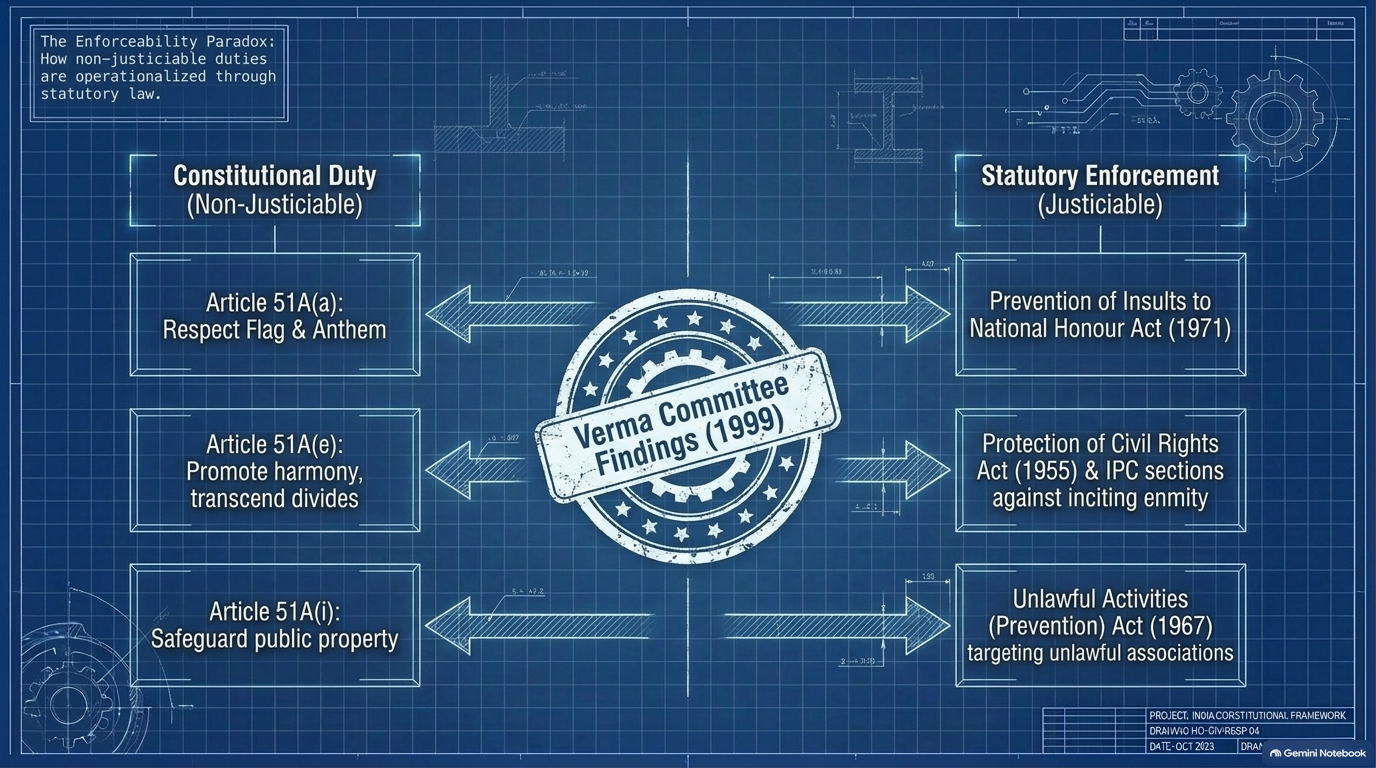
Although Fundamental Duties under Article 51A are non-justiciable (meaning they are not directly enforceable by courts on their own)[1], Parliament is empowered to enact statutory laws to penalize non-compliance and give them legal force[1].
The Justice J.S. Verma Committee (1999) identified several key parliamentary legislations that legally enforce specific Fundamental Duties[6]:
- The Prevention of Insults to National Honour Act (1971): Prevents disrespect toward the Constitution of India, the National Flag, and the National Anthem[9][10] *(enforces Article 51A(a))*[11].
- The Protection of Civil Rights Act (1955): Provides for punishments for offenses related to caste and religion to promote social equality[9][10] *(enforces Article 51A(e))*[11].
- The Unlawful Activities (Prevention) Act (UAPA) of 1967: Allows the State to declare communal or secessionist organizations as unlawful associations to safeguard national sovereignty[9][10] *(enforces Article 51A(c))*[11].
- The Indian Penal Code (IPC) and Criminal Laws: Declare imputations, assertions, or speeches prejudicial to national integration or promoting enmity between religious, linguistic, or regional groups as punishable offenses[9] (enforces Article 51A(c) and Article 51A(e))
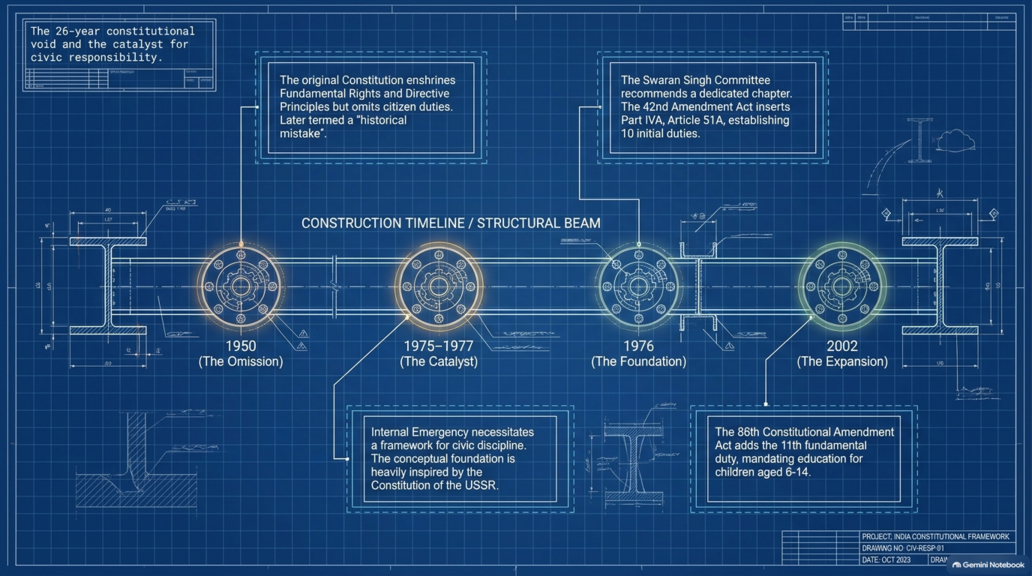
The Sardar Swaran Singh Committee was appointed by the Congress government in 1976 during the Internal Emergency (1975–77) to examine the inclusion of Fundamental Duties in the Constitution[1][2]. The committee stressed that citizens must perform duties alongside enjoying their rights[1][2].
1. Primary Recommendations (Accepted)
- Separate Constitutional Section: Recommended introducing a dedicated chapter on Fundamental Duties into the Constitution[2].
- Incorporation of Duties: Originally proposed adding a code of 8 Fundamental Duties[2].
> Outcome: The Central Government accepted the recommendation and enacted the 42nd Constitutional Amendment Act, 1976, which added Part IVA and Article 51A to the Constitution[3][5]. However, Parliament expanded the list to 10 Fundamental Duties rather than the eight proposed by the committee[3][5].
2. Key Recommendations Not Accepted by Parliament
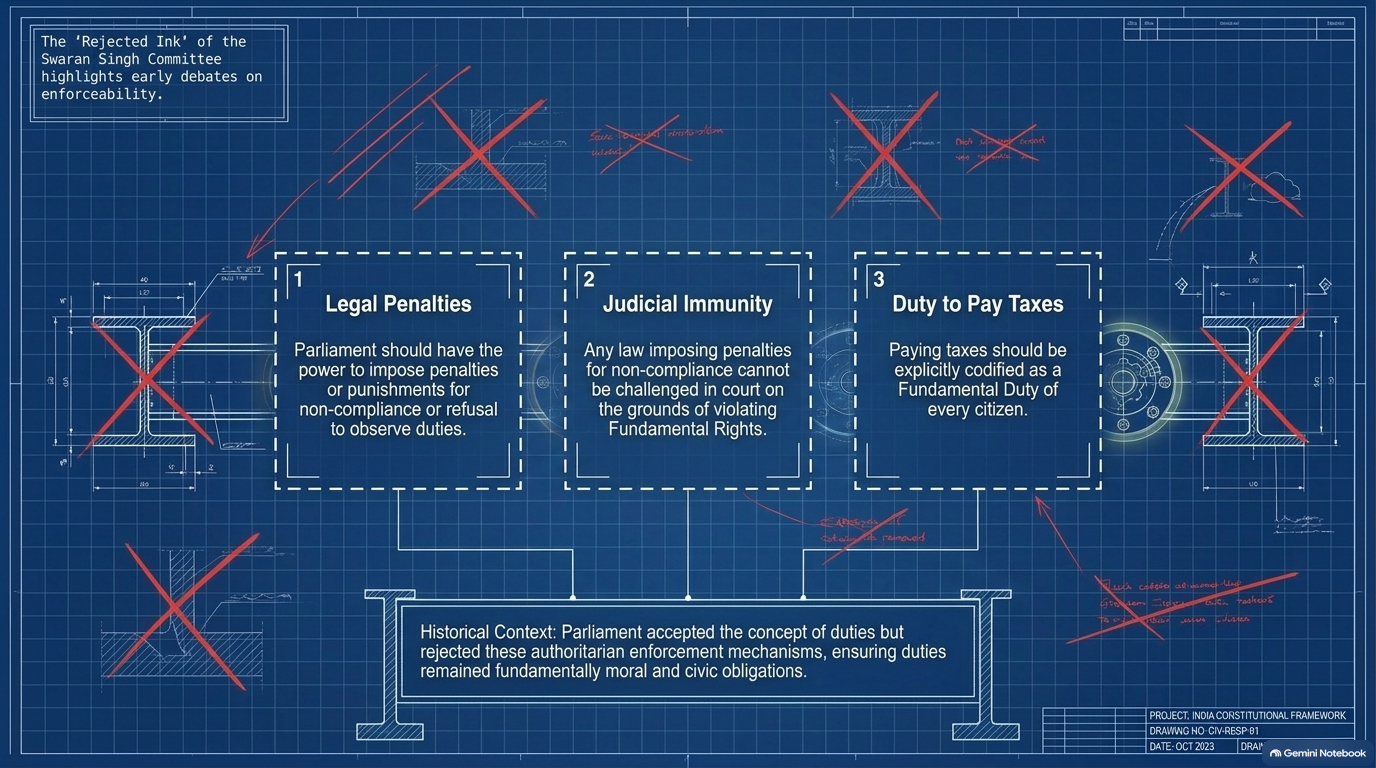
Several major proposals made by the Swaran Singh Committee were rejected by Parliament and omitted from the Constitution[3][4]:
- Penalties for Non-Compliance: Proposed empowering Parliament to enact laws imposing penalties or punishments on citizens who fail or refuse to observe Fundamental Duties[3][4].
- Immunity from Judicial Review: Recommended that laws imposing penalties for non-compliance should not be challengeable in court on the grounds of violating Fundamental Rights or other constitutional provisions[3][4].
- Duty to Pay Taxes: Suggested making the obligation to pay taxes an explicit Fundamental Duty for Indian citizens[3]
Fundamental Duties under Article 51A (Part IVA) are non-justiciable—meaning they cannot be directly enforced by courts through writs or legal actions—due to several key constitutional and structural reasons[1]:
- Moral and Civic Character: Fundamental Duties were incorporated as moral guidelines, ethical principles, and civic standards rather than strict legal mandates[1]. They serve as a normative compass to remind citizens of their responsibilities toward society and the nation without imposing direct legal compulsion under Article 51A itself[1].
- Parallels with Directive Principles (DPSPs): Similar to the Directive Principles of State Policy in Part IV—which guide government action without being directly actionable in court—Part IVA provides a non-justiciable framework guiding individual conduct[1].
- Omission of Penalty Provisions by Parliament: When the Sardar Swaran Singh Committee originally recommended introducing Fundamental Duties in 1976, it proposed empowering Parliament to enact penalties or punishments for non-compliance and immunizing those laws from judicial review[6][7]. However, Parliament deliberately rejected these penalty proposals when enacting the 42nd Constitutional Amendment Act, choosing to keep Article 51A non-coercive[6][7].
- Delegation to Specific Statutory Laws: Instead of making Article 51A automatically enforceable by judicial writs, the constitutional design leaves it to Parliament to pass individual legislations when penal sanctions are necessary[1]. Specific duties are legally enforced through parliamentary statutes—such as the Prevention of Insults to National Honour Act (1971), the Protection of Civil Rights Act (1955), and the *Unlawful Activities (Prevention) Act (1967)*[10].
- Role in Constitutional Interpretation: Though non-justiciable on their own, courts frequently use Fundamental Duties as an interpretive aid to judge the reasonableness of statutory restrictions on Fundamental Rights and assess the constitutional validity of legislation
Both Directive Principles of State Policy (DPSPs) (Part IV) and Fundamental Duties (Part IVA, Article 51A) serve as moral guidelines within the Indian Constitution[1][2]. While they share structural similarities, they differ fundamentally in target audience and legal origin.
1. Key Similarities
- Non-Justiciable Nature: Neither DPSPs nor Fundamental Duties can be directly enforced through courts or constitutional writs[2][3]. However, Parliament has the power to pass statutory legislation to enforce specific provisions of both[2].
- Judicial Interpretation: Courts view Part III (Rights), Part IV (DPSPs), and Part IVA (Duties) as an interconnected constitutional framework[6]. The Supreme Court observed in In Re Ramlila Maidan Incident (2012) that a common thread links all three parts, requiring courts to consider their joint impact when interpreting constitutional provisions[6].
2. Primary Differences
| Aspect | Directive Principles of State Policy (DPSPs) | Fundamental Duties |
|---|---|---|
| Target Subject | Addressed to the State to guide policy-making, law-making, and governance[6][7]. | Addressed to individual citizens to guide personal conduct and civic responsibility[2]. |
| Constitutional Location | Part IV (Articles 36–51)[9]. | Part IVA (Article 51A)[1]. |
| Origin | Included in the original Constitution (1950)[9]. | Added later by the 42nd Constitutional Amendment Act, 1976[1][9]. |
| Applicability | Guides state action across the territory of India[6][7]. | Applies strictly to Indian citizens (not foreigners)[2][5]. |
3. Direct Correlative Linkages
The relationship between DPSPs and Fundamental Duties is correlative and complementary[7]. In several key areas, a DPSP sets an objective for the State, while a corresponding Fundamental Duty mandates participation from citizens[7]:
- Environmental Protection: Article 48A directs the State to protect and improve the environment and wildlife, while Article 51A(g) imposes a fundamental duty on citizens to protect and improve the natural environment and show compassion for living creatures[7].
- Education: Article 45 directs the State to provide early childhood care and education, while Article 51A(k) tasks parents and guardians with the duty to provide educational opportunities to children aged 6–14 years[7].
- Cultural Heritage: Article 49 directs the State to protect monuments and historic places, while Article 51A(f) obligates citizens to value and preserve the rich heritage of India’s composite culture[7]
The Justice J.S. Verma Committee was constituted in 1998–1999 to formulate a strategy and methodology for implementing a national program to teach Fundamental Duties, make them enforceable in educational institutions, and initiate in-service training[1].
Key Highlights and Findings of the Verma Committee
- Promoting Public Awareness: The committee aimed to create a structured approach to generate widespread awareness and education regarding civic responsibilities across India[1].
- Proposed Amendments to Article 51A: The committee suggested amending Article 51A of the Constitution to introduce additional responsibilities for citizens, including the duty to vote in elections, actively participate in democratic governance, and pay taxes[1].
- Identification of Existing Statutory Laws: The committee pointed out that while Fundamental Duties under Article 51A are non-justiciable on their own, Parliament has already enacted several statutory laws that legally enforce specific duties[2][3]:
- The Prevention of Insults to National Honour Act (1971): Penalizes disrespect toward the Constitution of India, the National Flag, and the National Anthem[4][5].
- The Protection of Civil Rights Act (1955): Provides punishments for offenses related to caste and religion[4][5].
- The Unlawful Activities (Prevention) Act (1967): Authorizes the declaration of communal or secessionist organizations as unlawful associations[4][5].
- The Indian Penal Code (IPC) and Criminal Laws: Declare imputations and assertions prejudicial to national integration or promoting enmity between religious, linguistic, or regional groups as punishable offenses[4][5].
Judicial Implementation
In Shri Ranganath Mishra v. Union of India (2003), the Supreme Court emphasized that Fundamental Duties should be upheld through both social and legal sanctions[6][7]. Consequently, the Court directed the Central Government to implement the recommendations of the Justice J.S. Verma Committee for the widespread dissemination of knowledge on Fundamental Duties to the public
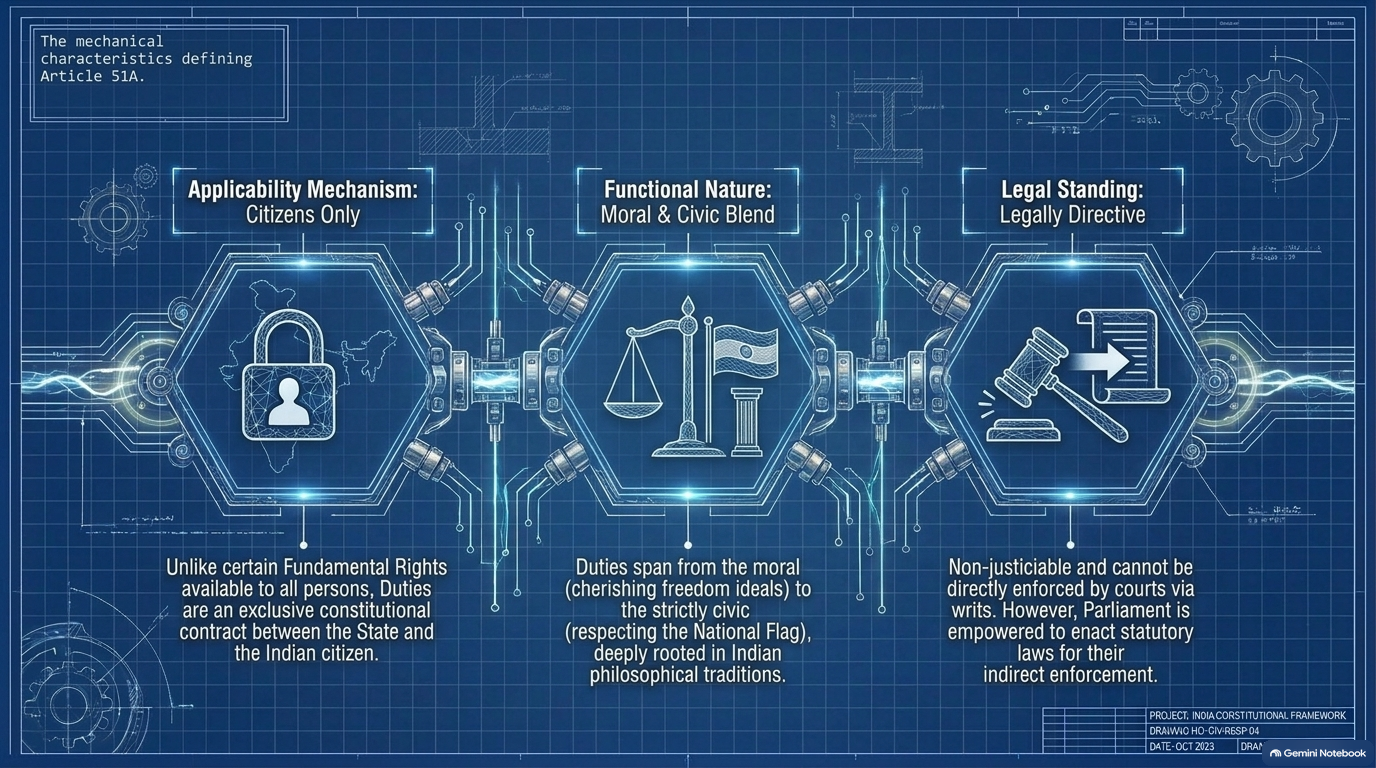
Under the Indian Constitution, Fundamental Duties (Article 51A) apply strictly and exclusively to citizens of India[1].
1. Explicit Constitutional Phrasing
The opening sentence of Article 51A explicitly dictates its scope: *”It shall be the duty of every citizen of India…”*[4][5]. By contrast, several provisions under Part III (Fundamental Rights) use broader phrasing like “any person”[1][2].
2. Distinction Between Rights and Duties
- Rights Open to Foreigners: Fundamental Rights protecting basic human liberties—such as Equality before Law (Article 14) and Protection of Life and Personal Liberty (Article 21)—extend to all persons, including foreign nationals.
- Duties Exclusive to Citizens: All 11 Fundamental Duties under Part IVA apply solely to Indian citizens[1]. Foreigners visiting or residing in India are bound by statutory penal and civil laws[6], but they carry no constitutional civic duties toward the Indian nation-state[1].
3. Underlying Rationale
- Political Allegiance & Loyalty: Key duties—such as defending the nation when called upon[4][7], protecting national sovereignty and integrity[4][7], respecting the National Flag and Anthem[4][7], and cherishing freedom struggle ideals[4][7]—presuppose political loyalty and civic allegiance that only a citizen owes to their country.
- Reciprocal Relationship: Fundamental Duties reflect the social contract between the citizen and the sovereign State, balancing constitutional privileges with civic obligations and shared national goals
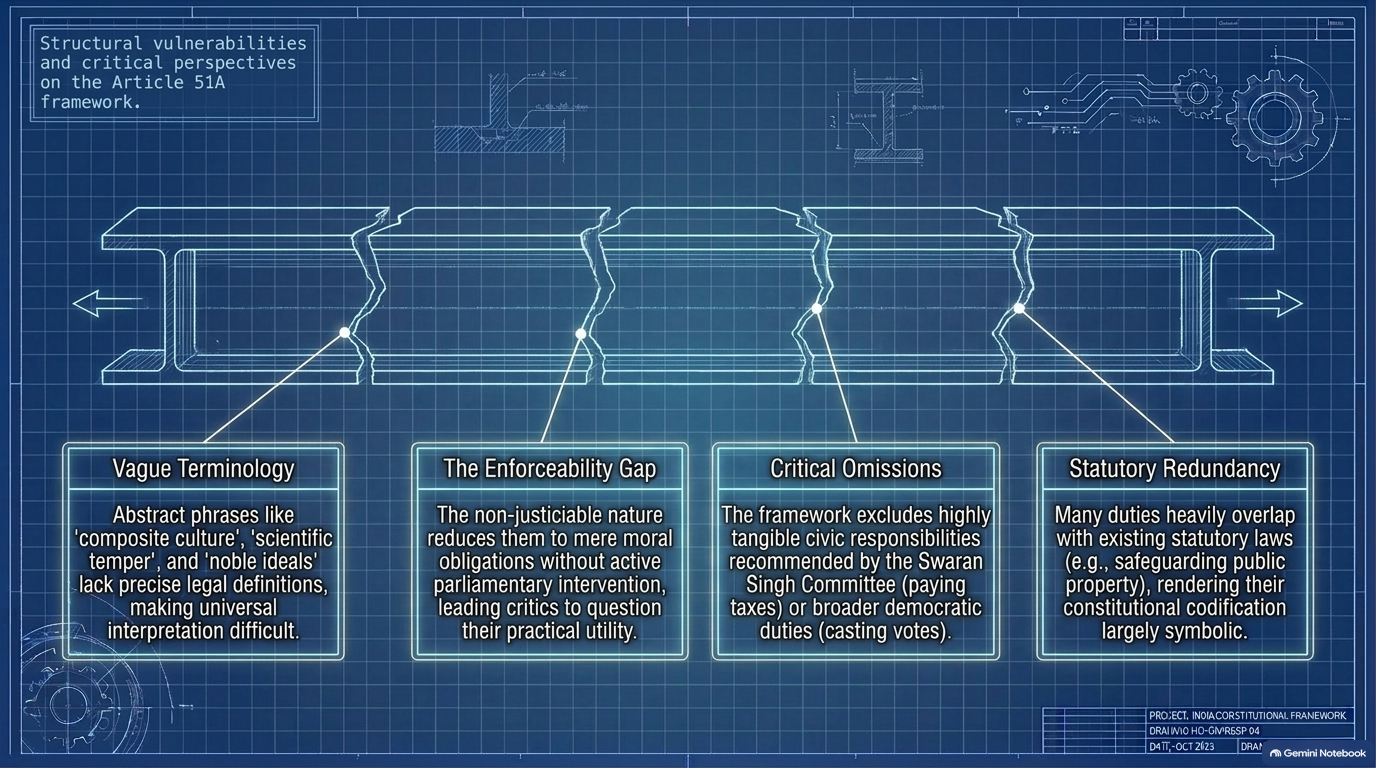
Despite their intent to foster responsible citizenship, Fundamental Duties (Article 51A) have faced several key criticisms from constitutional scholars and legal experts:
- Non-Justiciable Status: The primary criticism is that Fundamental Duties are legally non-enforceable by courts on their own, rendering them mostly moral precepts without direct legal teeth and causing critics to question the practical purpose of their inclusion in the Constitution[1][2].
- Vague and Ambiguous Terminology: Several duties employ abstract concepts—such as “composite culture,” “scientific temper,” “humanism,” and “spirit of inquiry”—that lack precise legal definitions, making them difficult for ordinary citizens to grasp and open to subjective interpretations[1][2].
- Incomplete Scope and Omissions: The list is criticized for omitting crucial civic responsibilities such as paying taxes, casting votes in elections, and family planning—duties that were explicitly recommended by committees like the Sardar Swaran Singh Committee[1].
- Redundancy and Superfluity: Critics argue that many of these duties reflect basic, self-evident moral practices that citizens naturally observe, or are already covered by pre-existing statutory laws, making their explicit constitutional listing redundant[1][2].
- Constitutional Placement: Critics question placing these duties in Part IVA following the non-justiciable Directive Principles (Part IV), arguing that appending them after Part IV reduces their standing rather than placing them right alongside Fundamental Rights in Part III[2].
- Lack of Civic Awareness: Insufficient public education and awareness regarding these duties have limited their practical impact and integration into daily public life
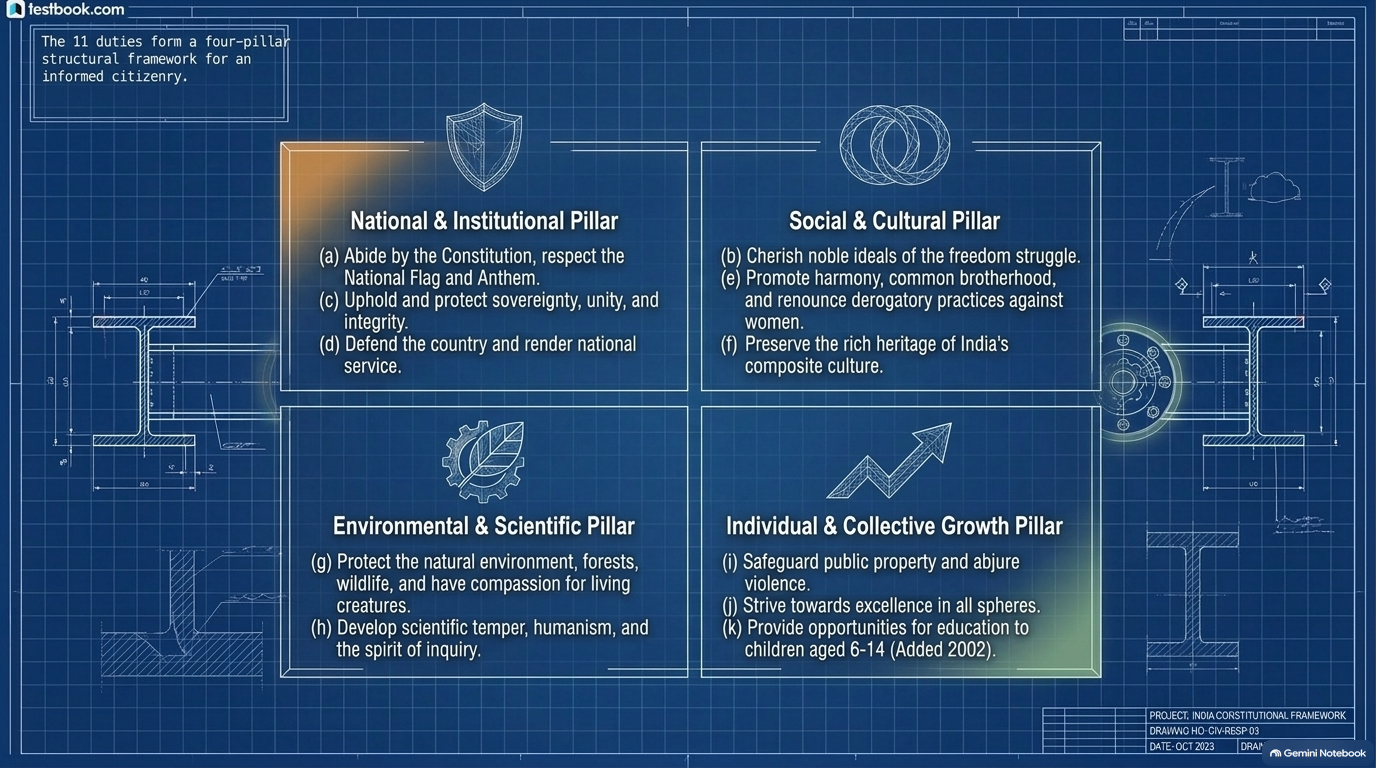
Enshrined in Part IVA, Article 51A of the Indian Constitution, there are 11 Fundamental Duties prescribed for Indian citizens[1]. The first 10 duties were added by the 42nd Constitutional Amendment Act, 1976[5], while the 11th duty was added by the 86th Constitutional Amendment Act, 2002[1].
According to Article 51A, it shall be the duty of every citizen of India[1][9]:
- Article 51A(a): To abide by the Constitution and respect its ideals and institutions, the National Flag, and the National Anthem[1].
- Article 51A(b): To cherish and follow the noble ideals that inspired the national struggle for freedom[1].
- Article 51A(c): To uphold and protect the sovereignty, unity, and integrity of India[1].
- Article 51A(d): To defend the country and render national service when called upon to do so[1].
- Article 51A(e): To promote harmony and common brotherhood transcending religious, linguistic, regional, or sectional diversities, and to renounce practices derogatory to the dignity of women[1].
- Article 51A(f): To value and preserve the rich heritage of India’s composite culture[1].
- Article 51A(g): To protect and improve the natural environment (including forests, lakes, rivers, and wildlife) and to have compassion for living creatures[1].
- Article 51A(h): To develop a scientific temper, humanism, and the spirit of inquiry and reform[1].
- Article 51A(i): To safeguard public property and to abjure violence[1].
- Article 51A(j): To strive towards excellence in all spheres of individual and collective activity so that the nation constantly rises to higher levels of endeavor and achievement[1].
- Article 51A(k): To provide educational opportunities to a child or ward between the ages of six and fourteen years (as a parent or guardian)
In a democratic society, Fundamental Rights (Part III) and Fundamental Duties (Part IVA, Article 51A) operate in a correlative and complementary manner as two sides of the same coin[1][2]. While rights guarantee individual freedoms, duties establish civic accountability and social responsibility[3].
1. Complementary and Inseparable Framework
- Creating an Enabling Environment: The performance of Fundamental Duties by citizens is necessary to create an enabling environment in which others can freely enjoy their Fundamental Rights[1].
- Establishing a Democratic Balance: Former Prime Minister Indira Gandhi defended duties by explaining that their purpose is not to smother rights, but to establish a “democratic balance” by making citizens as conscious of their duties as they are of their rights[7].
- Restraint and Responsibility: Duties serve as a constant reminder that the enjoyment of constitutional freedoms comes with responsibilities toward the nation, society, and fellow citizens[5].
2. Direct Constitutional Correlations
The Constitution establishes direct parallels between specific Fundamental Rights and Fundamental Duties[9]:
- Freedom of Speech vs. National Integrity: The freedom of speech and expression under Article 19 (subject to reasonable restrictions) is balanced by the duty under Article 51A(c) to uphold and protect the sovereignty, unity, and integrity of India[9].
- Right to Dignity vs. Dignity of Women: The right of women to be treated with decency and dignity under Article 21 corresponds to the duty under Article 51A(e) to renounce practices derogatory to the dignity of women[9].
- Right to Education vs. Duty of Parents: The fundamental right guaranteeing free and compulsory education to children aged 6–14 under Article 21A is complemented by the duty of parents and guardians under Article 51A(k) to provide educational opportunities[9].
- Protection Against Forced Labor vs. National Service: The state’s power under Article 23(2) to impose compulsory public service aligns with the fundamental duty under Article 51A(d) to defend the country and render national service when called upon[9].
3. Judicial Harmonization and Constitutional Status
- Equal Significance: In AIIMS Students Union v. AIIMS (2001), the Supreme Court ruled that Fundamental Duties carry equal constitutional importance to Fundamental Rights, noting that both being designated as “Fundamental” underscores their equal significance[10][11].
- Common Constitutional Thread: In the Ramlila Maidan Incident case (2012), the Supreme Court observed that a common thread runs through Part III (Rights), Part IV (Directive Principles), and Part IVA (Duties), requiring courts to consider the scope and impact of all three parts together when interpreting constitutional provisions[7].
- Assessing Reasonable Restrictions: When courts evaluate the constitutional validity of a law, a statute that gives effect to a Fundamental Duty is considered reasonable and constitutional[6].
4. Key Legal Differences
- Justiciability: Fundamental Rights are justiciable and directly enforceable in court through constitutional writs, whereas Fundamental Duties are non-justiciable moral and civic obligations[3].
- Applicability: Fundamental Duties apply strictly to Indian citizens, whereas several Fundamental Rights extend to all persons, including foreign nationals
Balancing Rights and Responsibilities: Understanding Fundamental Duties in India
Introduction
Can a democracy truly thrive if citizens demand their rights with passion but ignore their duties to the nation? When India adopted its Constitution in 1950, it guaranteed robust Fundamental Rights to protect individual liberty, yet it remained silent on civic obligations—a omission that political leaders later termed a “historical mistake.”
In this lesson, we will explore how Fundamental Duties were introduced, how they function within India’s legal architecture, and why they remain vital to modern governance. By the end of this lesson, you will be able to:
- Trace the historical evolution of Fundamental Duties under Article 51A from the 1975 Emergency to the 86th Amendment.
- Categorize and explain the 11 Fundamental Duties enshrined in Part IVA of the Indian Constitution.
- Analyze key judicial interpretations and committee findings regarding legal enforcement and statutory backing.
- Evaluate the theoretical relationship and democratic balance between Fundamental Rights, Directive Principles, and Fundamental Duties.
Genesis and Evolution: From Emergency to Constitutional Consensus
The original Constitution of India (1950) contained Fundamental Rights (Part III) to guard individual liberties and Directive Principles of State Policy (Part IV) to guide state action, but it left out explicit obligations for citizens. The framers assumed that in a free society, civic responsibility would naturally flourish. However, by the mid-1970s, national political tensions prompted a dramatic reassessment.
The Swaran Singh Committee (1976)
In 1976, during the period of Internal Emergency (1975–1977), the Congress government appointed the Sardar Swaran Singh Committee to study the inclusion of citizen duties. The committee argued that citizens must perform duties alongside enjoying rights, especially during times of national distress.
While the committee recommended eight Fundamental Duties, Parliament went further and enacted ten duties under the 42nd Constitutional Amendment Act, 1976. This amendment created a brand new section: Part IVA containing a single article—Article 51A.
Unaccepted Recommendations
Interestingly, several strict measures proposed by the Swaran Singh Committee were rejected by Parliament and never entered the Constitution:
- Legal Penalties: Parliament holding explicit power to impose penalties or punishments for non-compliance.
- Judicial Immunity: Laws penalizing non-compliance being shielded from judicial challenge on grounds of violating Fundamental Rights.
- Duty to Pay Taxes: Explicitly classifying tax payment as a constitutional fundamental duty.
The 86th Amendment and Political Consensus
Though political opponents initially criticized the duties as Emergency-era authoritativeness, the post-Emergency Janata Government chose not to repeal Part IVA. Over time, a strong national consensus emerged around their value.
In 2002, the 86th Constitutional Amendment Act added the 11th Fundamental Duty—requiring parents or guardians to provide educational opportunities to children aged 6 to 14 years—bringing the total to eleven duties.
flowchart
Recommended · Mind Map
Evolution and Genesis of Article 51A
A branching diagram illustrating the historical timeline, Swaran Singh Committee proposals, accepted vs. rejected recommendations, and subsequent amendments.
Decoding Article 51A: The 11 Fundamental Duties
Article 51A prescribes eleven constitutional obligations for every Indian citizen. These duties reflect a mix of moral ideals, civic mandates, and deep-rooted cultural values.
The Complete Code of Citizen Duties
Under Article 51A, it shall be the duty of every citizen of India:
- Article 51A(a): To abide by the Constitution and respect its ideals and institutions, the National Flag, and the National Anthem.
- Article 51A(b): To cherish and follow the noble ideals that inspired the national struggle for freedom.
- Article 51A(c): To uphold and protect the sovereignty, unity, and integrity of India.
- Article 51A(d): To defend the country and render national service when called upon to do so.
- Article 51A(e): To promote harmony and common brotherhood among all people, transcending religious, linguistic, regional, or sectional diversities, and to renounce practices derogatory to the dignity of women.
- Article 51A(f): To value and preserve the rich heritage of our composite culture.
- Article 51A(g): To protect and improve the natural environment (including forests, lakes, rivers, and wildlife) and to have compassion for living creatures.
- Article 51A(h): To develop scientific temper, humanism, and the spirit of inquiry and reform.
- Article 51A(i): To safeguard public property and to abjure violence.
- Article 51A(j): To strive towards excellence in all spheres of individual and collective activity so that the nation constantly rises to higher levels of endeavor and achievement.
- Article 51A(k): To provide opportunities for education to one’s child or ward between six and fourteen years of age (added by the 86th Amendment Act, 2002).
Core Characteristics
- Moral vs. Civic Duties: Some obligations are moral (such as cherishing freedom struggle ideals), while others are purely civic (such as respecting the National Flag).
- Exclusive to Citizens: Unlike several Fundamental Rights (like Article 14 or Article 21) which extend to foreigners, Fundamental Duties apply strictly to Indian citizens.
- Non-Justiciable Nature: They cannot be directly enforced by courts via writs. However, Parliament has the legislative authority to enact statutes penalizing specific violations.
cards_star
Recommended · Flashcards
Fundamental Duties Active Recall Deck
Interactive question-and-answer flashcards covering individual clause definitions from Article 51A(a) through 51A(k) and their core classifications.
Legal Enforceability, Judicial Interpretation, and Statutory Backing
While Fundamental Duties are non-justiciable on their own, they are far from legal non-entities. Both the judiciary and Parliament have given them substantial enforcement mechanisms.
Justice J.S. Verma Committee Observations (1999)
The Justice Verma Committee identified several pre-existing and operational parliamentary statutes that enforce aspects of Article 51A:
- Prevention of Insults to National Honour Act (1971): Prevents disrespect toward the Constitution, National Flag, and National Anthem [enforces 51A(a)].
- Protection of Civil Rights Act (1955): Punishes offenses related to caste discrimination and religious intolerance [enforces 51A(e)].
- Indian Penal Code (IPC) & Criminal Laws: Penalize activities promoting enmity between groups or assertions prejudicial to national integration [enforces 51A(c) and (e)].
- Unlawful Activities (Prevention) Act of 1967: Declares illegal communal or secessionist organizations as unlawful associations [enforces 51A(c)].
- Wildlife Protection Act (1972) & Forest Conservation Act (1980): Protect natural environments and living creatures [enforces 51A(g)].
Landmark Supreme Court Judgments
The judiciary uses Article 51A to interpret statutory ambiguities and determine the constitutional validity of laws:
- Mohan Kumar Singhania v. Union of India (1991): The Supreme Court ruled that Article 51A can be used to interpret ambiguous statutes in alignment with constitutional goals.
- AIIMS Students Union v. AIIMS (2001): The Court affirmed that Fundamental Duties hold equal importance to Fundamental Rights, noting that both being designated as ‘Fundamental’ underscores their equal constitutional stature.
- Shri Ranganath Mishra v. Union of India (2003): The SC directed the government to implement the Verma Committee recommendations to spread awareness of duties through educational and social sanctions.
- Ramlila Maidan Incident (2012): The SC observed that Parts III (Rights), IV (DPSPs), and IVA (Duties) run along a common integrated thread and must be interpreted together.
- M.C. Mehta Cases: The Court repeatedly used Article 51A(g) to read environmental preservation into the Right to Life under Article 21 and enforce the ‘polluter pays’ principle.
stacked_bar_chart
Recommended · Infographic
Statutory Enforceability and SC Rulings Matrix
A structured comparison linking specific Fundamental Duties clauses to corresponding legislative acts and Supreme Court precedents.
The Democratic Balance: Interplay and Criticisms
Fundamental Duties do not exist in isolation; they create a crucial constitutional balance when viewed alongside Fundamental Rights, Directive Principles, and the Preamble.
Harmonious Interplay Across Constitutional Parts
Rights and duties are correlative and complementary—without fulfilling obligations, rights become fragile:
| Constitutional Provision | Fundamental Right / DPSP / Preamble Ideal | Complementary Fundamental Duty |
|---|---|---|
| Freedom of Speech | Article 19(1)(a) protects expression, subject to sovereignty restrictions. | Article 51A(c) obligates citizens to uphold sovereignty, unity, and integrity. |
| Dignity & Personal Liberty | Article 21 protects individual dignity and safety. | Article 51A(e) requires renouncing practices derogatory to the dignity of women. |
| Right to Education | Article 21A guarantees free education for children aged 6–14. | Article 51A(k) casts a duty on parents to provide educational opportunities. |
| Environmental State Policy | Article 48A directs the State to protect forests and wildlife. | Article 51A(g) mandates citizens to protect the environment and show compassion. |
| Fraternity in Preamble | Assures dignity of individual and national unity. | Article 51A(e) mandates common brotherhood transcending diversities. |
Major Criticisms of Part IVA
Despite their normative value, constitutional scholars point out several limitations:
- Lack of Direct Justiciability: Critics argue that without direct court enforcement or constitutional penalties, duties remain largely advisory.
- Vague and Complex Phraseology: Phrases like “composite culture,” “humanism,” and “scientific temper” are subjective and open to conflicting interpretations.
- Significant Omissions: The list omits critical civic responsibilities suggested by committees, such as voting in elections, paying taxes, and family planning.
- Placement Issues: Placing duties in Part IVA (after Directive Principles) rather than Part III (after Fundamental Rights) leads some to argue they are treated as secondary obligations.
subscriptions
Recommended · Video
The Democratic Balance: Rights, DPSPs, and Duties
A video presentation examining how Fundamental Duties balance individual freedoms with public responsibility, detailing constitutional harmony and common criticisms.
Summary
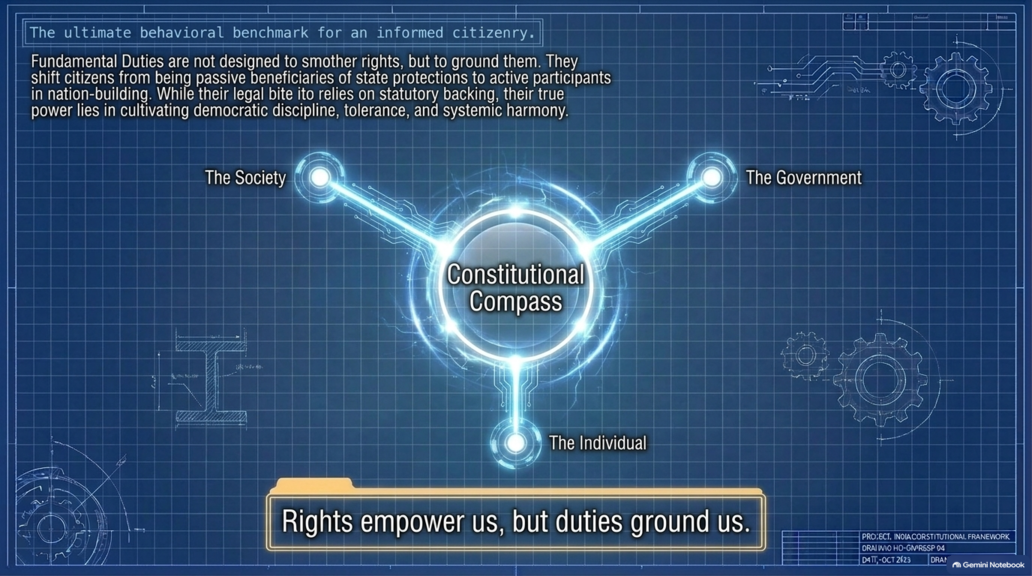
Fundamental Duties act as the moral and civic compass of Indian democracy, ensuring that individual rights are balanced by collective responsibilities toward the nation, society, and environment.
Key Takeaways
- Genesis: Added by the 42nd Amendment Act (1976) on the Swaran Singh Committee’s recommendation; an 11th duty was added by the 86th Amendment Act (2002).
- Location: Contained exclusively within Article 51A under Part IVA of the Constitution.
- Applicability & Nature: Applicable only to Indian citizens; non-justiciable directly, but enforceable via parliamentary legislation.
- Statutory Backing: Backed by existing acts like the Prevention of Insults to National Honour Act (1971), Protection of Civil Rights Act (1955), and Wildlife Protection Act (1972).
- Judicial Use: Used by courts (e.g., AIIMS Students Union, M.C. Mehta) to interpret ambiguous laws, evaluate constitutional validity, and balance Fundamental Rights.