Constitution Amendments

Introduction
Imagine creating a legal framework meant to govern over a billion people across centuries. If you make it impossible to change, it will shatter under the pressure of evolving social values; if you make it too easy to alter, every temporary political majority will rewrite it to suit their whims. How did India’s constitutional framers solve this dilemma?
They constructed a “living document”—a framework engineered with a dynamic spine that adapts to shifting economic, social, and political landscapes while safeguarding its foundational democratic core.
By the end of this lesson, you will be able to:
- Analyze the dual architecture of flexibility and rigidity embedded in Article 368.
- Compare the three distinct mechanisms required to amend different provisions of the Constitution.
- Outline the step-by-step parliamentary procedure for passing a Constitutional Amendment Bill.
- Evaluate the judicial boundaries set by the Supreme Court through the Basic Structure Doctrine.
- Trace major historic amendments from 1951 to the present day that reshaped Indian democracy.
The Philosophy and Blueprint of Constitutional Amendment
No constitution can remain static. As societies progress, their supreme legal framework must adjust to meet new challenges. The Indian Constitution provides for its own amendment under Article 368, located in Part XX. Borrowed structurally from the South African Constitution, this provision empowers Parliament to adjust the text through addition, variation, or repeal.
Constitutional legal scholars have long admired this delicate architectural balance:
- Political scientist KC Wheare observed: “This variety in the amending process is wise but rarely found.”
- Constitutional historian Granville Austin noted: “The amending process has proved itself one of the most ably conceived aspects of the constitution. Although it appears complicated, it is merely diverse.”
This design positions India directly between two global extremes. On one end stands the British Constitution—unwritten, highly flexible, where Parliament can alter fundamental law using an ordinary legislative vote. On the other end lies the United States Constitution—exceptionally rigid, requiring cumbersome ratification processes that make amendments rare and difficult.
India’s amendment framework blends both philosophies: routine administrative matters can adapt smoothly, while essential structural and federal features demand rigorous consensus.
Recommended · Mind Map
Foundations of Article 368 Mind Map
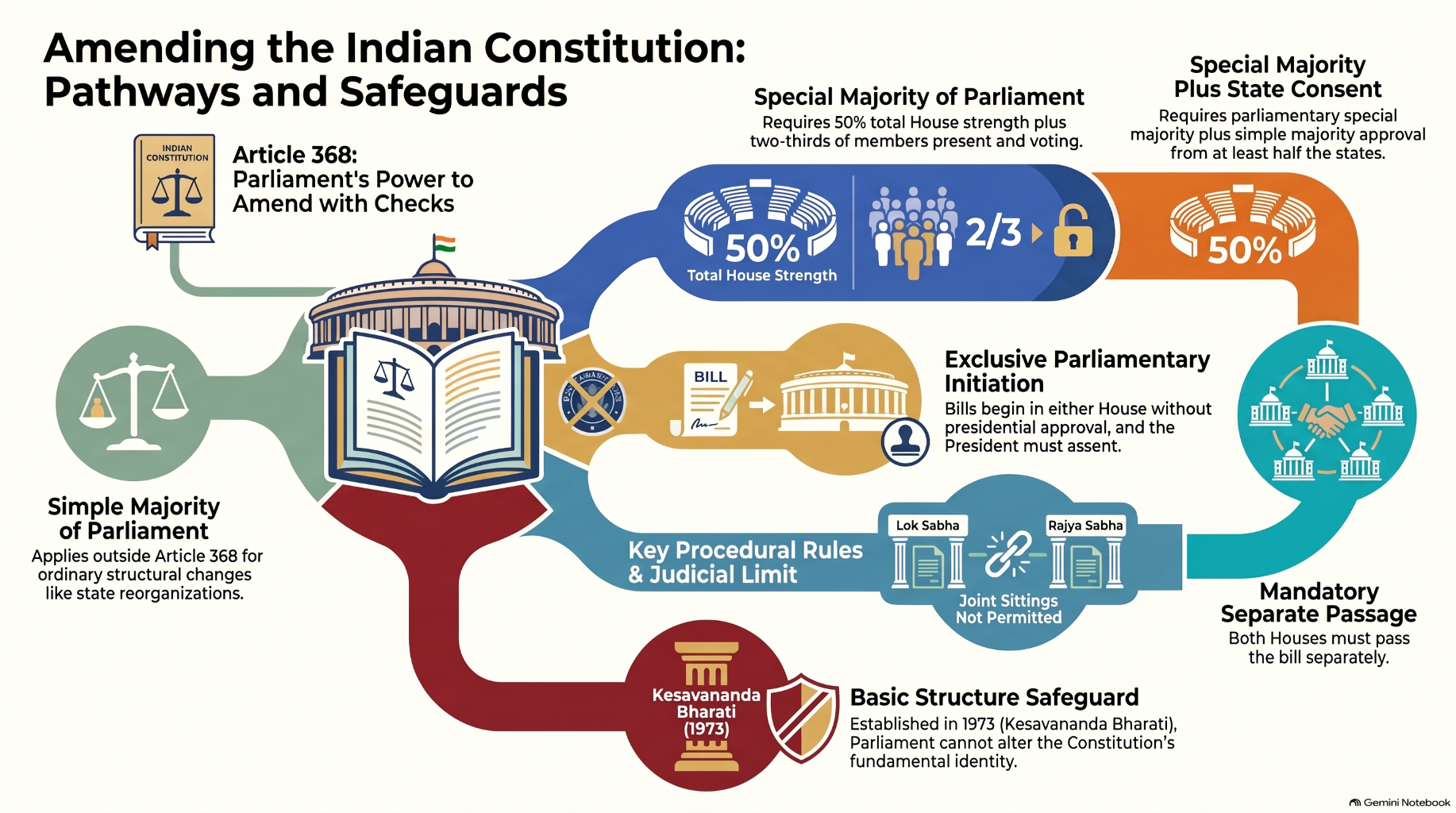
A branching diagram illustrating the origins, core philosophy, and comparative position of Article 368 between rigid and flexible constitutional systems.Add
The Step-by-Step Procedure: How a Bill Becomes Law
Amending the Constitution follows a strict, constitutional journey under Article 368. Unlike ordinary lawmaking, every stage demands heightened scrutiny.
- Initiation Only in Parliament A Constitutional Amendment Bill can be introduced only in either House of Parliament (Lok Sabha or Rajya Sabha). State legislatures cannot initiate a constitutional amendment bill. The bill may be introduced by either a minister or a private member, and no prior permission of the President is required.
- Separate Passage by Special Majority The bill must be passed in each House separately by a special majority: a majority of the total membership of the House, AND a two-thirds majority of members present and voting. Crucial Exception: If the two Houses disagree, there is no provision for a joint sitting. If one House rejects or fails to pass the bill by the required majority, the bill dies.
- State Ratification (For Federal Provisions) If the bill seeks to alter federal structures (such as Centre-State legislative powers or Supreme Court jurisdiction), it must be ratified by the legislatures of at least half of the states. State ratification requires only a simple majority in those state assemblies. Notably, the Constitution sets no fixed time limit for states to give or withhold their consent.
- Presidential Assent Once passed by Parliament (and ratified by states, if necessary), the bill is presented to the President. Under the 24th Amendment Act (1971), the President is constitutionally bound to give assent. The President can neither withhold assent nor return the bill for reconsideration.
- Enactment Upon receiving the President’s signature, the bill officially becomes a Constitutional Amendment Act, amending the supreme law of the land accordingly.
Recommended · Slide Deck
The Constitutional Amendment Lifecycle
A 5-slide visual deck guiding learners through introduction, parliamentary voting, state ratification, presidential assent, and final notification.Add
The Three Pathways of Amendment: Simple, Special, and Federal Consensus
Not all constitutional provisions carry the same weight. Consequently, the amendment process operates through three distinct pathways, categorized by the level of consensus required.
1. Pathway 1: Simple Majority of Parliament (Outside Article 368)
Certain flexible provisions can be modified through the ordinary legislative process (a majority of members present and voting). Changes made under this route follow standard lawmaking and are expressly treated as falling outside the scope of Article 368.
- Key Subjects: Admission or formation of new states, alterating state boundaries or names (Articles 2–4); creation or abolition of State Legislative Councils (Article 169); official language use; citizenship acquisition and termination; quorum in Parliament; MP salaries; rules of procedure; and matters listed in the Fifth and Sixth Schedules.
2. Pathway 2: Special Majority of Parliament (Under Article 368)
The vast majority of constitutional provisions require a formal amendment under Article 368 via a special majority in each House (total membership majority + 2/3 present and voting).
- Key Subjects: Fundamental Rights (Part III), Directive Principles of State Policy (Part IV), and all other provisions not covered by the simple majority pathway or federal ratification.
3. Pathway 3: Special Majority + Consent of Half the States (Under Article 368)
When an amendment touches upon the federal balance between the Centre and the States, Parliament cannot act unilaterally. It requires a special majority in Parliament plus ratification by a simple majority in at least 50% of state legislatures.
- Key Subjects: Manner of election of the President; extent of Union and State executive powers; Supreme Court and High Court provisions; distribution of legislative powers between Centre and States; Seventh Schedule lists; Goods and Services Tax (GST) Council (Article 279A); representation of states in Parliament; and Article 368 itself.
Recommended · Infographic
Three Pathways of Amendment Infographic
A comparative structured chart detailing the voting thresholds, applicability under Article 368, and subject matter examples for each of the three amendment pathways.Add
Judicial Guardrails: The Basic Structure Doctrine and Landmark Cases
Does Parliament’s power under Article 368 mean it can alter or destroy any part of the Constitution—including fundamental liberties or democratic elections?
This question triggered a landmark constitutional tug-of-war between Parliament and the Judiciary:
- Shankari Prasad (1951) & Sajjan Singh (1965): The Supreme Court initially ruled that Parliament possessed unlimited power to amend any part of the Constitution, including Fundamental Rights.
- Golak Nath (1967): The Supreme Court reversed its stance, holding that Fundamental Rights were sacrosanct and Parliament could not curtail them through constitutional amendments.
- Kesavananda Bharati (1973): In a historic 7-6 verdict, a 13-judge bench established the Basic Structure Doctrine. The Court ruled that while Parliament has wide power under Article 368 to amend any provision—including Fundamental Rights—it cannot alter, damage, or destroy the ‘Basic Structure’ or core identity of the Constitution.
- Minerva Mills (1980): Parliament attempted via the 42nd Amendment to grant itself unlimited amending power. The Supreme Court struck down those clauses, holding that a limited amending power is itself a basic feature of the Constitution.
- I.R. Coelho (2007): The Court ruled that laws placed in the Ninth Schedule after April 24, 1973, are not immune from judicial review if they violate the basic structure.
While the Supreme Court has purposefully avoided creating an exhaustive textual definition, recognized Basic Structure features include: supremacy of the Constitution, republican and democratic form of government, secularism, federalism, separation of powers, judicial review, rule of law, free and fair elections, and individual liberty.
Recommended · Audio
The Rise of the Basic Structure Doctrine
An engaging 5-minute audio overview detailing the historic courtroom clash between judicial review and parliamentary sovereignty from Shankari Prasad to Kesavananda Bharati.Add
Milestones of Change: Landmark Amendments That Shaped Modern India
Since 1950, over 100 Constitutional Amendment Acts have responded to India’s evolving needs. Examining these key milestones highlights the nation’s political, economic, and social transformation:
Early Foundations (1951–1975)
- 1st Amendment (1951): Enacted by the Provisional Parliament; introduced the Ninth Schedule to protect land reform laws from judicial review; added reasonable restrictions to free speech (public order, friendly relations with foreign states, incitement).
- 7th Amendment (1956): Reorganized Indian states on a linguistic basis, abolishing Part A, B, C, D categories into 14 states and 6 UTs; enabled common High Courts for two or more states.
- 24th Amendment (1971): Made presidential assent to Constitutional Amendment Bills mandatory and affirmed Parliament’s power to amend any part of the Constitution.
- 26th Amendment (1971): Abolished the Privy Purses and privileges of former rulers of princely states.
The Emergency & Restoration Era (1976–1978)
- 42nd Amendment (1976): Known as the “Mini-Constitution” due to its sweeping scope; added “Socialist, Secular, Integrity” to the Preamble; introduced Fundamental Duties (Part IV-A); inserted administrative tribunals (Part XIV-A); extended Lok Sabha terms to 6 years.
- 44th Amendment (1978): Passed to undo Emergency excesses; reduced Lok Sabha term back to 5 years; removed the Right to Property as a Fundamental Right (making it a legal right under Article 300A); replaced “internal disturbance” with “armed rebellion” in Article 352; guaranteed that Articles 20 and 21 cannot be suspended during an Emergency.
Democratic & Local Governance Reforms (1985–2003)
- 52nd Amendment (1985): Added the Tenth Schedule (Anti-Defection Law) to prevent political floor-crossing.
- 61st Amendment (1988/1989): Lowered the voting age for Lok Sabha and Assembly elections from 21 to 18 years.
- 69th Amendment (1991): Granted special status to Delhi as the National Capital Territory (NCT) under Article 239AA.
- 73rd & 74th Amendments (1992): Granted constitutional status to rural local self-government (Panchayats – Part IX, 11th Schedule) and urban local bodies (Municipalities – Part IX-A, 12th Schedule).
- 86th Amendment (2002): Made free and compulsory education for children aged 6–14 a Fundamental Right (Article 21A).
- 91st Amendment (2003): Capped the size of the Council of Ministers at 15% of the total strength of the Lok Sabha/State Legislative Assembly.
Contemporary Transformations (2014–Present)
- 99th Amendment (2014): Created the National Judicial Appointments Commission (NJAC); subsequently declared unconstitutional by the Supreme Court in 2015.
- 101st Amendment (2016): Introduced the Goods and Services Tax (GST) and established the GST Council under Article 279A.
- 102nd Amendment (2018): Granted constitutional status to the National Commission for Backward Classes (NCBC).
- 103rd Amendment (2019): Provided a 10% reservation for Economically Weaker Sections (EWS) in public employment and education (Articles 15(6) and 16(6)).
- 104th Amendment (2020): Extended SC/ST legislative seat reservations for 10 years (until 2030) while ending nomination of Anglo-Indians to legislative bodies.
- 105th Amendment (2021): Restored state governments’ power to identify socially and educationally backward classes (SEBCs).
- 106th Amendment (2023): Enacted the Nari Shakti Vandan Adhiniyam, reserving one-third (33%) of seats for women in Lok Sabha, State Legislative Assemblies, and the Delhi Assembly.
Important Note on Terminology: A Constitution Amendment Bill is merely a legislative proposal. It only becomes a numbered Constitution Amendment Act once it successfully passes all constitutional steps and receives presidential assent. For example, defeated or pending bills (like the 129th or 130th Amendment Bills) carry higher bill numbers than enacted Acts (which currently extend to the 106th Amendment Act).
Recommended · Flashcards
Landmark Constitutional Amendments Flashcards
A set of flashcards testing recall on major Constitutional Amendment Acts, their numbers, year of enactment, and key provisions.Add
Summary
The Indian Constitution achieves a masterclass in institutional design by balancing dynamic adaptability with democratic stability through Article 368. By requiring different consensus thresholds—ranging from simple parliamentary majorities to state ratification—and remaining bounded by the judicial Basic Structure Doctrine, the Constitution ensures that India can modernize its legal framework without dismantling its foundational democratic values.
Key Takeaways
- Constitutional Provision: Article 368 in Part XX empowers Parliament to amend the Constitution by addition, variation, or repeal.
- Three Pathways:
- Simple Majority (Outside Art. 368): For administrative reorganizations, state boundary changes, and schedule updates.
- Special Majority (Under Art. 368): Requires majority of total membership + 2/3 present and voting in each House separately (e.g., Fundamental Rights, DPSPs). No joint sitting allowed.
- Special Majority + State Consent: Required for federal provisions (e.g., President’s election, Seventh Schedule, GST Council, Art. 368 itself); needs approval from at least 50% of state legislatures by simple majority.
- Presidential Role: Under the 24th Amendment (1971), the President is bound to assent to a Constitutional Amendment Bill once duly passed.
- Judicial Safeguard: The Kesavananda Bharati (1973) ruling established that Parliament cannot alter or destroy the Basic Structure of the Constitution.
Want to submit a review? Login
