Structure of Governments

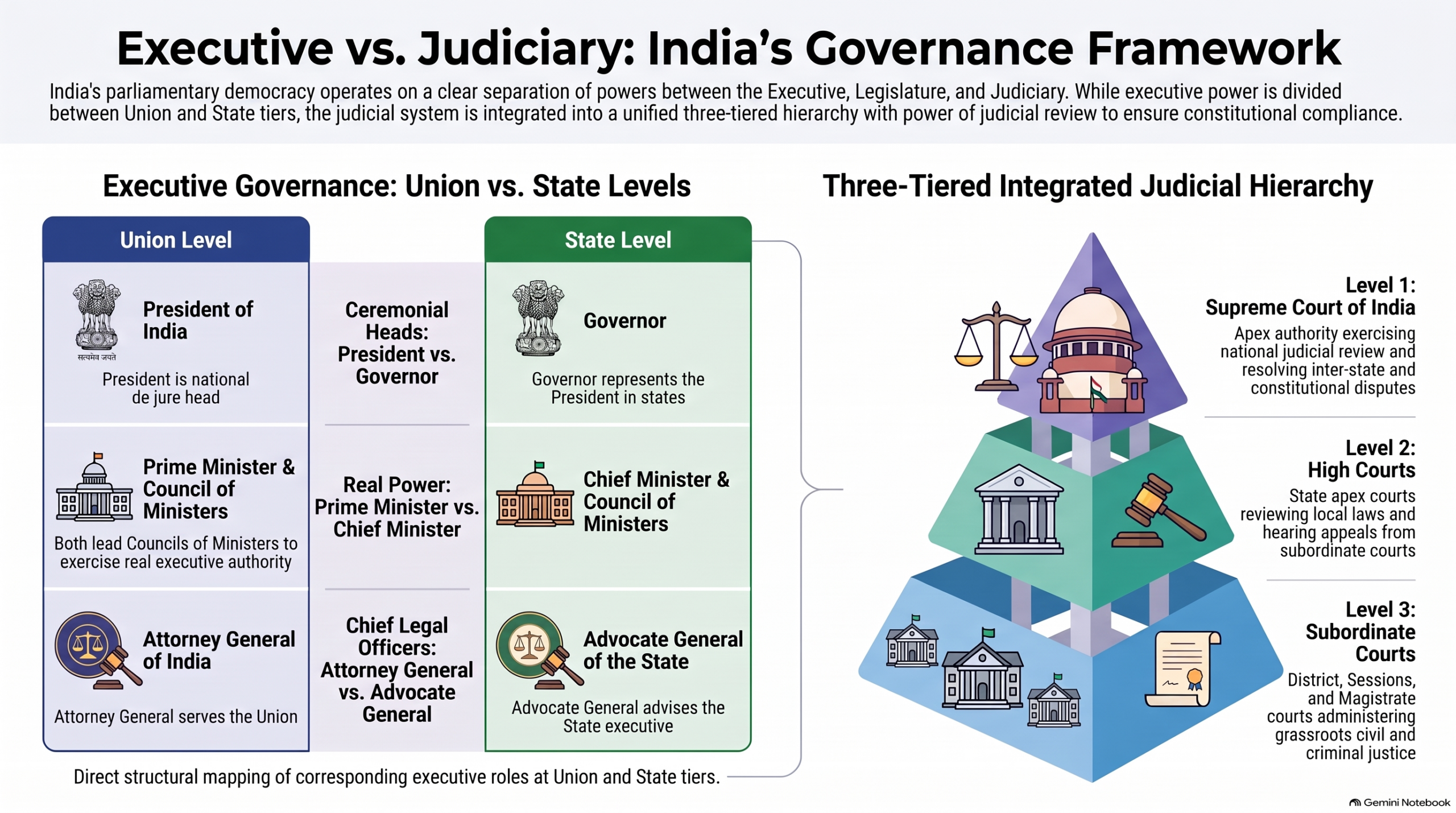
The provided sources detail the administrative framework of India, highlighting a parliamentary form of government that relies on a clear separation of powers among the central and state branches. They emphasize the structure and responsibilities of the Union and State Executives, focusing on key figures such as the President, Governors, Prime Minister, Chief Ministers, and their respective councils. Furthermore, the texts examine the operations of the Legislature and the Judiciary, outlining how an independent court system, headed by the Supreme Court and High Courts, enforces constitutional rule through judicial review. Finally, the materials serve as essential study guides for UPSC aspirants, offering deep insights into constitutional articles, case laws, and the intricate system of checks and balances that drives Indian governance.
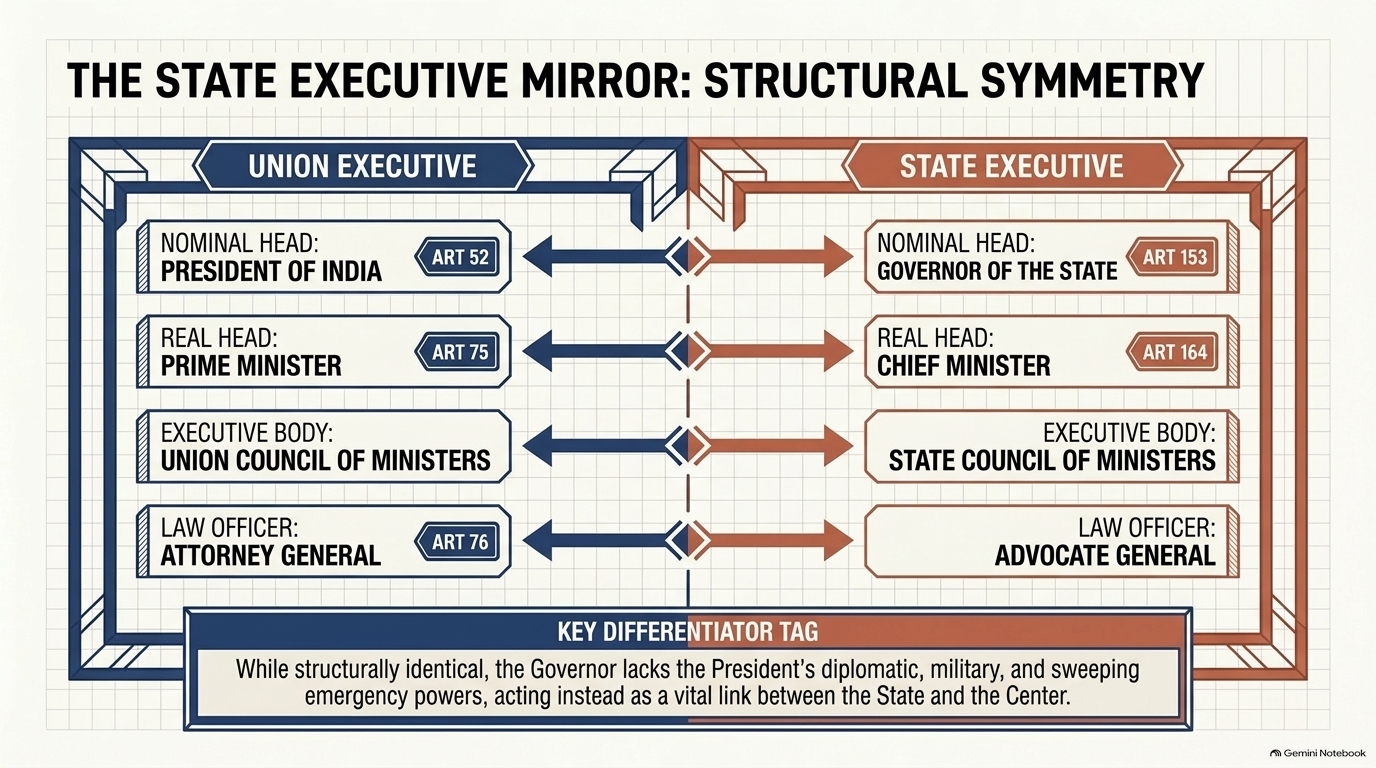
The Union Executive and the State Executive in India mirror each other in structure under the parliamentary system of governance, but they differ significantly in their territorial scope, operational authority, and constitutional powers[1][2].
1. Constitutional Provisions & Composition
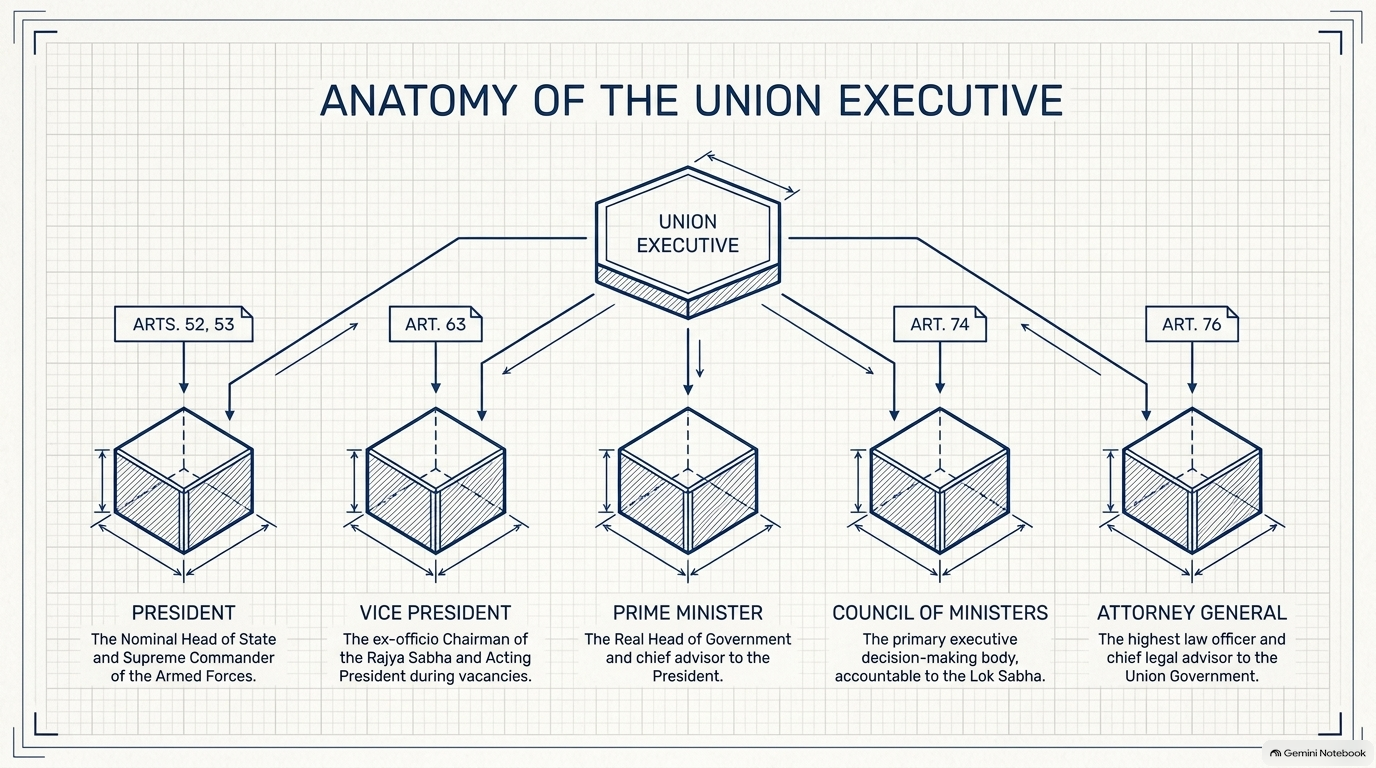
- Union Executive (Part V, Articles 52–78 & 123): Operates at the national level[3][4]. It consists of the President, Vice-President, Prime Minister, Union Council of Ministers, and the Attorney General of India[3].
- State Executive (Part VI, Articles 153–167 & 213): Operates at the regional/state level[2][7]. It consists of the Governor, Chief Minister, State Council of Ministers, and the Advocate General of the State[2]. *(Note: There is no Vice-Governor at the state level)*[2].
2. Nominal Heads: President vs. Governor
Both the Union and State levels feature a nominal/constitutional head (de jure executive)[2]:
- Method of Appointment & Removal:
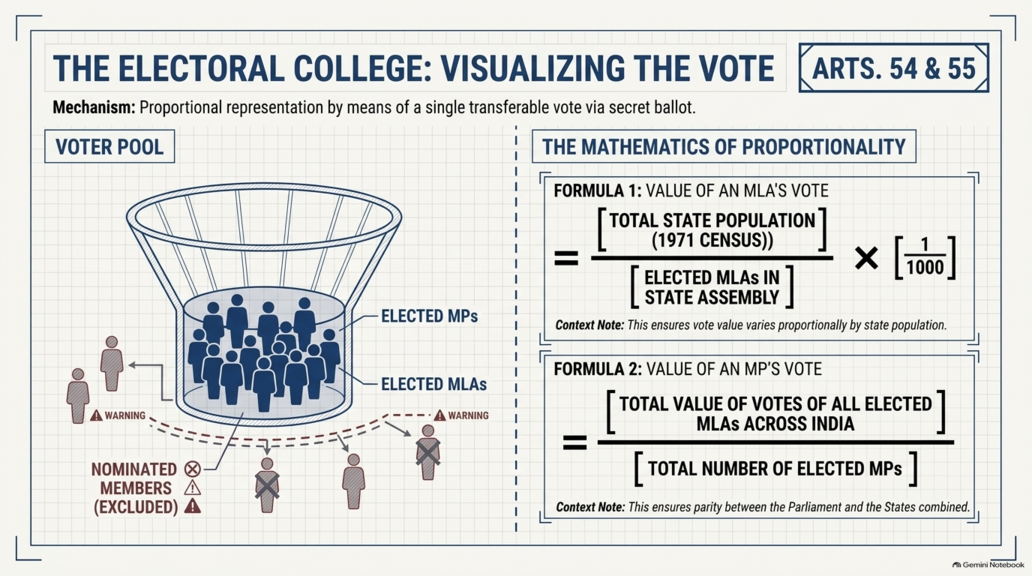
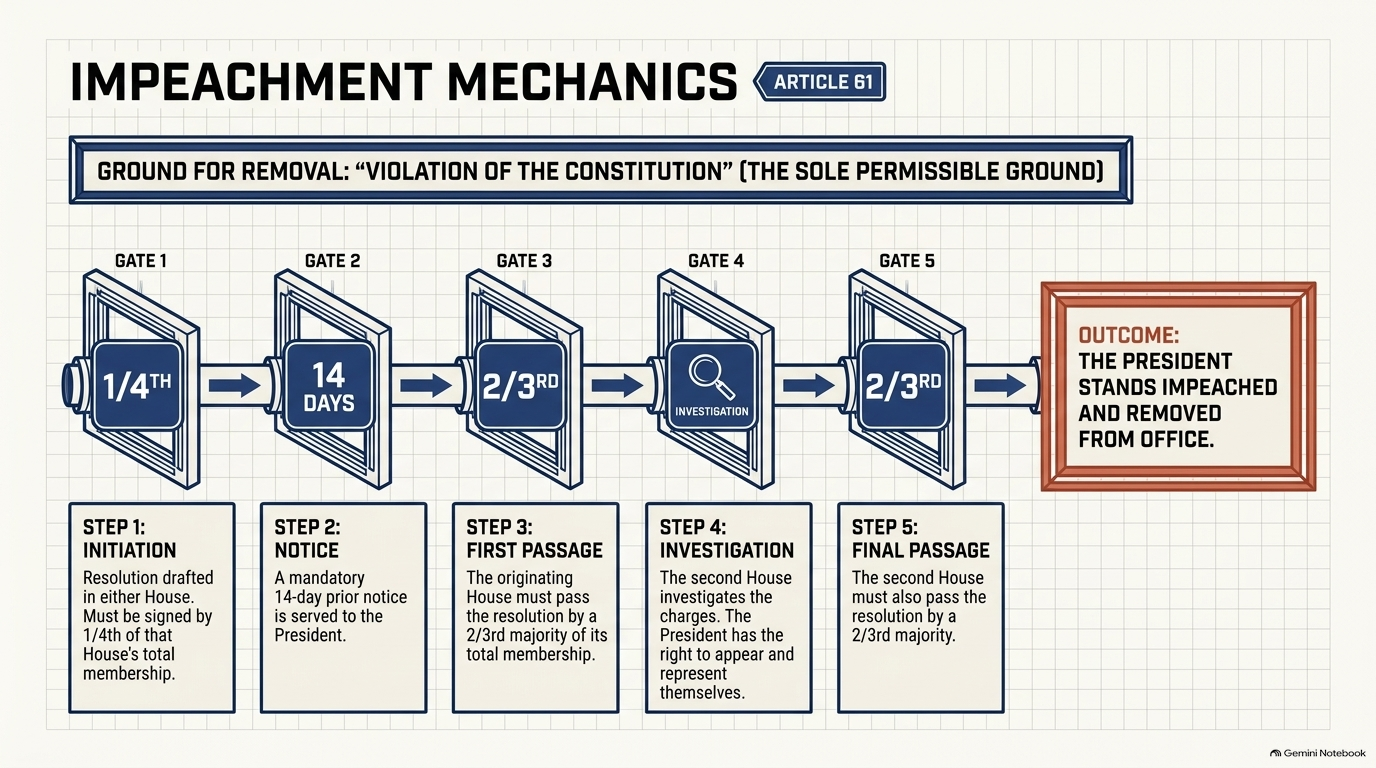
- President: Indirectly elected by an Electoral College consisting of elected members of both Houses of Parliament (MPs) and elected members of State Legislative Assemblies (MLAs), as well as Union Territories (Delhi & Puducherry)[6]. The President can be removed only through a formal impeachment procedure in Parliament for “violation of the Constitution” under Article 61[15].
- Governor: Appointed directly by the President of India and acts as the Centre’s representative in the state[18][19]. The Governor holds office during the pleasure of the President and can be removed at any time without a formal constitutional impeachment process[2].
3. Real Executive: Prime Minister vs. Chief Minister
Real governing authority (de facto executive) rests with the elected leadership and their cabinet at both levels[3]:
- Leadership & Appointment: The Prime Minister leads the central government and is appointed by the President[20]. The Chief Minister leads the state government and is appointed by the Governor[8][18].
- Legislative Accountability: The Union Council of Ministers is collectively responsible to the Lok Sabha (House of the People)[24]. The State Council of Ministers is collectively responsible to the State Legislative Assembly (Vidhan Sabha)[2][18].
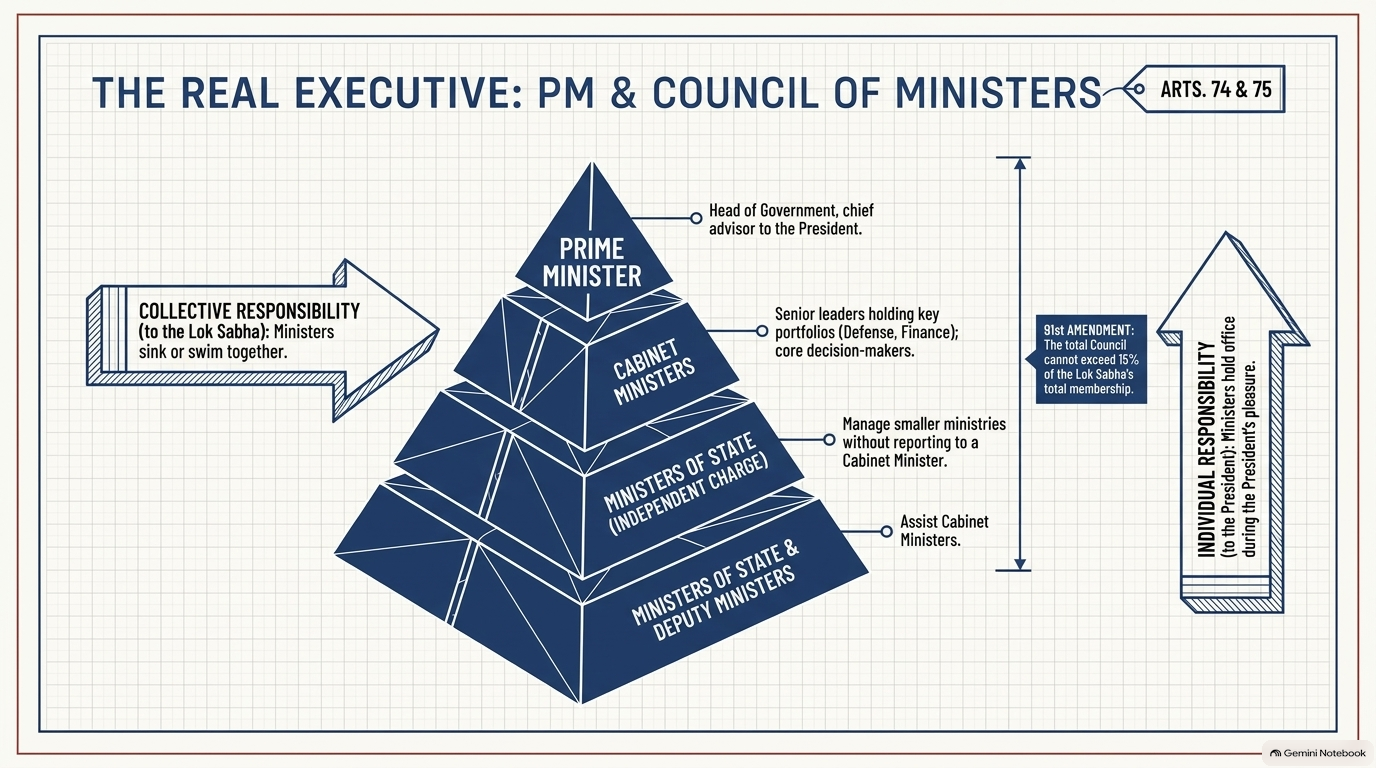
- Ministerial Cap: Under the 91st Constitutional Amendment Act (2003), the size of both the Union and State Councils of Ministers cannot exceed 15% of the total membership of the Lok Sabha or State Legislative Assembly, respectively[24].
4. Chief Legal Officers
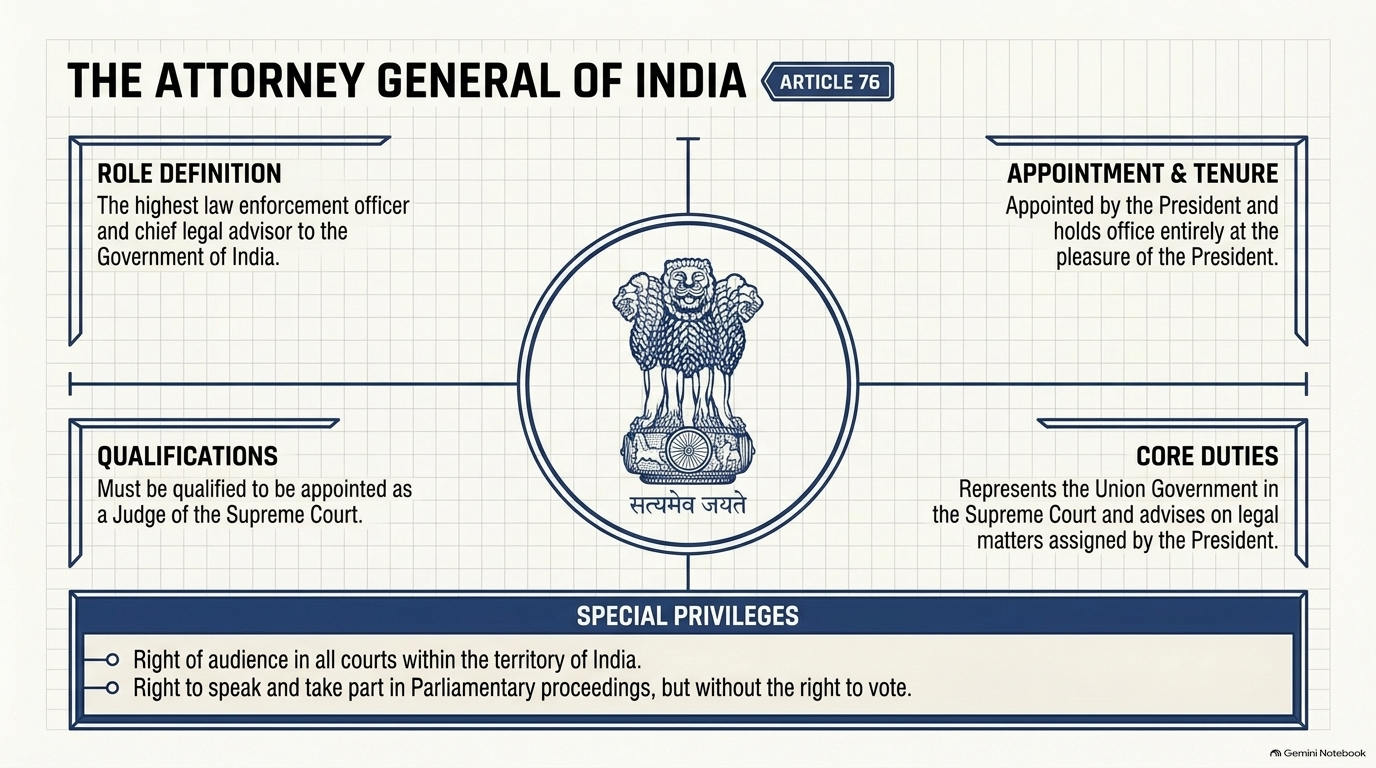
- Attorney General of India (Article 76): Appointed by the President as the highest law officer of the country, with the right of audience across all courts in India and the right to participate in Parliamentary proceedings (without voting rights)[29].
- Advocate General of the State (Article 165): Appointed by the Governor to serve as the highest legal advisor to the state executive[2].
5. Critical Distinctions in Executive Powers
| Feature / Power | Union Executive (President) | State Executive (Governor) |
|---|---|---|
| Military & Diplomatic Powers | Holds supreme command over the Indian Armed Forces and negotiates foreign treaties/diplomatic relations[34]. | Possesses no military or diplomatic powers[2]. |
| Emergency Powers | Can proclaim National Emergency (Art. 352), President’s Rule (Art. 356), or Financial Emergency (Art. 360)[38]. | Cannot declare emergencies; can only report a constitutional breakdown to recommend President’s Rule[2]. |
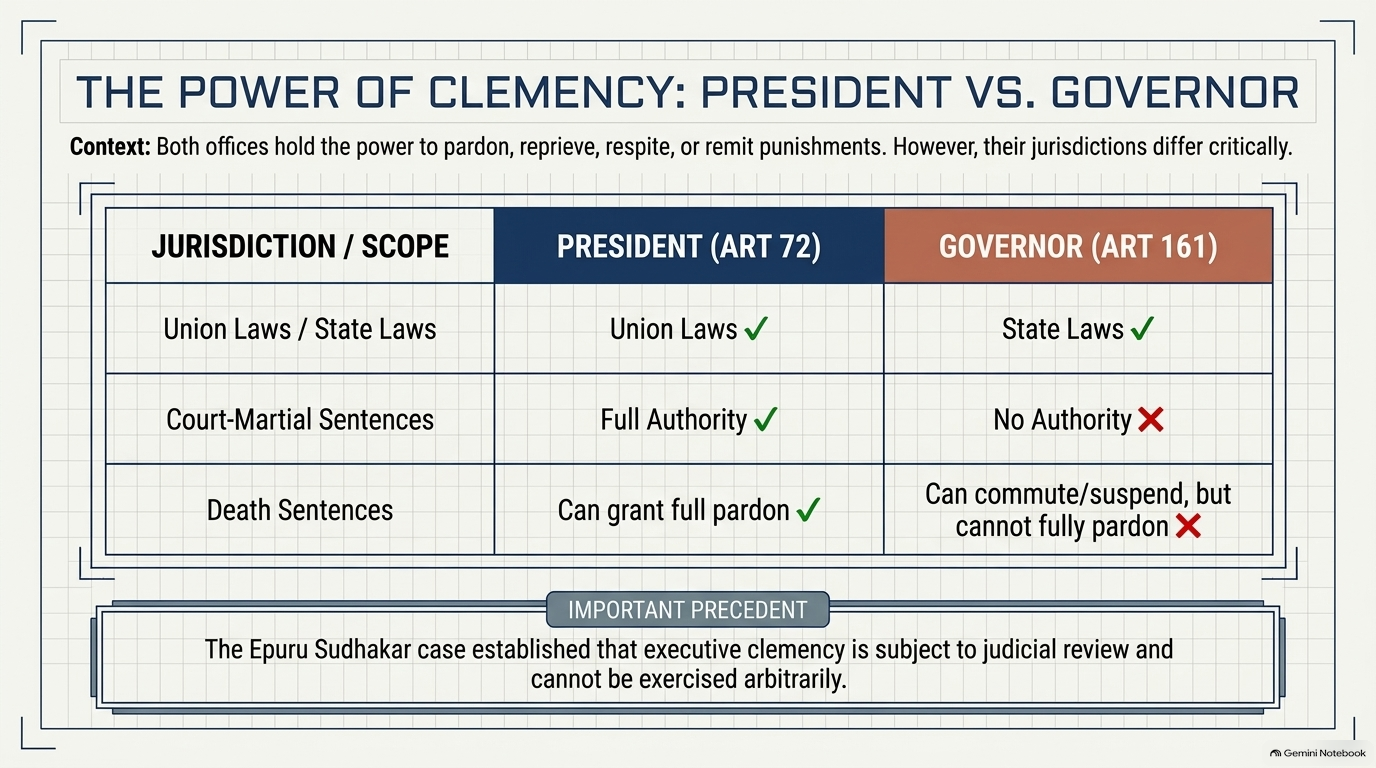
| Pardoning Power | Article 72: Can grant pardons, reprieves, remissions, or commutations for all offenses, including death sentences and sentences passed by court-martials[41]. | Article 161: Can suspend, remit, or commute sentences under state law, but cannot grant pardons for death sentences or court-martial cases[42][43]. |
| Ordinance-Making Power | Article 123: Promulgates ordinances when Parliament is not in session[7]. | Article 213: Promulgates ordinances when the State Legislature is not in session; certain subjects require prior instructions from the President[7] |
Mastering Indian Governance: The Executive, Legislature, and Judiciary
Introduction
Did you know that India’s President is the Supreme Commander of the Armed Forces and holds the power to pardon death sentences, yet cannot enact a single major policy decision without the advice of the Prime Minister and Council of Ministers? This fascinating interplay between formal ceremonial authority and real administrative power is the heartbeat of the world’s largest democracy. Governance in India is an intricate machine designed to rule a vast and diverse nation while safeguarding individual liberties through a delicate web of checks and balances.
In this lesson, we will explore the foundational machinery of the Indian state at both the Union and State levels.
- Analyze the constitutional division of powers among the Executive, Legislature, and Judiciary.
- Examine the election, powers, and constitutional position of the Union Executive, including the President and Vice-President.
- Evaluate the real executive authority vested in the Prime Minister, the Council of Ministers, and the role of the Attorney General.
- Compare the central governance model with state governance structures and understand India’s integrated judicial hierarchy.
The Architecture of Indian Governance: Three Branches, Two Levels
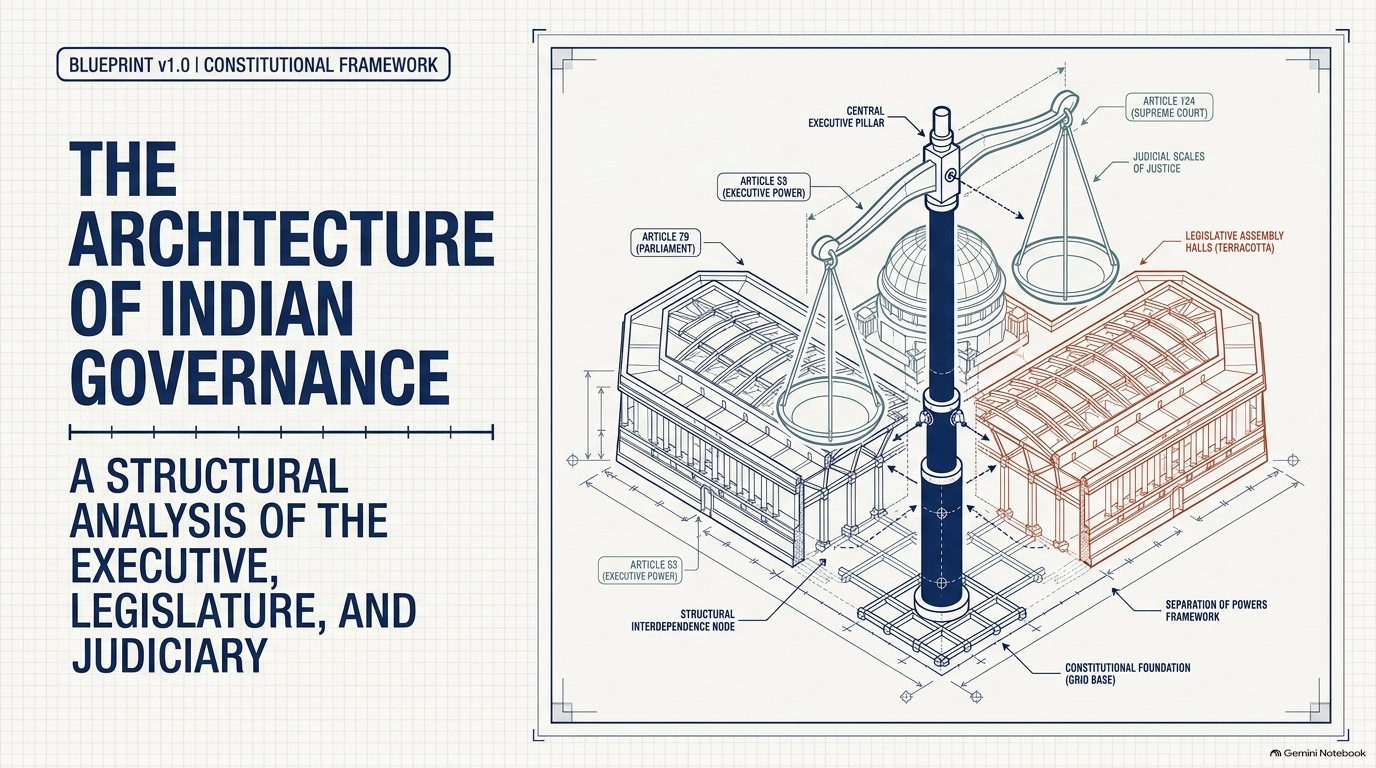
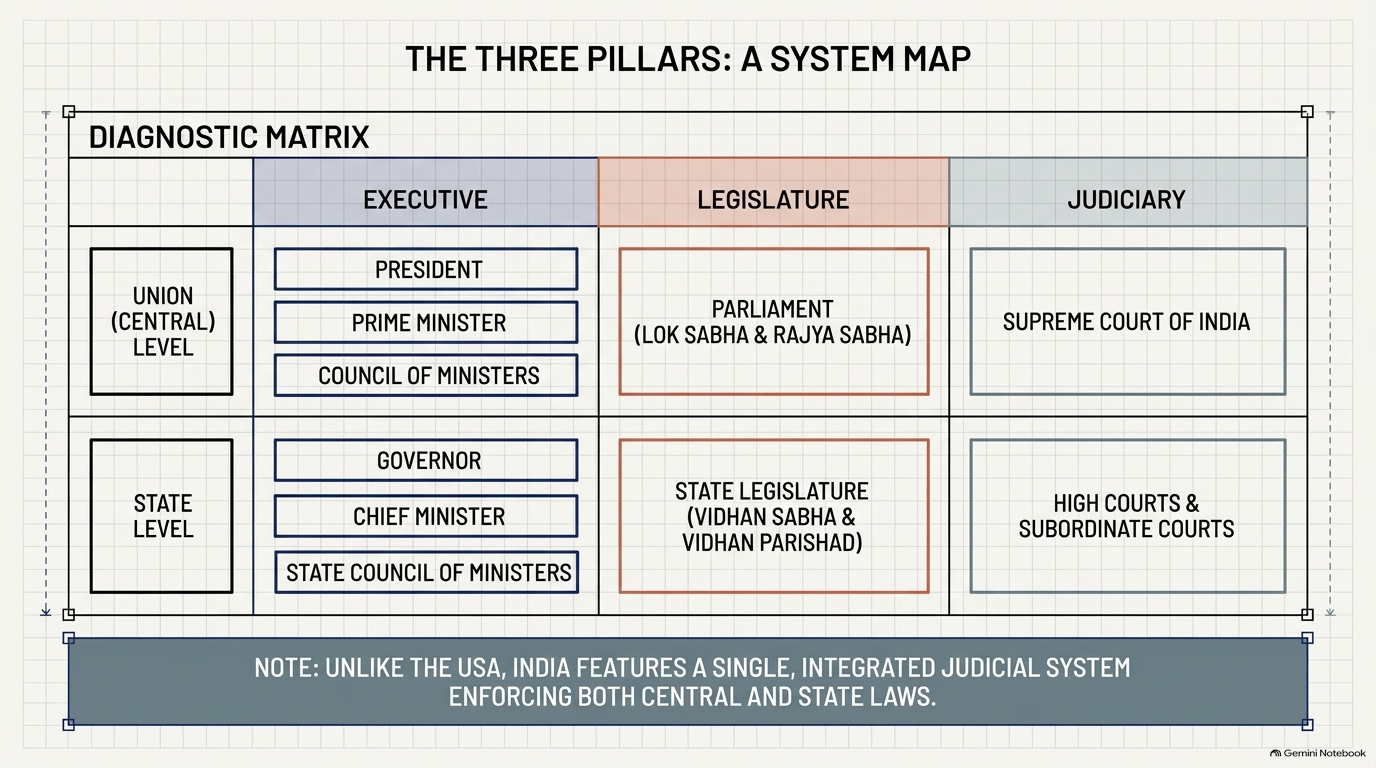
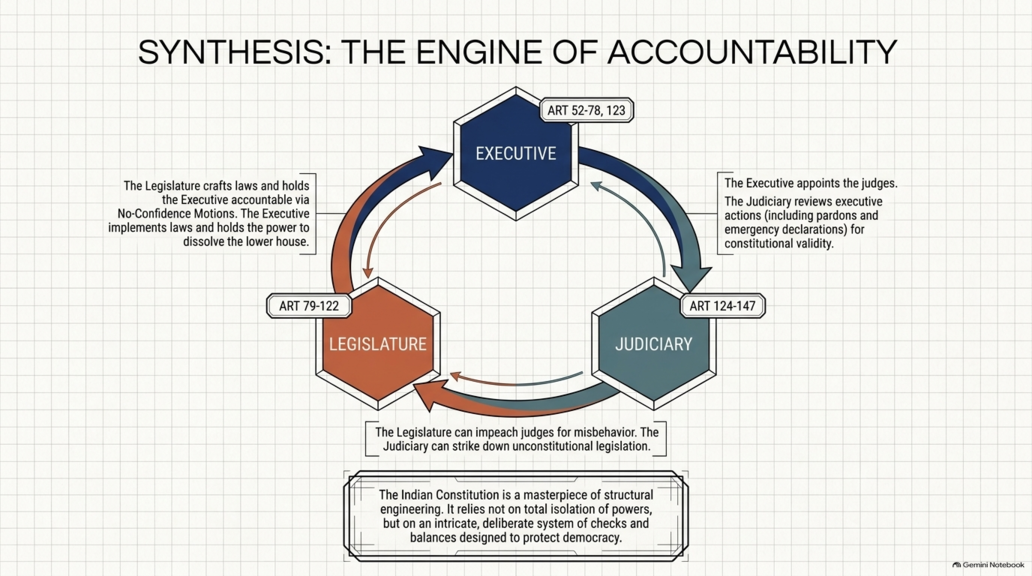
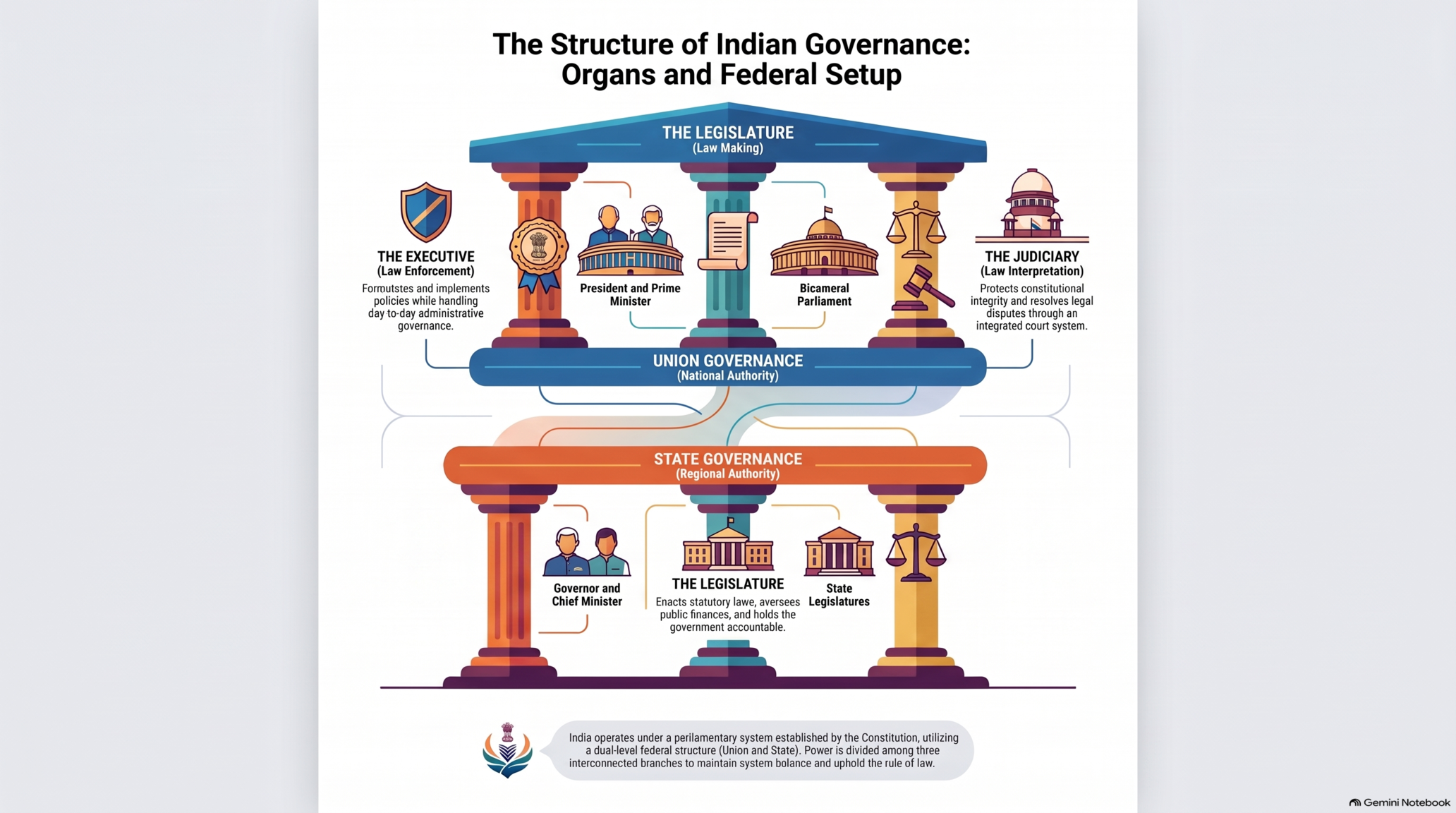
Think of the Indian government as a massive three-story complex operating across two distinct campuses: the Union (Central) Government in New Delhi and individual State Governments across the nation. To prevent any single entity from usurping total control, the Constitution divides authority into three specialized functional branches: the Executive, the Legislature, and the Judiciary.
The Legislature acts as the architect and law-maker. At the central level, the Parliament—comprising the Lok Sabha (House of the People) and the Rajya Sabha (Council of States)—debates public policy, passes legislation, and approves federal spending. At the state level, this responsibility falls on the Legislative Assembly (Vidhan Sabha) and, in select states, a Legislative Council (Vidhan Parishad).
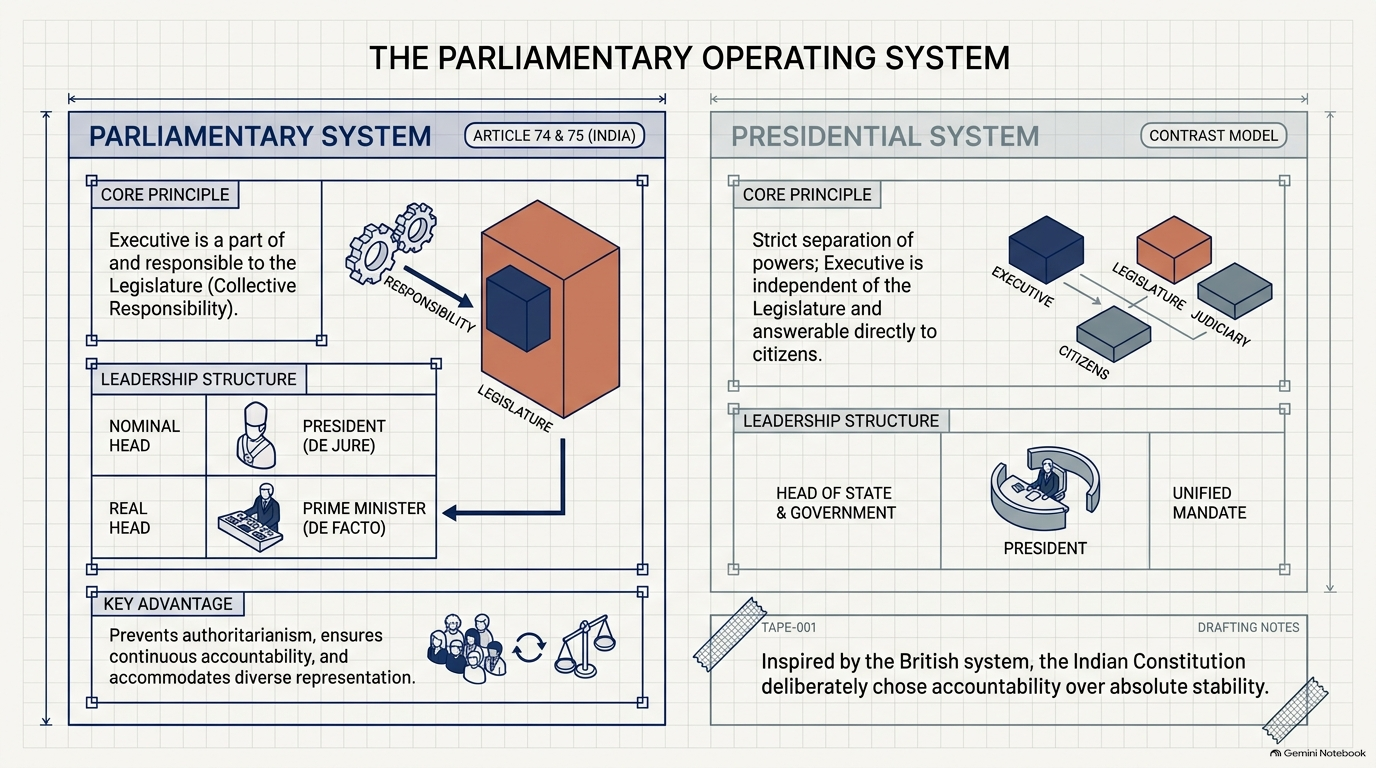
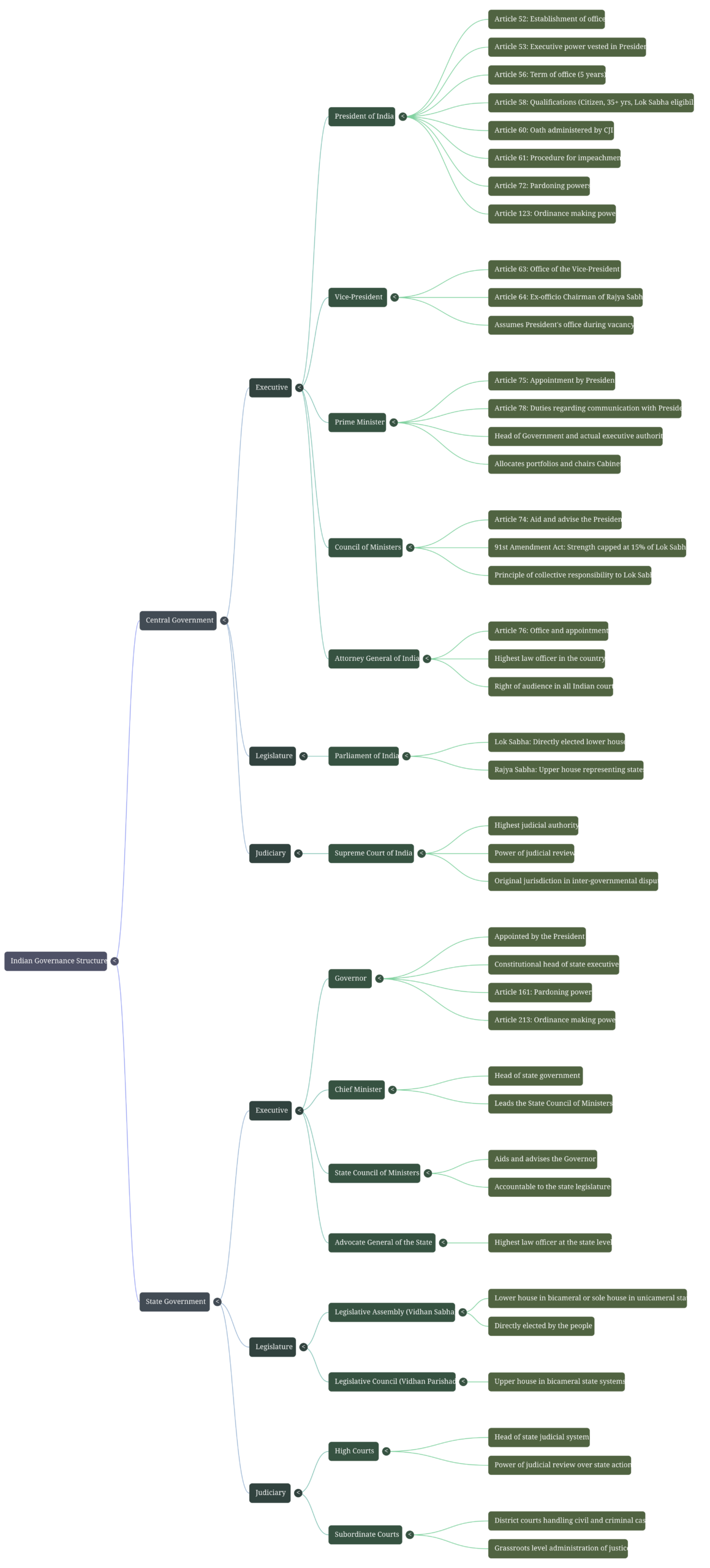
The Executive serves as the project manager and administrator responsible for enforcing these laws. It operates on a dual-head principle: a ceremonial nominal head (de jure) and an actual decision-maker (de facto). The Union Executive consists of the President, Vice-President, Prime Minister, Council of Ministers, and the Attorney General of India (Articles 52 to 78).
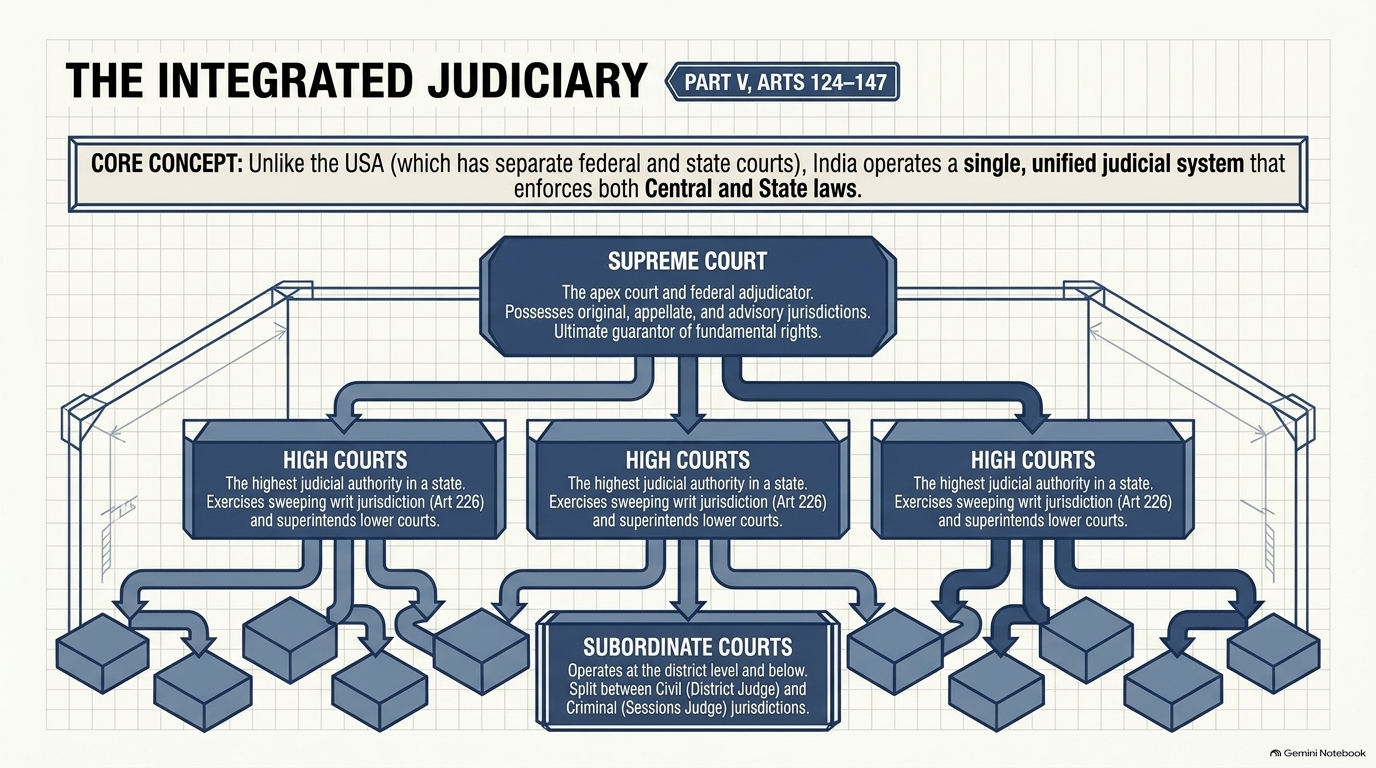
The Judiciary acts as the referee and guardian of the Constitution. Unlike true federal models like the United States—where state and federal courts exist side-by-side—India features a single, integrated judicial system. The Supreme Court stands at the apex, followed by High Courts at the state level and Subordinate Courts (District and Sessions Courts) at the grassroots level. This unified structure ensures that both federal and state laws are interpreted with national uniformity.
The Union Executive: The President and Vice-President
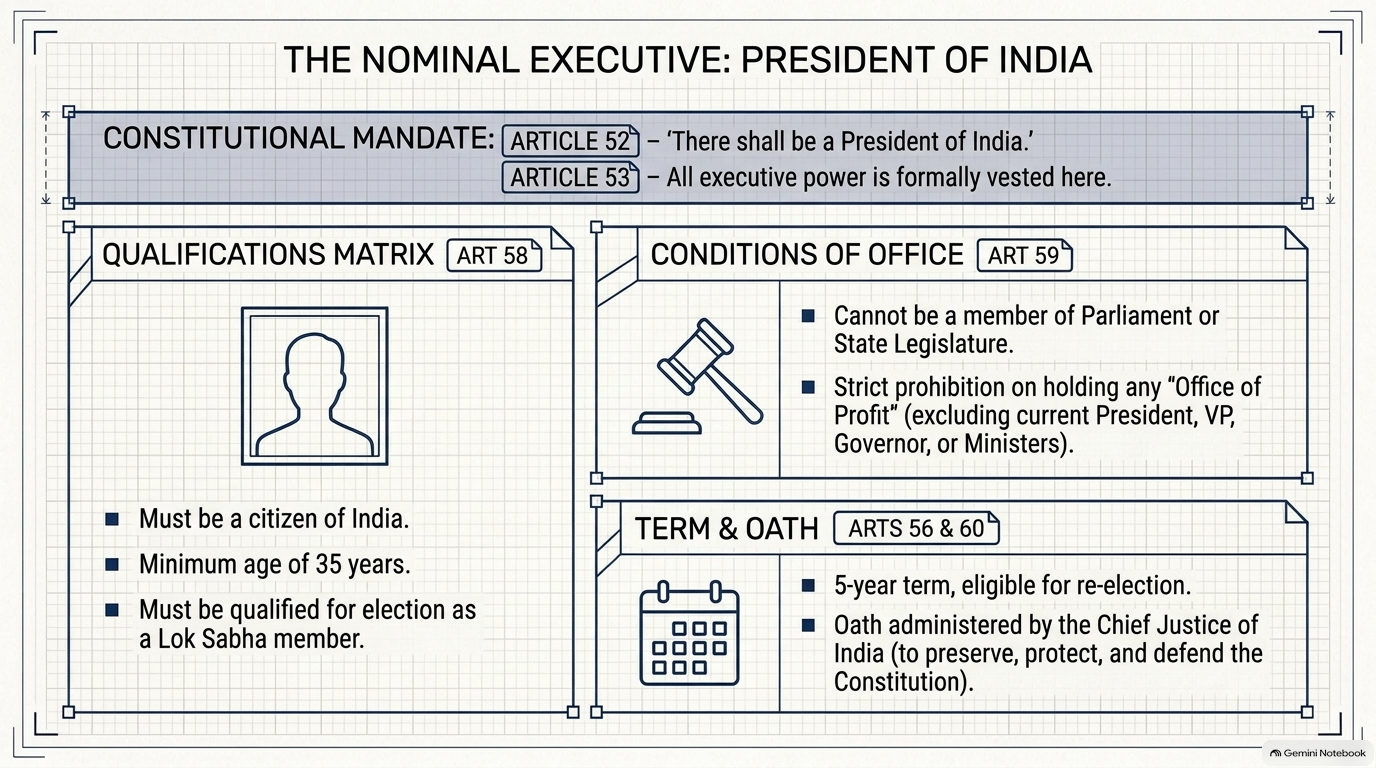
At the summit of the Indian state sits the President of India (Article 52), recognized as the First Citizen and the symbol of national unity. Under Article 53, the executive power of the Union is formally vested in the President. However, India’s parliamentary system creates a clear distinction between the ceremonial head of state and the practical head of government.
To qualify for the presidency under Article 58, a candidate must be an Indian citizen, at least 35 years old, qualified to contest elections for the Lok Sabha, and free from holding any office of profit. The President is elected indirectly by an Electoral College (Article 54) consisting of elected members of both Houses of Parliament and elected members of State Legislative Assemblies (including Delhi and Puducherry). Voting follows proportional representation by means of a single transferable vote via secret ballot. If the President violates the Constitution, Article 61 prescribes a rigorous impeachment procedure requiring a two-thirds majority of total membership in both parliamentary houses.
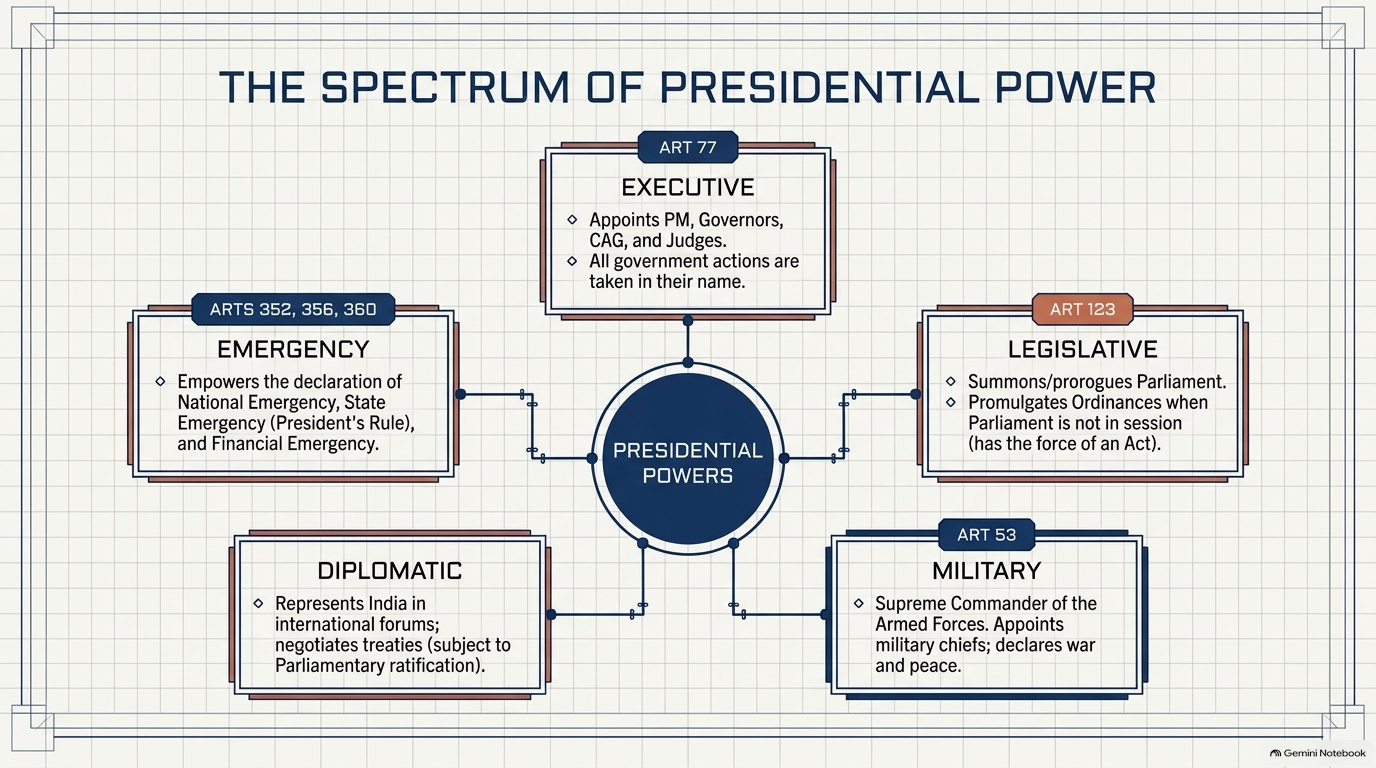
The President possesses expansive powers categorized into key domains:
- Executive Powers: Appointing the Prime Minister, Council of Ministers, Governors, Chief Election Commissioners, and the Comptroller and Auditor General (CAG).
- Legislative Powers: Summoning and proroguing Parliament, dissolving the Lok Sabha, delivering opening session addresses, and promulgating Ordinances (Article 123) when Parliament is not in session.
- Judicial & Pardoning Powers: Appointing judges and exercising clemency under Article 72 to grant pardons, reprieves, respites, remissions, or commutations of sentences.
- Emergency Powers: Proclaiming National Emergency (Article 352), President’s Rule in states (Article 356 & 365), or Financial Emergency (Article 360).
Despite these extensive powers, the 42nd and 44th Constitutional Amendment Acts established that the President must act on the aid and advice of the Council of Ministers, though the President retains the right to return advice once for reconsideration.
Directly following the President in precedence is the Vice-President (Article 63). Elected by an electoral college of all members (elected and nominated) of both Houses of Parliament, the Vice-President serves as the ex-officio Chairman of the Rajya Sabha and steps in as Acting President for up to six months during presidential vacancies.
tablet
Recommended · Slide Deck
Presidential Powers and Electoral Mechanics
A structured slide presentation detailing the Electoral College formula, Presidential veto types, pardoning powers under Article 72, and the impeachment workflow.
The Real Engine: Prime Minister, Council of Ministers, and Attorney General
While the President is the formal figurehead, the Prime Minister is the de facto executive authority—the real driver of government policy. Appointed by the President under Article 75, the Prime Minister is typically the leader of the majority party or coalition in the Lok Sabha. The Prime Minister selects ministers, allocates portfolios, chairs Cabinet meetings, and acts as the primary channel of communication between the Cabinet and the President (Article 78).
The Council of Ministers (CoM) is constitutionalized under Article 74 to aid and advise the President. To prevent bloated governments, the 91st Constitutional Amendment Act of 2003 capped the total size of the Council of Ministers, including the Prime Minister, at 15% of the total membership of the Lok Sabha. A non-member of Parliament can be appointed a minister, but must secure a seat in either House within six consecutive months.
The Council of Ministers is structured into distinct tiers:
- Cabinet Ministers: Senior leaders holding crucial portfolios (e.g., Finance, Home, Defence) who meet regularly to determine government policy.
- Ministers of State (Independent Charge): Ministers who head specific departments without reporting to a Cabinet Minister.
- Ministers of State & Deputy Ministers: Junior officials assigned to assist senior ministers.
The fundamental operating rule of this system is Collective Responsibility (Article 75(3)). The entire Council of Ministers is collectively answerable to the Lok Sabha. If a vote of no-confidence passes in the Lok Sabha, the entire ministry must resign together. Ministers must defend Cabinet decisions publicly regardless of personal reservations.
Completing the Union Executive is the Attorney General of India (Article 76). As the nation’s highest law officer, the Attorney General is appointed by the President and must meet the qualifications of a Supreme Court judge. The Attorney General enjoys the right of audience in all Indian courts and can speak in parliamentary proceedings (without the right to vote), advising the Union Government on complex legal matters.
State Governance and the Integrated Judiciary
State governments in India replicate the federal template. The Governor acts as the formal constitutional head of the state, appointed by the President and holding office during the President’s pleasure. Real executive authority at the state level resides with the Chief Minister and the state Council of Ministers, who are collectively answerable to the elected Legislative Assembly (Vidhan Sabha). The state’s legal advisor is the Advocate General (Article 165), mirroring the central Attorney General.
State legislatures manage state-specific subjects such as police, public health, and agriculture. Most Indian states possess a unicameral legislature consisting solely of the Legislative Assembly, while a few maintain a bicameral structure with an upper house called the Legislative Council (Vidhan Parishad).
Ensuring constitutional integrity across both central and state spheres is India’s integrated Judiciary. High Courts oversee justice within individual states, while the Supreme Court of India (Articles 124 to 147) functions as the ultimate judicial authority, guardian of fundamental rights, and final interpreter of the Constitution.
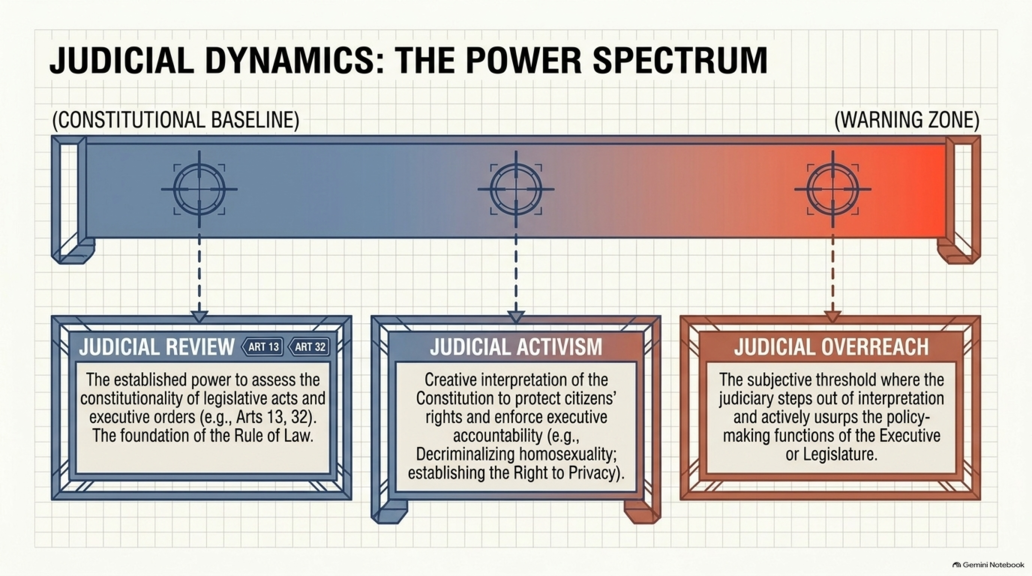
Through Judicial Review (Articles 13, 32, 136, 142), courts review executive actions and legislative enactments, declaring them void if they violate constitutional limits. Over time, Indian courts have utilized Judicial Activism to expand fundamental human rights—such as expanding Article 21 to cover the right to privacy and clean environment. However, legal scholars distinguish this from Judicial Overreach, which occurs when the judiciary inappropriately steps into legislative policy-making or executive administration, disrupting the separation of powers.
Summary
India’s governance framework balances democratic representation with constitutional safeguards through a carefully structured separation of powers. By pairing a ceremonial head of state with an accountable parliamentary executive, and backing them with an integrated independent judiciary, the Constitution ensures stable rule, executive accountability, and fundamental rights protection.
Key Takeaways
- Dual Structure: Governance operates at the Union and State levels, dividing function across Executive, Legislative, and Judicial branches.
- De Jure vs De Facto: The President (Union) and Governors (States) are nominal executive heads, while the Prime Minister and Chief Ministers hold actual political power.
- Accountability & Limits: The Council of Ministers is capped at 15% of the lower house’s strength and operates on the principle of Collective Responsibility to the Lok Sabha.
- Pardons & Ordinances: The President holds key constitutional powers under Article 72 (Pardons) and Article 123 (Ordinances), executed on Cabinet advice.
- Integrated Judiciary: A unified court hierarchy led by the Supreme Court enforces federal and state laws while exercising Judicial Review to uphold constitutional limits.

