Preamble

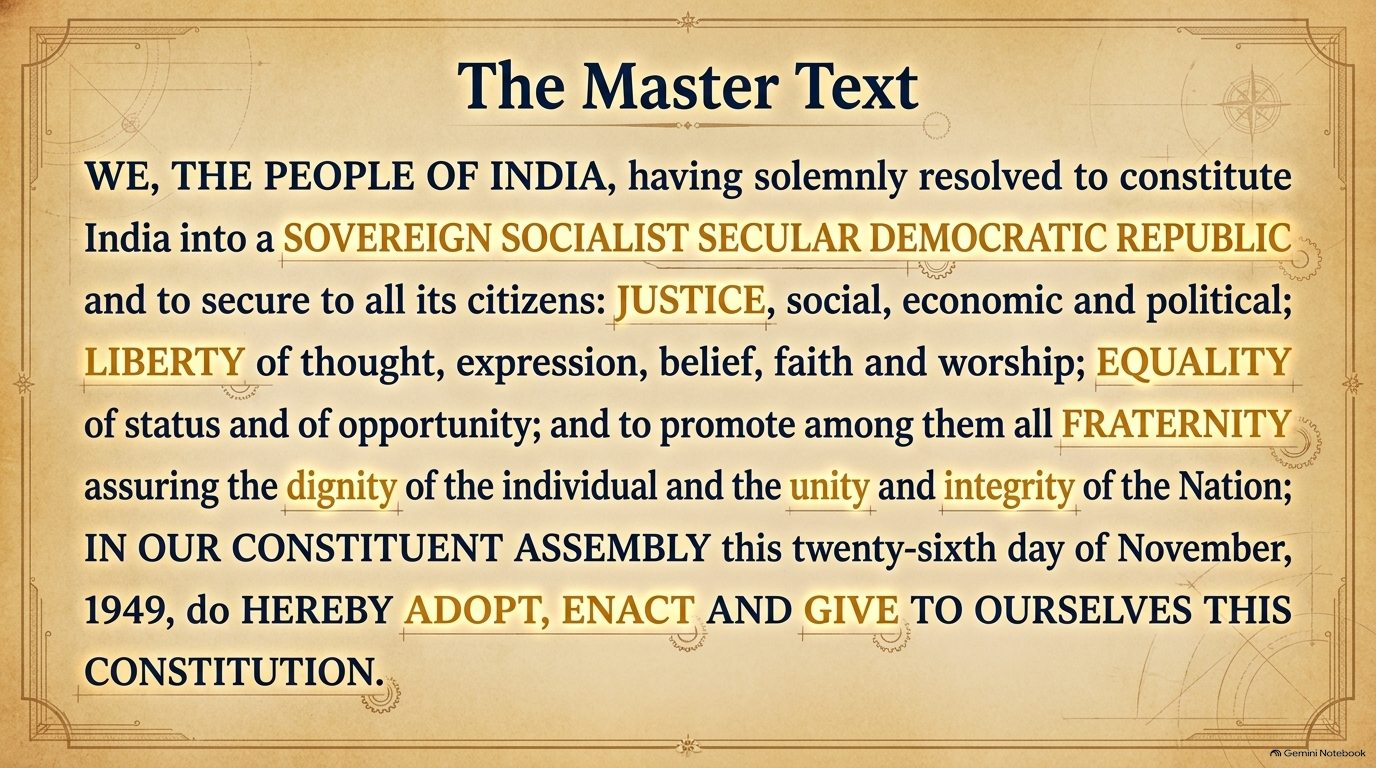
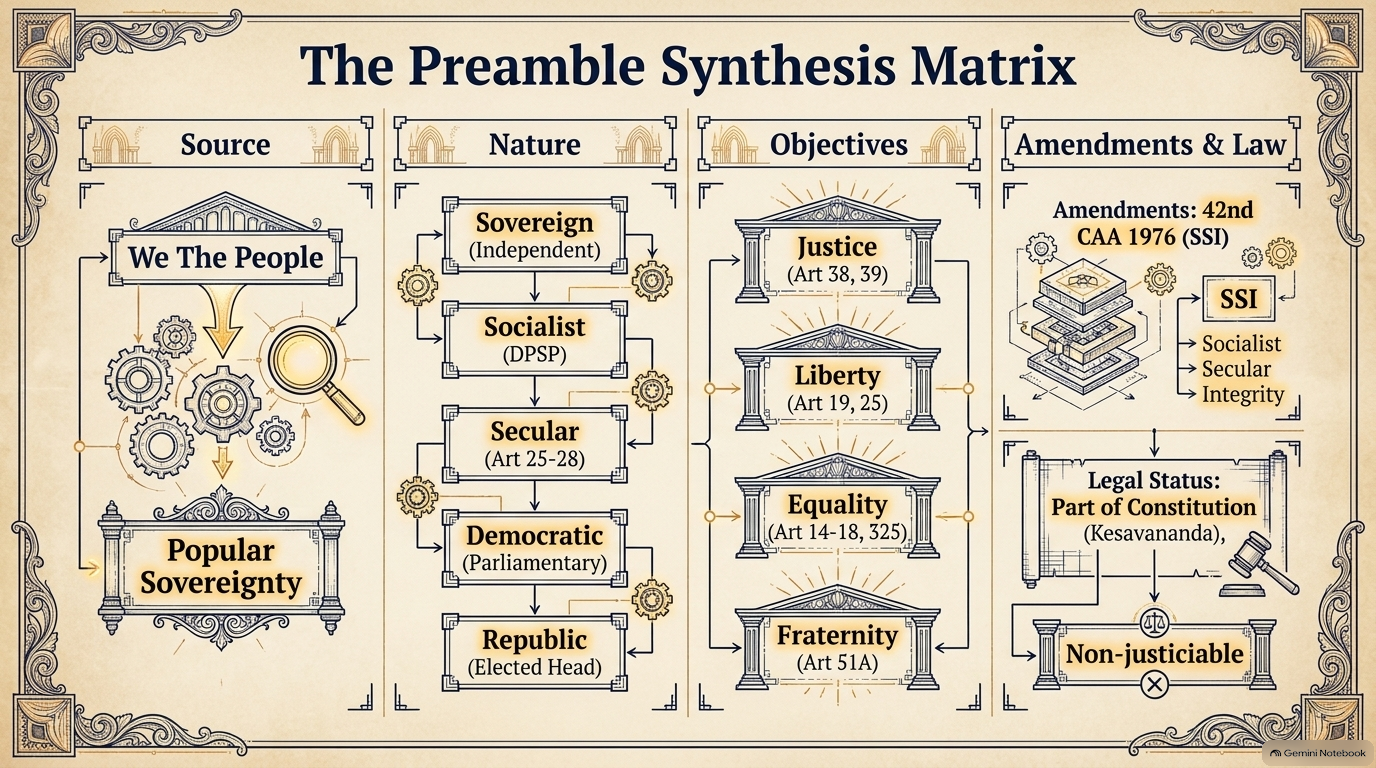
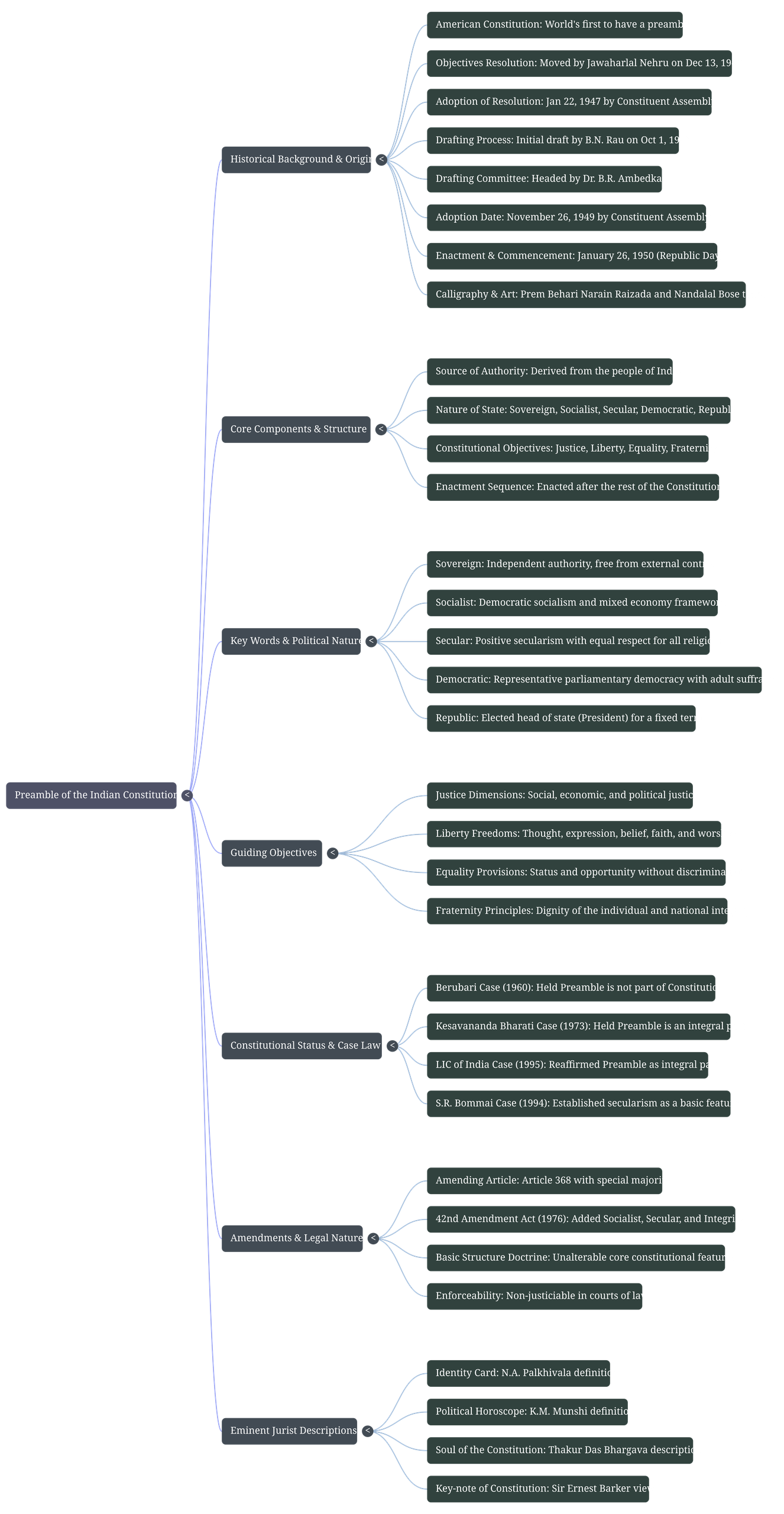
Preamble of the Indian Constitution, detailing its foundational history rooted in Jawaharlal Nehru’s Objectives Resolution and its American inspiration. They explain the core structural components of the Preamble, including its declaration of India as a Sovereign, Socialist, Secular, Democratic Republic and its commitment to Justice, Liberty, Equality, and Fraternity. Furthermore, the sources examine the evolving judicial perspective on whether the Preamble is an integral part of the Constitution, highlighting landmark supreme court rulings such as the Berubari, Kesavananda Bharati, and LIC cases. Finally, the materials outline the amendability of the Preamble under Article 368, noting the singular inclusion of terms like Socialist, Secular, and Integrity via the 42nd Constitutional Amendment Act of 1976, alongside ongoing discussions surrounding constitutional reforms.
The Supreme Court of India’s interpretation of the status of the Preamble has evolved significantly over time, transitioning from viewing it as an external document to recognizing it as an integral, non-severable part of the Constitution that embodies its Basic Structure[1].
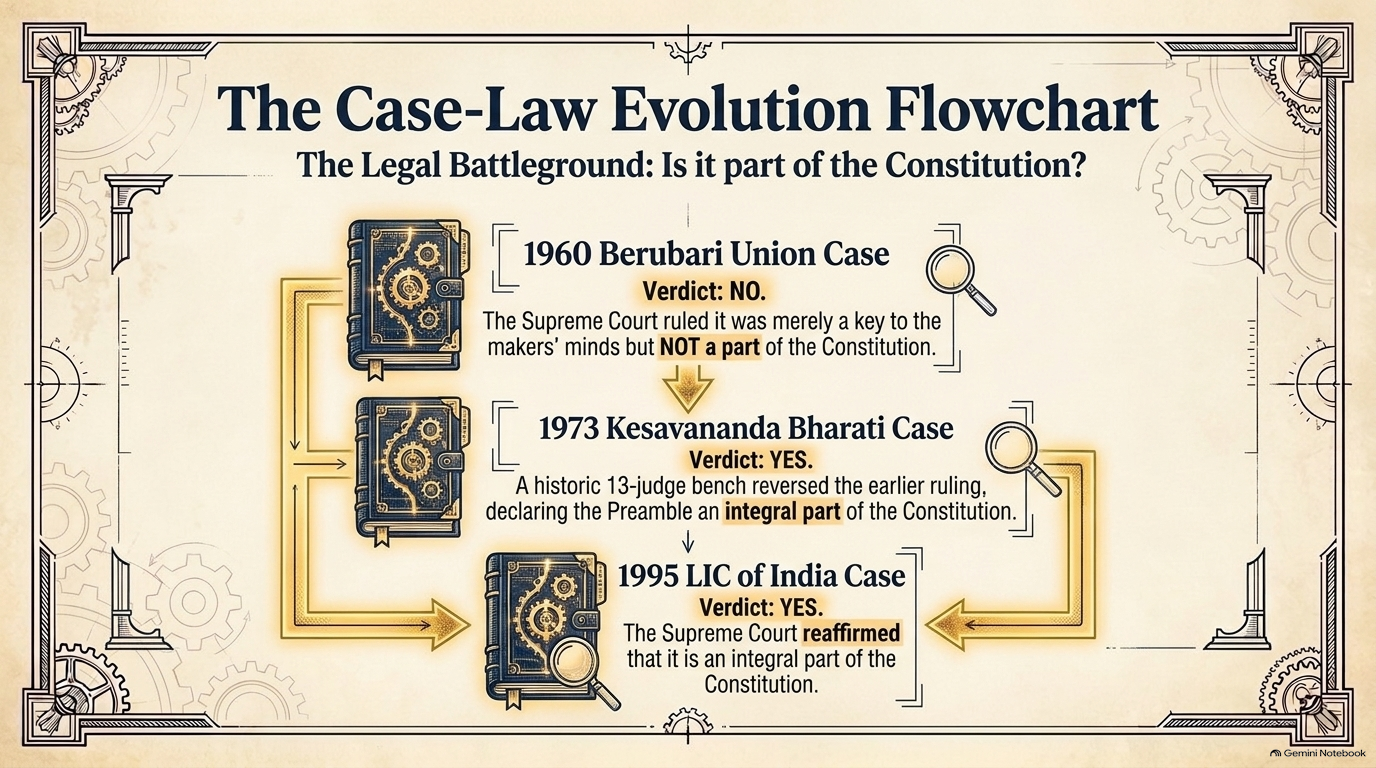
1. In re Berubari Union Case (1960): Not a Part of the Constitution
- Key Holding: The Supreme Court held that while the Preamble serves as a “key to open the mind of the makers” to help reveal the general intent of constitutional provisions, it is not a part of the Constitution[1].
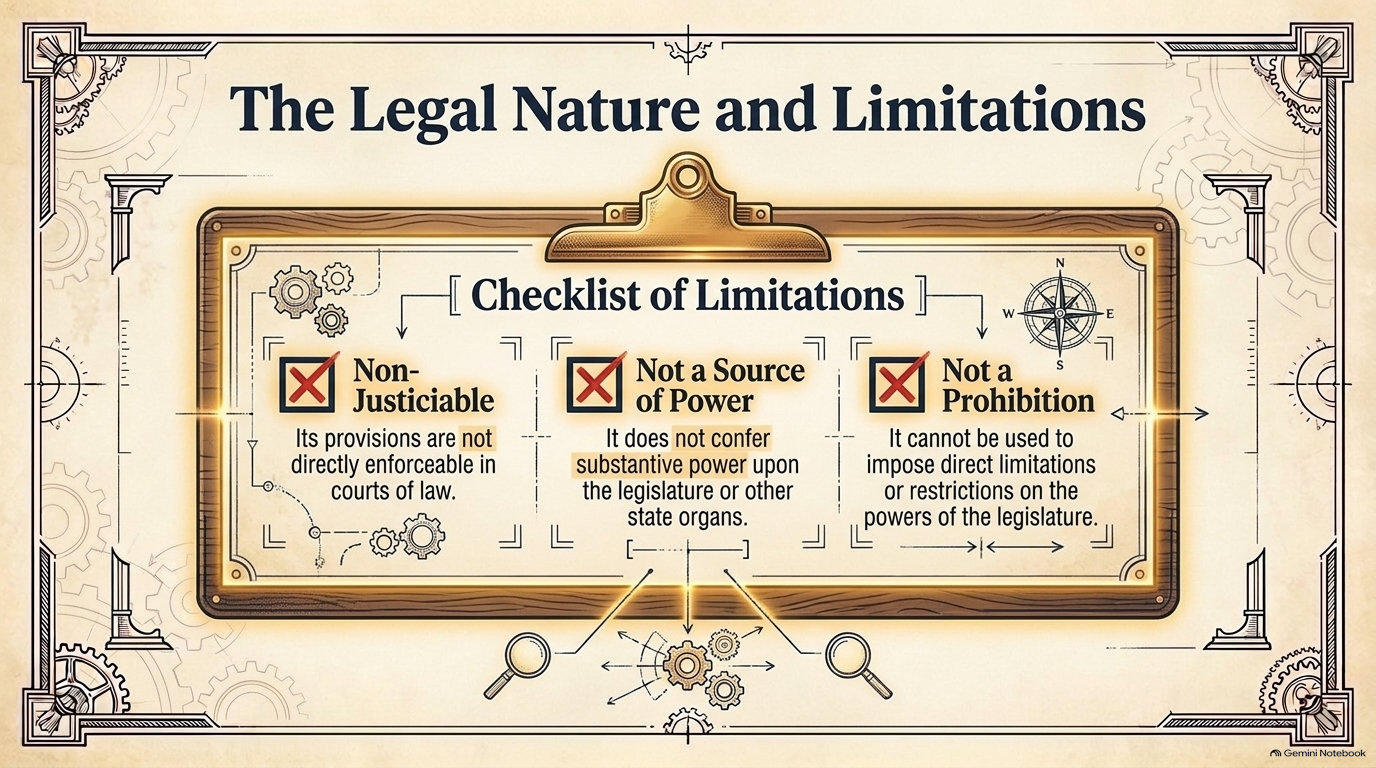
- Legal Status: The Court ruled that the Preamble is neither a source of substantive power to the legislature nor a source of limitation upon legislative powers[1][4]. It could only be referred to as an interpretive guide when a specific constitutional provision or statutory text was vague or ambiguous[1][4].
2. Golak Nath v. State of Punjab (1967): The Eternal Soul
- Judicial Observation: Justice Hidayatullah observed that the Preamble epitomizes the core principles on which the government functions, calling it the “very soul of the Constitution—eternal and unalterable”[1].
3. Kesavananda Bharati v. State of Kerala (1973): Overruling Berubari
- Landmark Shift: A 13-judge Constitution Bench expressly overruled the Berubari Union opinion and held that the Preamble is an integral part of the Constitution[1].
- Procedural Rationale: The Court highlighted that the Constituent Assembly formally debated, voted on, and adopted the Preamble in the exact same procedural manner as the rest of the text (under the formal motion “The question is that the Preamble stand part of the Constitution”)[3][7].
- Basic Structure Doctrine: The Court established that the Preamble encapsulates the Basic Structure of the Constitution—including sovereignty, democracy, secularism, the republican form of state, justice, liberty, equality, and fraternity[3].
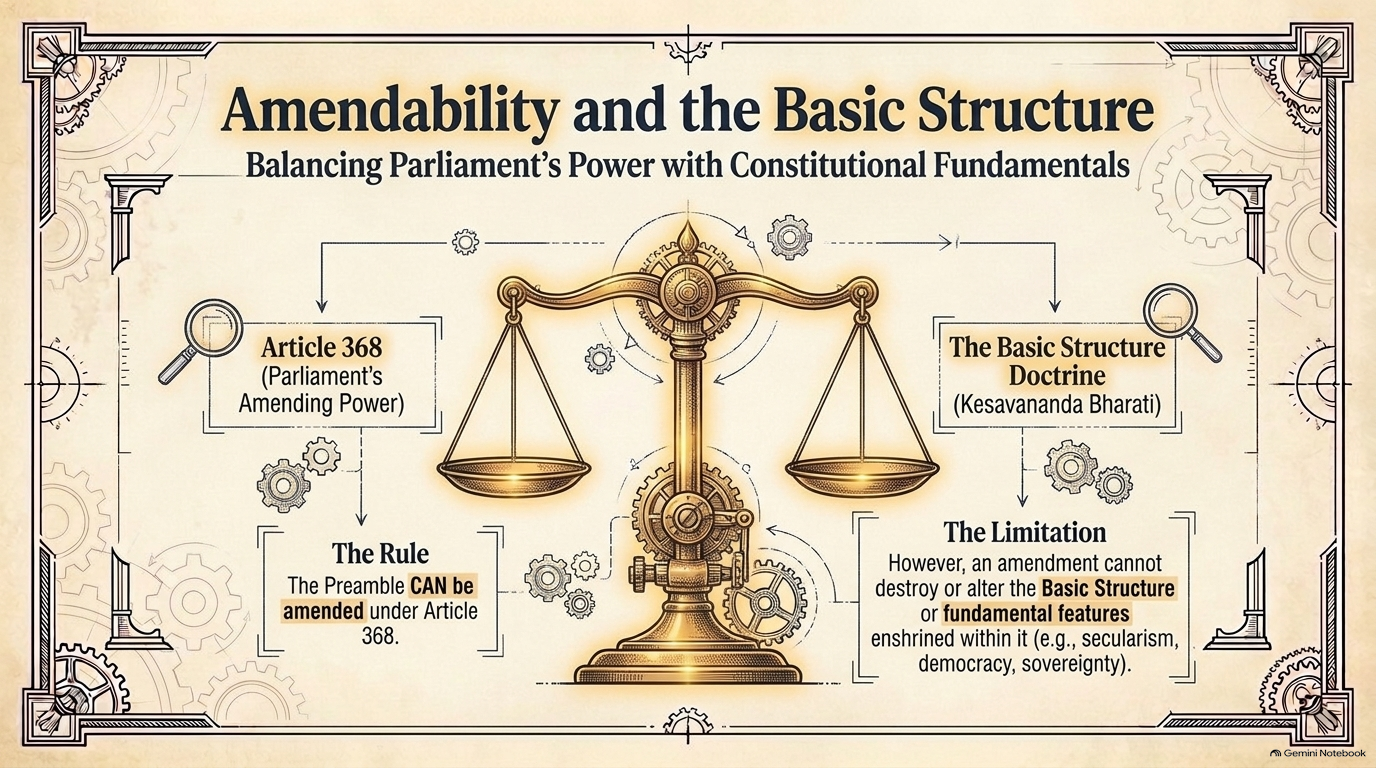
- Amendability: As part of the Constitution, the Preamble can be amended under Article 368, provided its Basic Structure is not destroyed or damaged[6].
4. LIC of India v. Consumer Education and Research Centre (1995): Reaffirmation
- Key Holding: The Supreme Court reaffirmed the Kesavananda Bharati ruling that the Preamble is an integral part of the Constitution[5].
- Non-Justiciability: The Court reiterated that while integral, the Preamble is non-justiciable—meaning it cannot be directly enforced in a court of law as a standalone cause of action without reference to operative constitutional provisions[5].
5. Recent Jurisprudence (e.g., Dr. Balram Singh v. Union of India, 2024)
- Continued Standing: The Supreme Court dismissed challenges regarding the addition of terms like “socialist” and “secular”, confirming that Article 368 extends to the Preamble as part and parcel of the Constitution, and that values like secularism and welfare form fundamental features of the Indian constitutional framework[19].
Summary of Current Constitutional Status
- Integral Part: Recognized as a formal and non-severable part of the Constitution[1].
- Interpretive Compass: Acts as a guiding light for courts to interpret ambiguous provisions and expand the scope of Fundamental Rights (Part III) and Directive Principles (Part IV)[3].
- Repository of Basic Structure: Enshrines unamendable core principles that restrict Parliament’s power under Article 368[3].
- Non-Justiciable & Non-Power Granting: It confers no independent substantive powers or restrictions on the state, nor can a citizen sue solely for a violation of the Preamble
Yes, the Preamble can be amended, but with a strict limitation: any amendment must not destroy or alter the Basic Structure of the Constitution[1].
1. Judicial Grounding & Limitations
- Kesavananda Bharati Case (1973): Overruling its earlier view in the Berubari Union (1960) case, the Supreme Court ruled that the Preamble is an integral part of the Constitution and can be amended under Article 368[1]. However, the Court established that Parliament’s amending power is limited—it cannot destroy or alter fundamental features enshrined in the Preamble, such as sovereignty, democracy, secularism, and justice[2].
- Dr. Balram Singh v. Union of India (2024): The Supreme Court recently reaffirmed that Article 368 extends to the Preamble as part and parcel of the Constitution, observing that the document is living and capable of evolution[14].
2. The Only Amendment So Far: 42nd Amendment Act (1976)
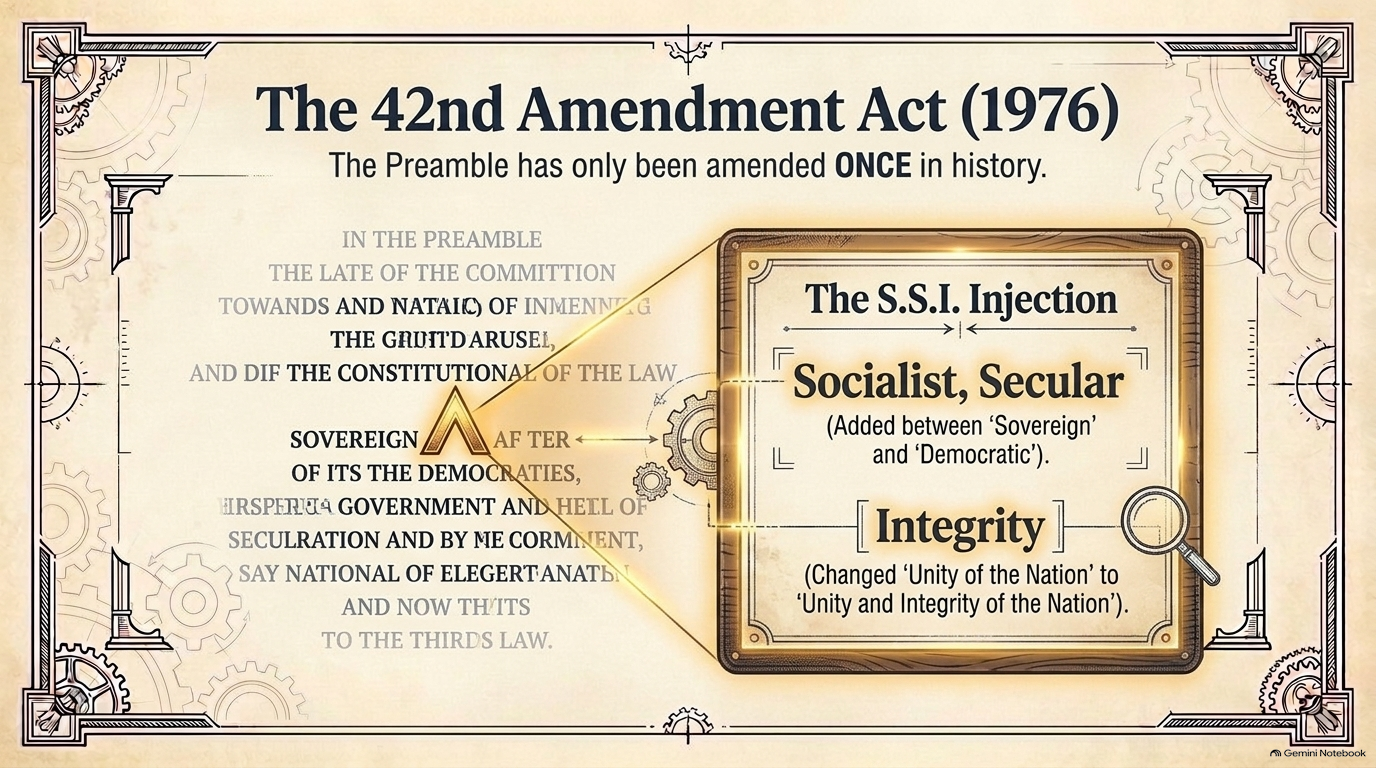
The Preamble has been amended only once in Indian history, through the 42nd Constitutional Amendment Act, 1976[1]:
- Three New Words Added: “Socialist”, “Secular”, and **”Integrity”**[1].
- Textual Restructuring:
- Changed the state’s description from “Sovereign Democratic Republic” to **”Sovereign Socialist Secular Democratic Republic”**[2].
- Changed the phrase “unity of the Nation” to **”unity and integrity of the Nation”**[1].
3. Procedural Requirements
- Special Majority: Amending the Preamble requires a special majority under Article 368 (a two-thirds majority of members present and voting in each House of Parliament)[2].
- Judicial Review: Any future amendment to the Preamble can be challenged in court and will be struck down if it is found to violate the Basic Structure Doctrine
The 42nd Constitutional Amendment Act, 1976 is one of the most comprehensive and significant amendments in Indian constitutional history, often referred to as the “Mini-Constitution” due to its vast scope[1][2]. Enacted during the Internal Emergency (1975–1977) under Prime Minister Indira Gandhi, it was based on the recommendations of the Swaran Singh Committee[1].
1. Impact on the Preamble
The 42nd Amendment is historically significant as the only time the Preamble has been amended[5]. It made two key textual changes[5][9]:
- Three New Words Added: It inserted the words “Socialist”, “Secular”, and **”Integrity”**[5].
- Textual Restructuring:
- The description of India was changed from “Sovereign Democratic Republic” to **”Sovereign Socialist Secular Democratic Republic”**[6].
- The phrase “unity of the Nation” was updated to **”unity and integrity of the Nation”**[3].
2. Constitutional & Judicial Context
- Legal Grounding: The amendment was made possible by the Supreme Court’s decision in the Kesavananda Bharati case (1973), which held that the Preamble is an integral part of the Constitution and can be amended under Article 368, provided its Basic Structure is not damaged[3].
- Making Implicit Values Explicit: Constitutional scholars and courts note that the amendment did not introduce entirely new concepts, but rather made explicit what was already embedded in the Constitution—such as secular principles in Fundamental Rights (Articles 25–28) and socialistic objectives in Directive Principles (Part IV)[3].
- Bipartisan Retainments: Although subsequent governments repealed or altered several Emergency-era provisions via the 43rd and 44th Amendments, the modifications made to the Preamble were retained, confirming a lasting national consensus[2]
The Basic Structure Doctrine is a cornerstone principle of Indian constitutional jurisprudence established by a 13-judge Constitution Bench of the Supreme Court of India in the landmark Kesavananda Bharati v. State of Kerala (1973) case[1].
Here is a breakdown of what the doctrine means, how it functions, and its role in Indian governance:
1. Core Principle
- Limitation on Parliamentary Power: The doctrine dictates that while Parliament has the authority to amend provisions of the Constitution under Article 368, this amending power is limited[3].
- Amend, Not Destroy: Parliament can amend the Constitution to adapt to changing societal needs, but it cannot alter, damage, or destroy the “Basic Structure” or fundamental identity of the Constitution[4]. The Court established that the power to amend is not a power to destroy[7].
2. Linkage to the Preamble
- Repository of Basic Features: Overruling its previous opinion in the Berubari Union case (1960), the Court held that the Preamble is an integral part of the Constitution and reflects its core identity[2].
- Interpretive Anchor: The core ideals articulated in the Preamble—such as sovereignty, democracy, secularism, social justice, liberty, equality, and fraternity—form the foundational edifice of the Constitution and serve as unamendable features[4].
3. Key Elements of the Basic Structure
The Supreme Court did not provide an exhaustive list of basic features in 1973, choosing instead to identify them incrementally through subsequent judicial decisions[11]. Core features identified by the judiciary include:
- Sovereignty, Unity, and Integrity of India[5]
- Democratic and Republican Form of Government[5]
- Secular Character of the State[5]
- Judicial Review (reaffirmed in Minerva Mills v. Union of India, 1980)[12]
- Rule of Law and Federalism[11][13]
- **The Balance between Fundamental Rights (Part III) and Directive Principles (Part IV)**[12]
4. Purpose & Impact
- Guardrail Against Majoritarian Overreach: It prevents any ruling majority from abusing Article 368 to dismantle India’s democratic and constitutional order[4].
- Basis for Judicial Review: It grants the judiciary the legal power to review constitutional amendments and strike down any amendment that violates these unamendable principles[7]
In recent jurisprudence, the Supreme Court of India has evolved the Basic Structure Doctrine from a simple restriction on parliamentary amendments into a dynamic, transformative framework for expanding fundamental rights and evaluating governance[1][2].
1. Reaffirming Amendability & Basic Features: Dr. Balram Singh v. Union of India (2024)
- Validity of Emergency-Era Words: A bench of Chief Justice Sanjiv Khanna and Justice Sanjay Kumar dismissed petitions seeking the removal of “socialist” and “secular” from the Preamble[3].
- Living Document Principle: The Court ruled that Article 368 extends to the Preamble as part and parcel of the Constitution[3]. It emphasized that the Constitution is a living document capable of evolution, meaning its retrospective date of adoption does not freeze the text[3].
- Secularism as an Unalterable Feature: Reaffirming earlier precedents (Kesavananda Bharati and S.R. Bommai), the Court held that secularism is a basic feature and a facet of the Right to Equality, ensuring equal state treatment of all faiths[3].
- Socialism as a Welfare Mandate: The Court clarified that Indian socialism in the constitutional context denotes a commitment to a welfare state rather than a restriction on private trade or entrepreneurship[3][4].
2. Anchoring Rights in ‘Constitutional Morality’ (2017–2018)
In recent years, the judiciary has frequently drawn upon the Preamble and the Basic Structure to develop the doctrine of constitutional morality—the principle that the core values of the Constitution (dignity, equality, liberty) must override social or popular morality[5][6]:
- Right to Privacy ( K.S. Puttaswamy v. Union of India , 2017): A 9-judge Bench unanimously recognized privacy as a Fundamental Right under Article 21, anchoring its decision in the Preamble’s values of liberty and individual dignity[7][8].
- Decriminalization of Homosexuality ( Navtej Singh Johar v. Union of India , 2018): The Court struck down Section 377 IPC, holding that constitutional morality and personal dignity take precedence over social prejudice[6][9].
- Gender Equality & Equal Status ( Joseph Shine & Shayara Bano , 2017–2018): Striking down the adultery law (Section 497 IPC) and instant triple talaq, the Court grounded its rulings in the Preamble’s guarantees of equality of status and individual dignity[6].
- Religious Freedom vs. Equality ( Sabarimala Case , 2018): The Court held that essential religious practices must yield to constitutional morality, equality, and non-discrimination[9][11].
3. Core Takeaways on the Modern Evolution
- A Compass for Social Transformation: Unlike static constitutions, India’s Basic Structure Doctrine acts as a transformative instrument to dismantle social hierarchies and secure socio-economic justice[1][2].
- Interpretive Lodestar: While the Preamble is non-justiciable on its own, its basic structure elements serve as a guiding compass for courts when interpreting ambiguous statutes or evaluating the constitutionality of legislative actions[12]
Comprehensive Briefing Document: Synthesizing the Preamble of the Indian Constitution
Comprehensive Briefing Document: Synthesizing the Preamble of the Indian Constitution
1. Executive Summary
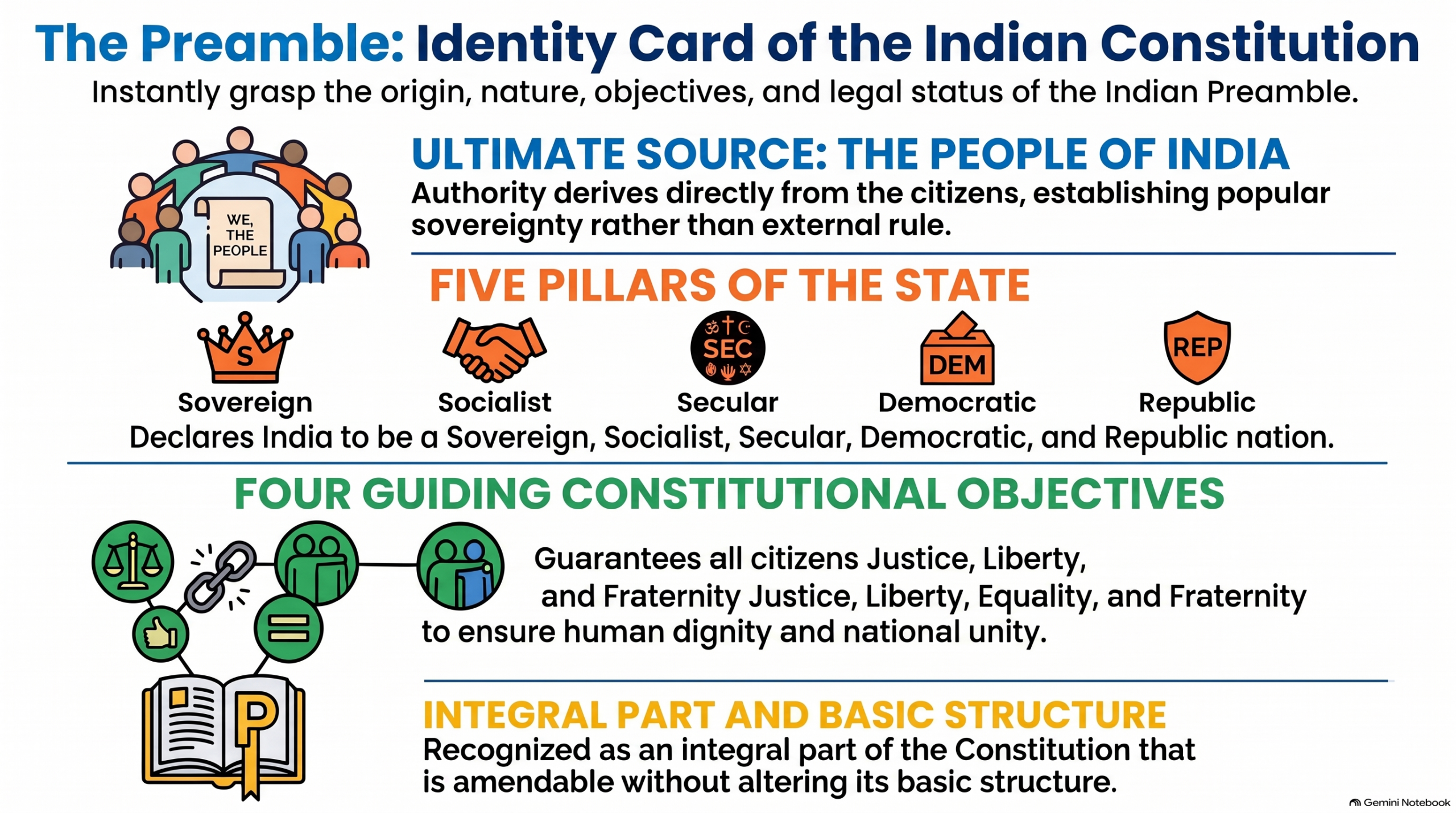
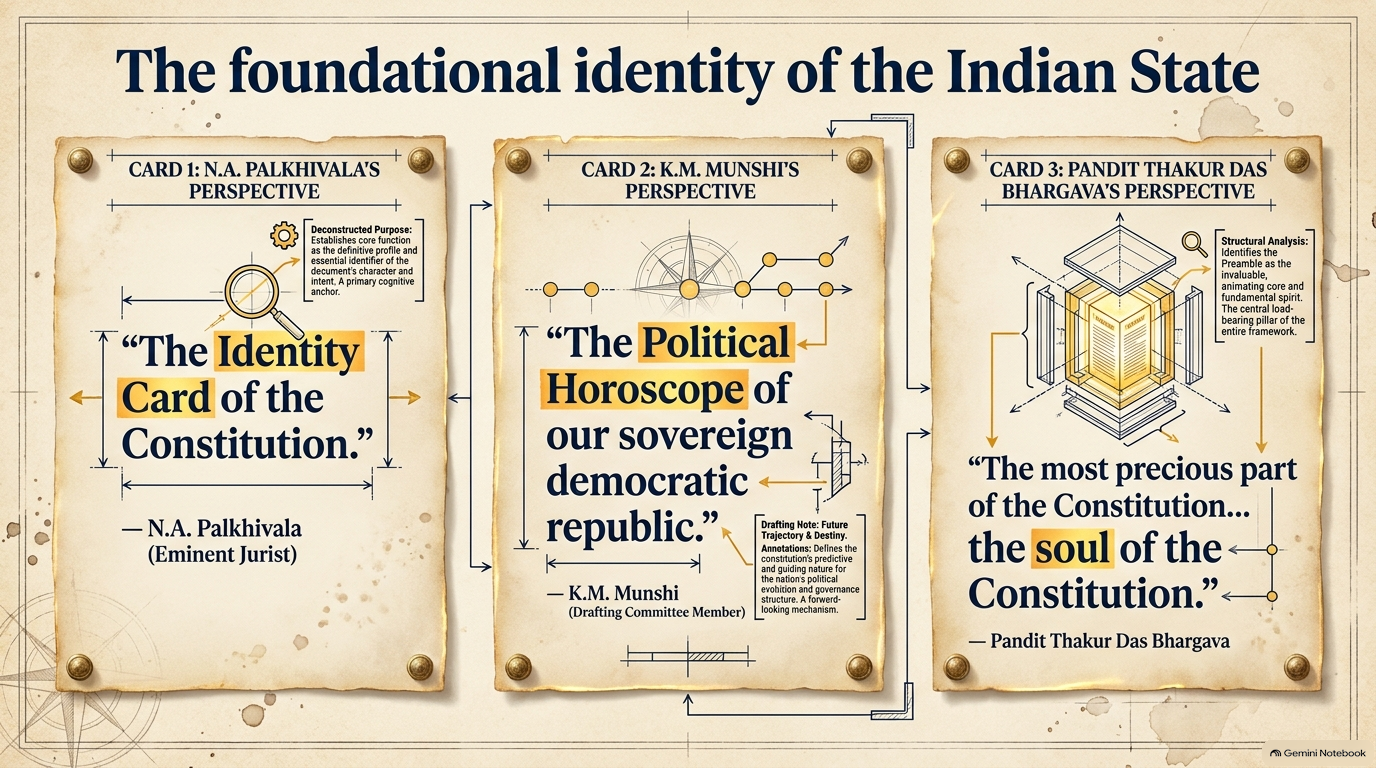
The Preamble to the Constitution of India serves as the introductory statement, preface, and philosophical blueprint of the nation’s legal and political framework. Eminent legal jurist N.A. Palkhivala characterized it as the “Identity Card of the Constitution,” while K.M. Munshi described it as the “Political Horoscope of the Constitution.” Derived from the “Objectives Resolution” introduced by Jawaharlal Nehru in 1946, the Preamble encapsulates the ultimate source of constitutional authority (“We, the People of India”), specifies the nature of the Indian State (Sovereign, Socialist, Secular, Democratic, Republic), articulates its foundational objectives (Justice, Liberty, Equality, Fraternity), and records its formal date of adoption (November 26, 1949).
Although the Preamble is non-justiciable—meaning its terms cannot be directly enforced in a court of law—and is neither an independent source of power nor a restriction on legislative capability, it possesses immense judicial and constitutional significance. Initially held by the Supreme Court in the Berubari Union Case (1960) to be excluded from the text of the Constitution, this position was definitively reversed in the landmark Kesavananda Bharati Case (1973). The Judiciary established that the Preamble is an integral part of the Constitution and can be amended under Article 368, provided its Basic Structure remains unviolated. It has been amended only once—via the 42nd Constitutional Amendment Act of 1976—which added the terms “Socialist,” “Secular,” and “Integrity.”
2. Historical Origins and Drafting Process
The Objectives Resolution
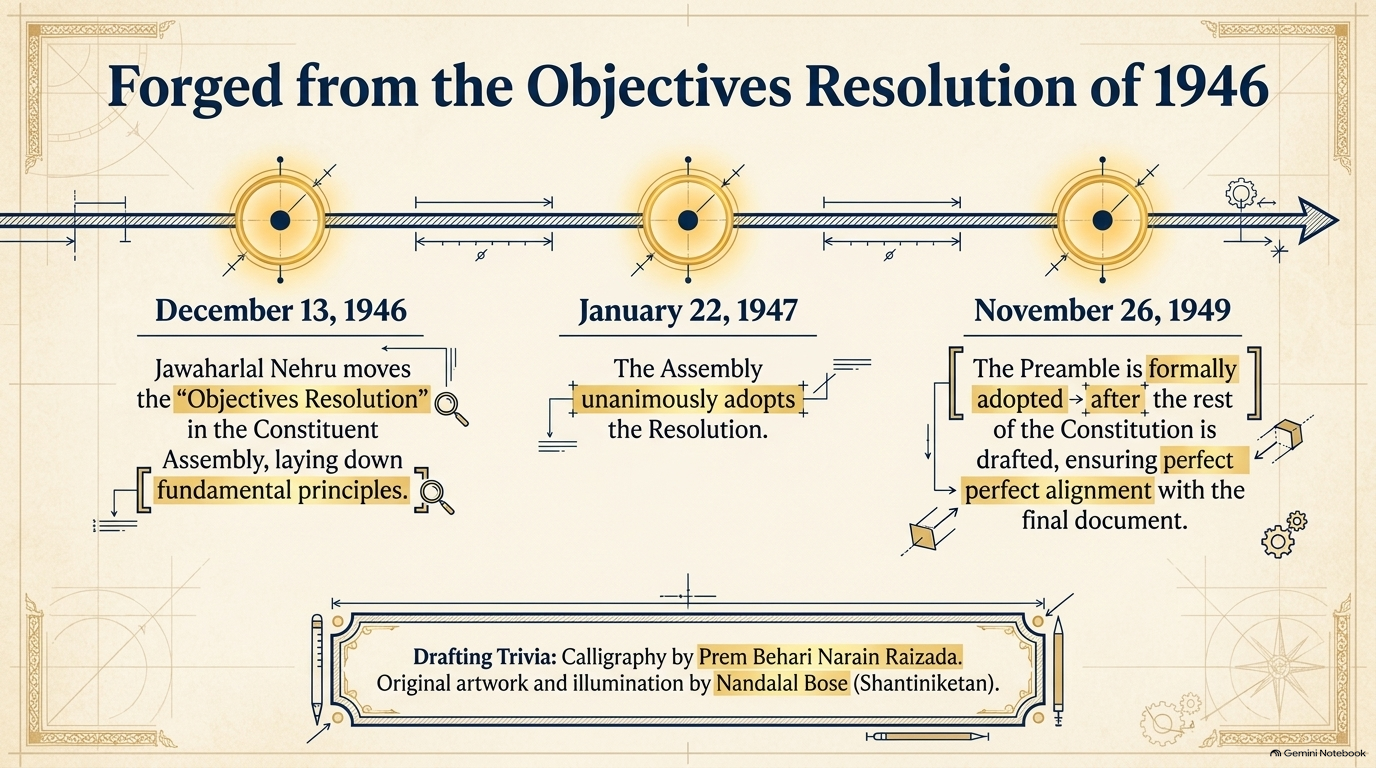
The philosophical foundation of the Preamble rests upon the Objectives Resolution, drafted and moved by Pandit Jawaharlal Nehru in the Constituent Assembly on December 13, 1946. Adopted unanimously on January 22, 1947, the resolution laid down the core ideals and commitments that guided the entire drafting process. Nehru stated:
> “It is something more than a resolution. It is a declaration, a firm resolve, a pledge, an undertaking and for all of us a dedication.”
The resolution outlined key imperatives:
- Establishing an Independent Sovereign Republic without allegiance to a foreign power or monarch.
- Forming a Union of territories with authority derived directly from the people.
- Guaranteeing social, economic, and political justice, alongside basic freedoms of thought, expression, belief, faith, worship, association, and action.
- Providing explicit safeguards for minorities, backward and tribal areas, and depressed classes.
- Maintaining territorial integrity and contributing to global peace and human welfare.
Drafting Committee member Muhammad Saadulla observed that the committee was instructed “only to dress the baby, and the baby was nothing but the Objectives Resolution.”
Milestones in Drafting and Finalization
- October 1, 1947: Sir B.N. Rau, Constitutional Adviser, prepared an initial draft of the Preamble based on the Objectives Resolution.
- February 21, 1948: The Drafting Committee, chaired by Dr. B.R. Ambedkar, published the revised Draft Constitution.
- October 17, 1949: The Assembly settled the text of the Preamble last, specifically after the rest of the Constitution was finalized, ensuring absolute alignment with the substantive provisions. A proposal by H.V. Kamath to open the Preamble with “In the name of God” was defeated (68 votes to 41) to maintain neutrality regarding personal faith.
- November 26, 1949: The Preamble and the Constitution were formally adopted by the Constituent Assembly.
- January 26, 1950: The Constitution came into full force, celebrated as Republic Day to commemorate the 1930 Purna Swaraj declaration.
Calligraphy and Artistic Embellishment
- Calligrapher: Prem Behari Narain Raizada handwrote the original English text.
- Artwork and Illumination: Beohar Rammanohar Sinha illuminated and beautified the Preamble page.
- Artistic Direction: Master artists from Shantiniketan, led by Nandalal Bose, executed the overall artwork and illustrations.
Global Precedents and Comparative Influences
The Indian Preamble integrates models from several global constitutional traditions:
- United States Constitution (1787): The custom of prefixing a written constitution with an introductory preamble originated in the U.S. (“We the People…”).
- French Revolution: Inspired the core triadic ideals of Liberty, Equality, and Fraternity.
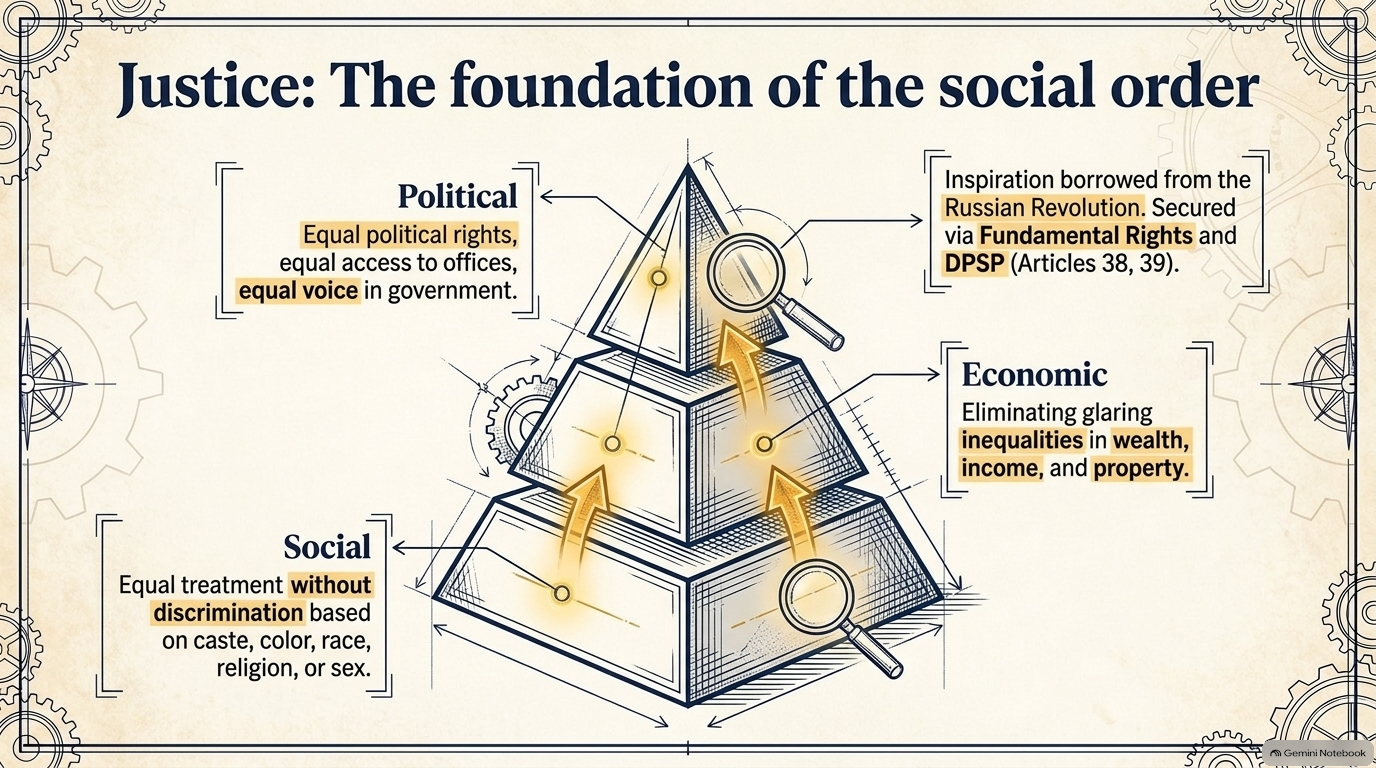
- Russian Revolution (1917): Inspired the multi-dimensional concept of Justice (Social, Economic, and Political).
- Government of India Act 1935 Comparison: Unlike the colonial 1935 Act, which carried no preamble because a British parliamentary statute claimed no popular mandate, the 1950 Indian Preamble deliberately asserts popular sovereignty (“We, the People”).
3. Structural Components of the Preamble
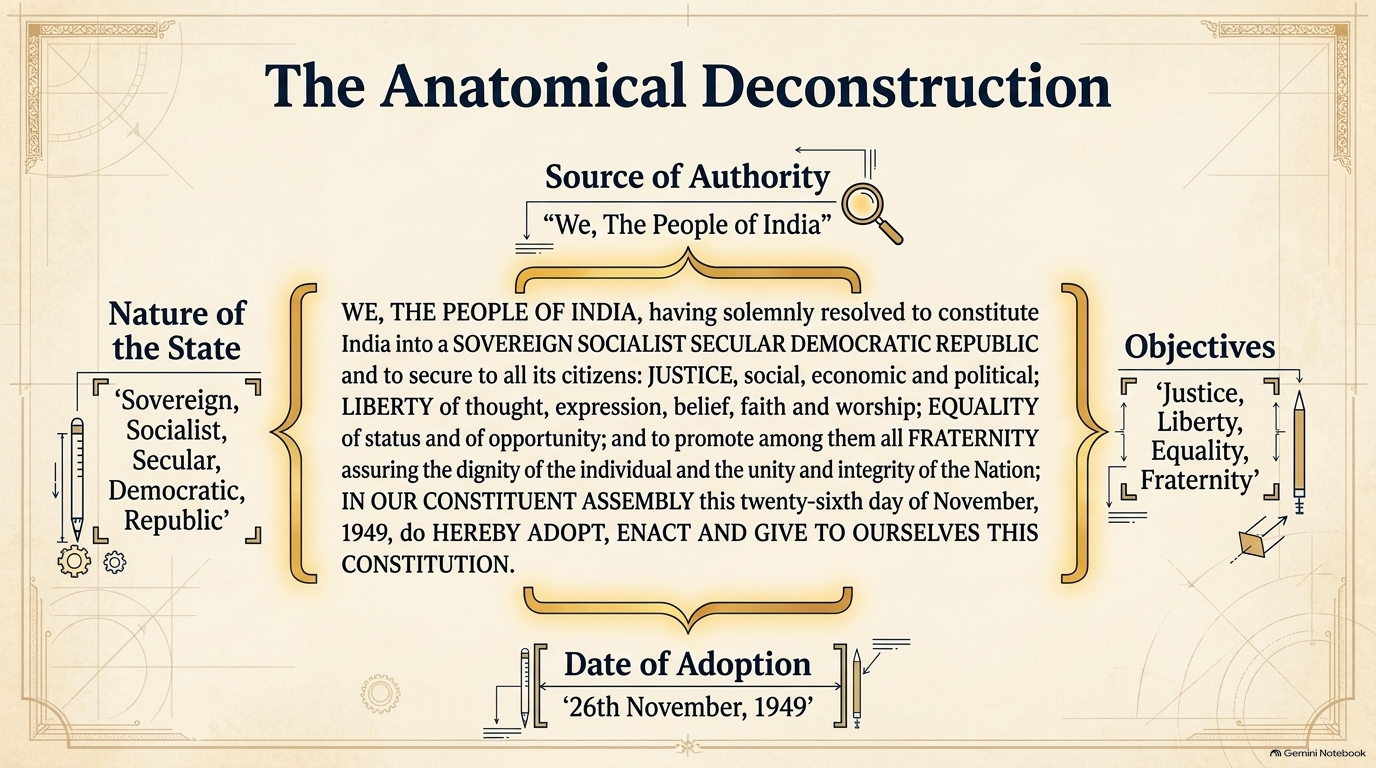
The text of the Preamble delineates four primary structural components:
                  +-------------------------------------------------------+
                  |              COMPONENTS OF THE PREAMBLE               |
                  +-------------------------------------------------------+
                                              |
      +-------------------+-------------------+-------------------+-------------------+
      |                   |                   |                   |                   |
+-----------+       +-----------+       +-----------+       +-----------+       +-----------+
| Source of |       | Nature of |       | Statement |       |  Date of  |       | Enacting  |
| Authority |       | the State |       |of Objectives|     | Adoption  |       |  Clause   |
+-----------+       +-----------+       +-----------+       +-----------+       +-----------+
| "We, the  |       | Sovereign |       | Justice   |       | Nov 26,   |       | "Adopt,   |
| People of |       | Socialist |       | Liberty   |       | 1949      |       | enact, &  |
| India"    |       | Secular   |       | Equality  |       |           |       | give to   |
|           |       | Democratic|       | Fraternity|       |           |       | ourselves"|
|           |       | Republic  |       |           |       |           |       |           |
+-----------+       +-----------+       +-----------+       +-----------+       +-----------+
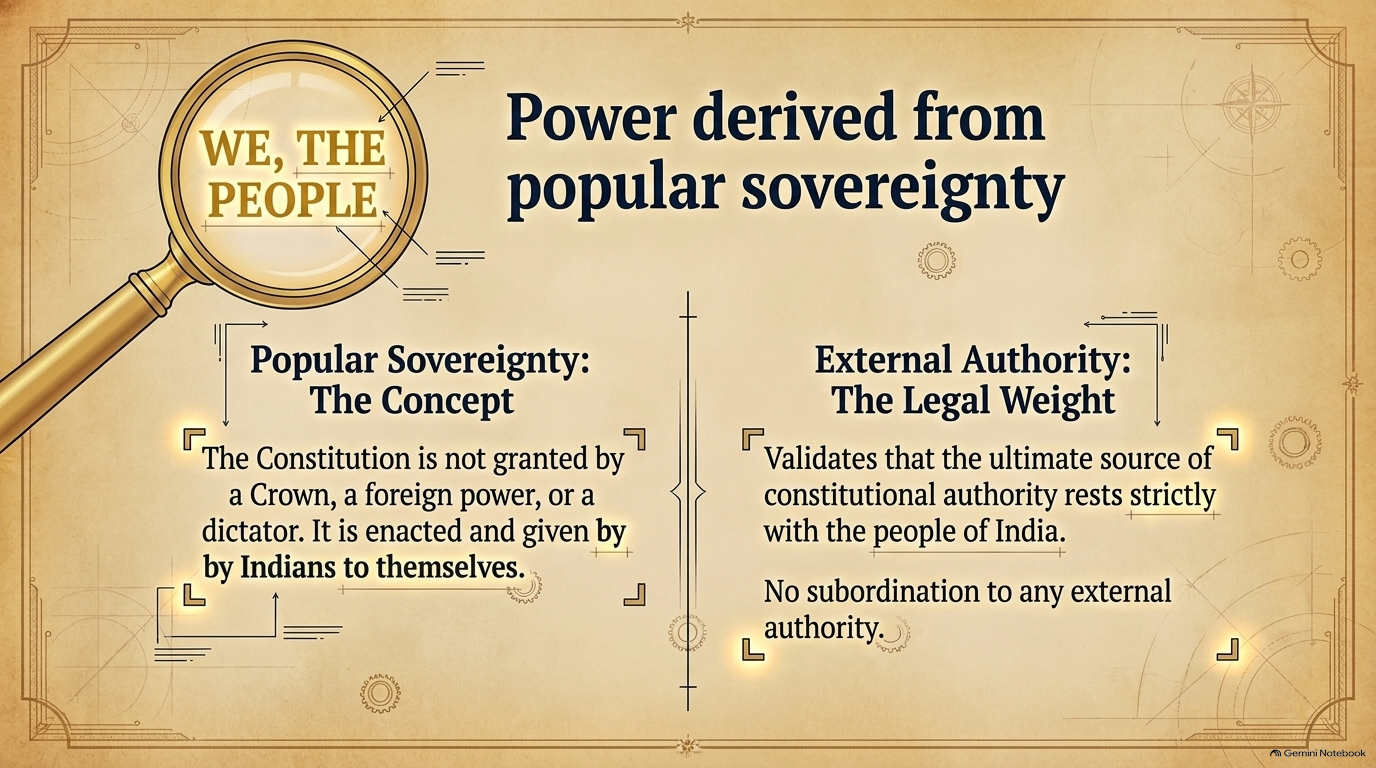
- Source of Constitutional Authority: Declares that the Constitution derives all its power and legitimacy directly from “We, the People of India.”
- Nature of the Indian State: Establishes India as a Sovereign, Socialist, Secular, Democratic, Republic.
- Objectives of the Constitution: Formulates four principal goals: Justice, Liberty, Equality, and Fraternity (guaranteeing human dignity and national unity/integrity).
- Date of Adoption & Enacting Clause: Stipulates November 26, 1949, as the date the people, through their assembled representatives, solemnly adopted, enacted, and gave to themselves the Constitution.
4. Comprehensive Analysis of Key Terminology
Source of Authority: “We, the People of India”
- Popular Sovereignty: Affirms that ultimate sovereignty resides with the citizens. The legal authority of the state does not emanate from a monarch, a foreign parliament, or divine right, but from the collective will of the Indian people.
- Indivisible Union: As emphasized by Jawaharlal Nehru and Sardar Vallabhbhai Patel, the phrase refers to the Indian populace in the aggregate as one sovereign body, prohibiting any constituent state or group from seceding. Patel noted the Constitution was “not an alliance between democracies and dynasties, but a real union of the Indian people.”
Nature of the State
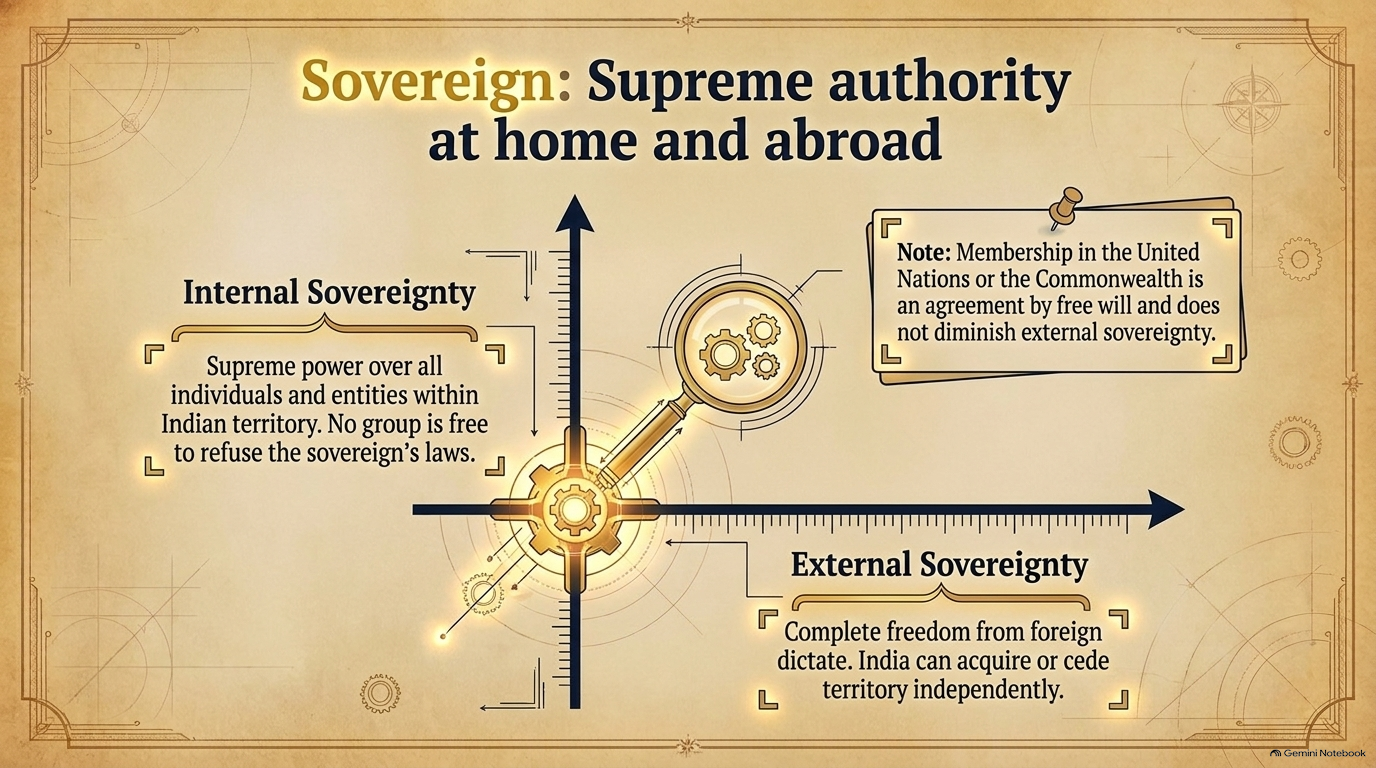
1. Sovereign
- Definition: Absolute independence; the state is free from internal or external control. India can formulate its own domestic policies and foreign relations without dictates from foreign powers.
- Internal Sovereignty: The capacity of a government to demand obedience to law from all individuals, groups, and entities within its borders (e.g., major corporate leaders like Mark Zuckerberg must comply with U.S. law).
- External Sovereignty: Freedom from subordination to foreign leaders or international bodies. While a sovereign state may participate in international organizations (e.g., the United Nations) or sign treaties, its decisions remain autonomous.
- Comparative Illustration: Taiwan possesses effective internal sovereignty but its claim to external sovereignty remains disputed internationally. The United States exhibits full internal and external sovereignty. India holds complete internal and external sovereignty, possessing the right to acquire foreign territory or cede national territory in accordance with constitutional procedures.
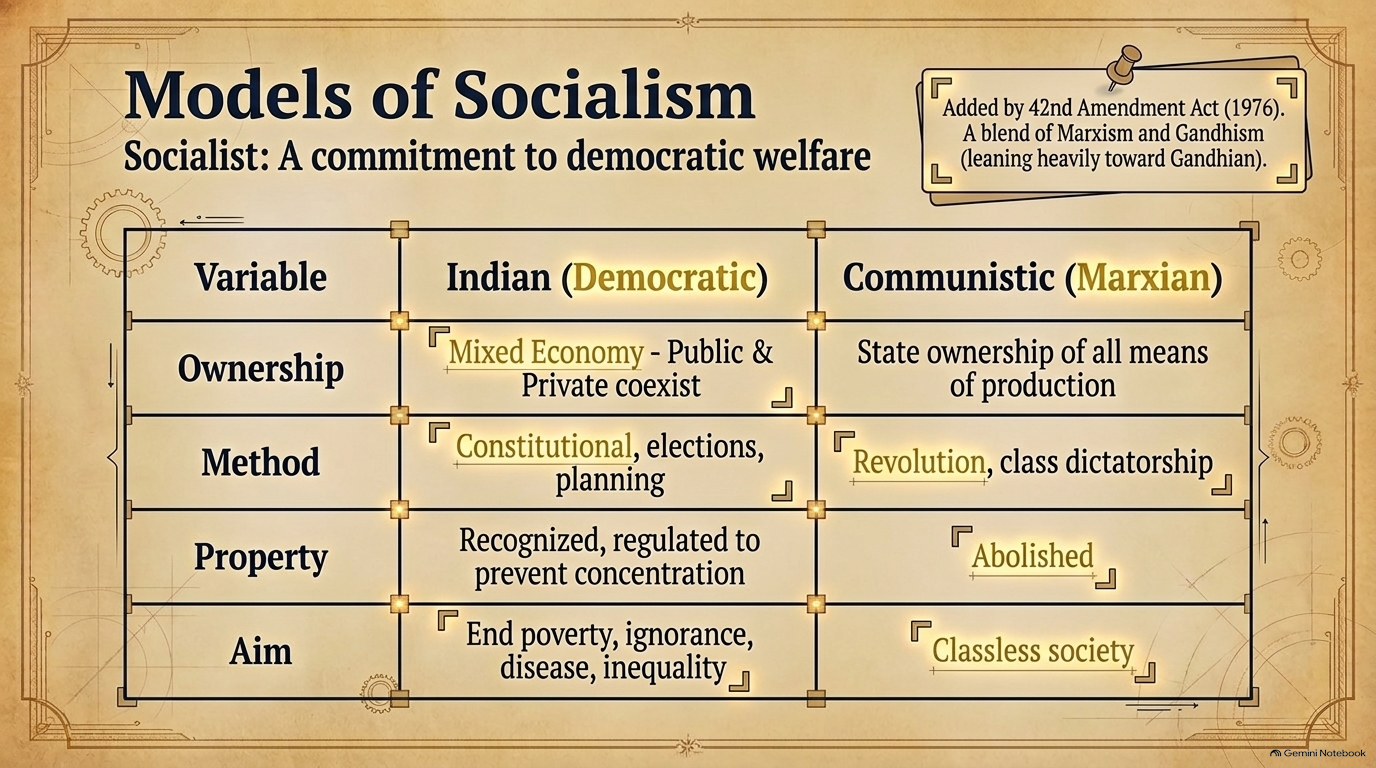
2. Socialist
- Insertion: Added by the 42nd Constitutional Amendment Act, 1976.
- Type of Socialism: India practices Democratic Socialism, embracing a mixed economy where both public and private sectors coexist.
- Ideological Synthesis: Indian socialism is a blend of Marxism and Gandhism, leaning heavily toward Gandhian socialism.
- Objectives: To eliminate poverty, disease, ignorance, and inequality of opportunity.
- Ambedkar’s Historical Opposition (1948): Dr. B.R. Ambedkar resisted explicitly adding the term “Socialist” during initial drafting, arguing that specifying an economic structure in the text destroyed democracy by denying future generations the right to choose their preferred socio-economic model based on changing times. He noted that socialist principles were already embedded in the Directive Principles of State Policy (DPSPs).
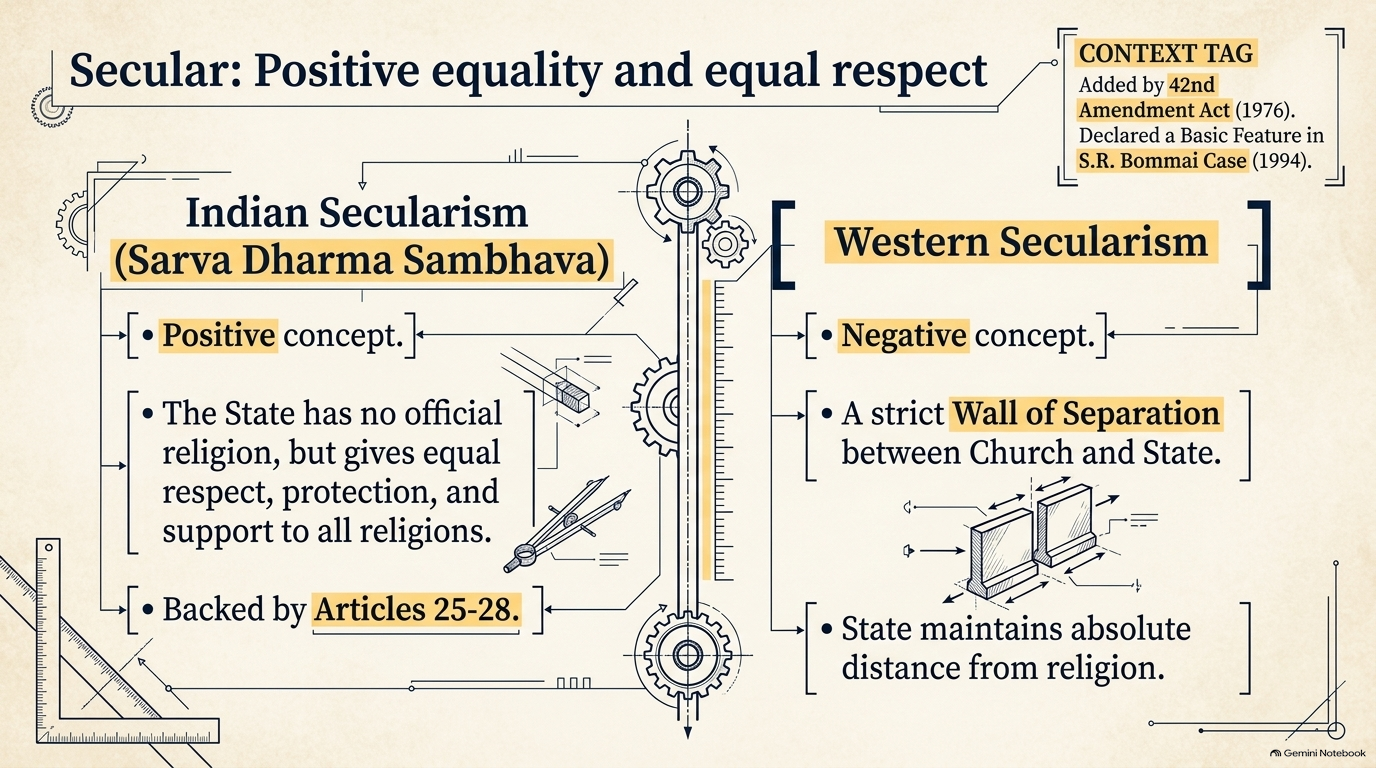
3. Secular
- Insertion: Formally added by the 42nd Constitutional Amendment Act, 1976 (though implicit in Articles 25 to 28 since inception; pre-1976, the word appeared explicitly only in Article 25(2)(a)).
- Positive Secularism: Unlike the Western concept, which dictates strict separation or mutual exclusion between Church and State, Indian secularism represents positive equality. The State has no official religion, remains neutral, and accords equal respect, protection, and support (Sarva Dharma Sambhava) to all religions.
- Judicial Affirmation: In Ziyauddin Burhammudin Bukhari v. Brijmohan Ramdass Mehra, Justice M.H. Beg noted that a secular state rises above religious differences to secure the good of all citizens impartially. In S.R. Bommai v. Union of India (1994), the Supreme Court declared Secularism to be a Basic Feature of the Constitution.
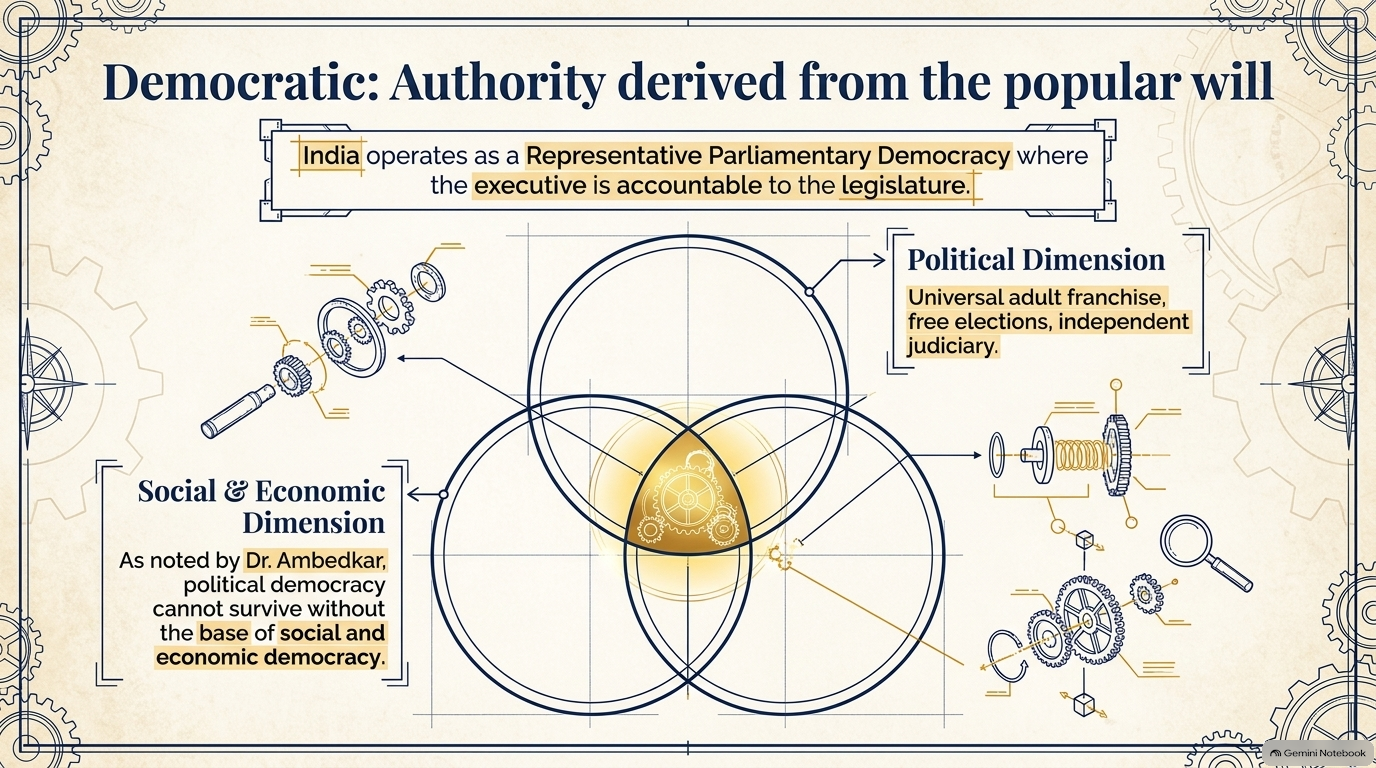
4. Democratic
- Definition: A system of government deriving power from the consent of the governed through representative democracy.
- Representative Parliamentary Democracy: The executive branch is directly responsible and accountable to the elected legislature for its policies and actions.
- Core Pillars: Regular, free, and fair elections; Universal Adult Franchise (voting rights for all citizens aged 18 and above without discrimination); Rule of Law; Independence of the Judiciary; and absence of arbitrariness.
- Broader Scope: Used in the Preamble to cover not merely political democracy, but social and economic democracy as well.
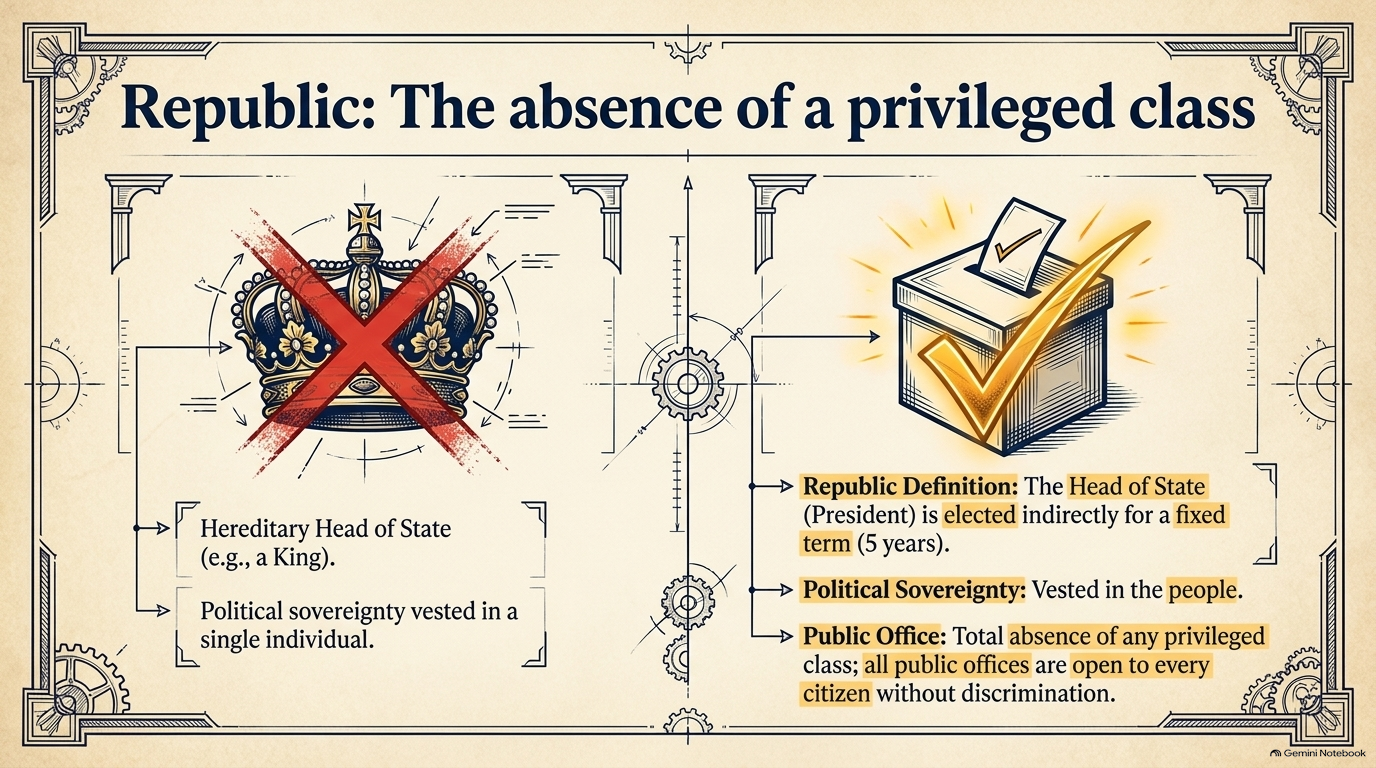
5. Republic
- Definition: The political head of state is an elected official (the President of India, elected indirectly for a fixed five-year term) rather than a hereditary monarch (such as in Great Britain).
- Vesting of Sovereignty: Sovereignty is vested in the populace rather than a single individual or class.
- Absence of Privileged Classes: All public offices are accessible to every citizen without discrimination.
- Madison’s Definition (The Federalist): A government deriving its powers directly or indirectly from the great body of the people, administered by officers holding office for a limited period or during good behavior.
Objectives of the Constitution
+-----------------------------------------------------------------------------------+
|                           OBJECTIVES OF THE CONSTITUTION                          |
+-----------------------------------------------------------------------------------+
|  JUSTICE    | Social, Economic, & Political (Achieved via Rights and DPSPs)      |
+-------------+---------------------------------------------------------------------+
|  LIBERTY    | Thought, Expression, Belief, Faith, & Worship (Qualified, not absolute)|
+-------------+---------------------------------------------------------------------+
|  EQUALITY   | Status & Opportunity; Civic, Political, & Economic Non-discrimination|
+-------------+---------------------------------------------------------------------+
| FRATERNITY  | Brotherhood, Dignity of Individual, Unity & Integrity of Nation    |
+-----------------------------------------------------------------------------------+
1. Justice
Promises citizens fair treatment and basic human dignity across three distinct dimensions (inspired by the Russian Revolution):
- Social Justice: Creating a society free from discrimination based on caste, creed, color, race, religion, or gender.
- Economic Justice: Non-discrimination based on wealth, income, or economic status; eliminating glaring inequalities in property and earnings; equal pay for equal work. Implemented primarily via Directive Principles of State Policy (e.g., Articles 38, 39, 42, 43A, 47).
- Political Justice: Equal, free, and fair opportunity for all citizens to participate in political processes, hold office, and exercise franchise without discrimination.
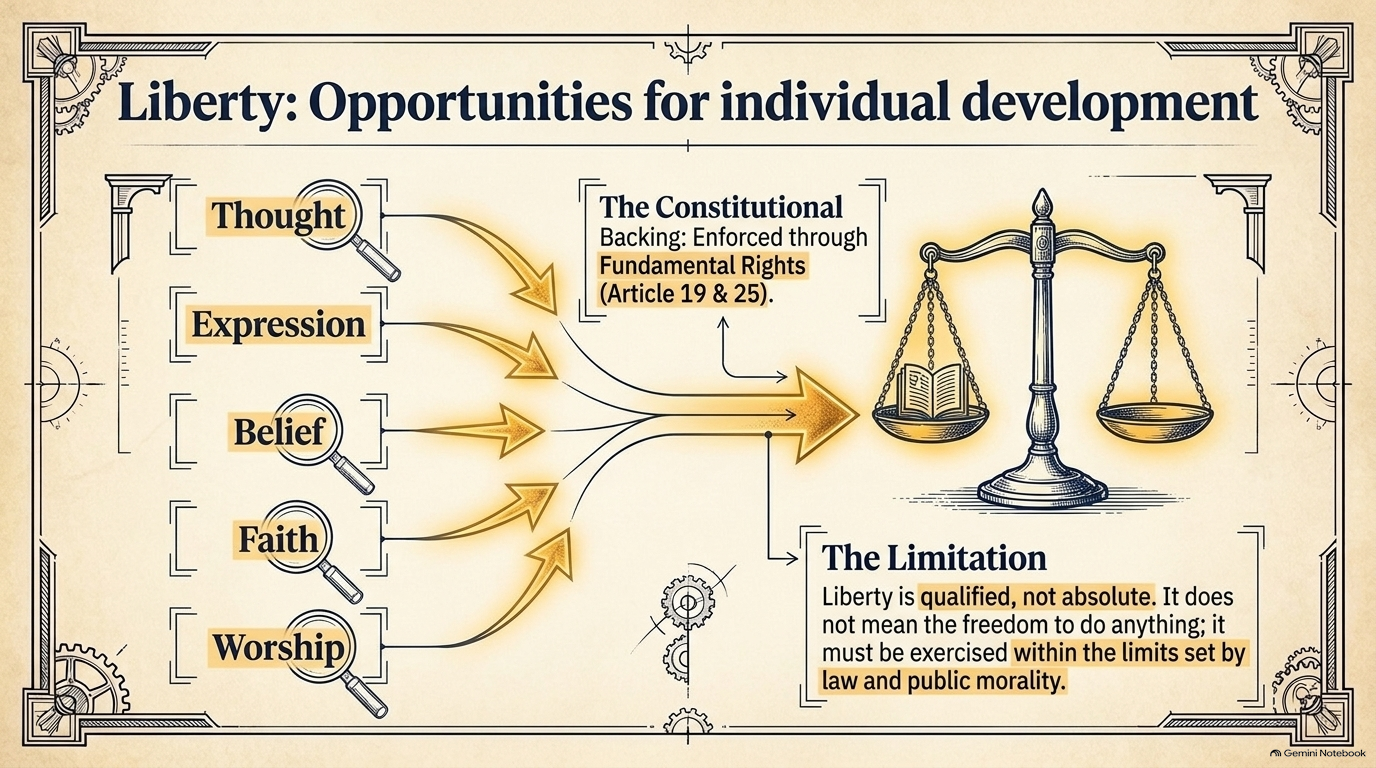
2. Liberty
- Guarantees: Liberty of thought, expression, belief, faith, and worship (operationalized through Fundamental Rights under Articles 19 and 25–28).
- Qualified Nature: Liberty does not grant absolute license to act without restraint. It must be exercised strictly within the boundaries and reasonable restrictions established by law and public morality.
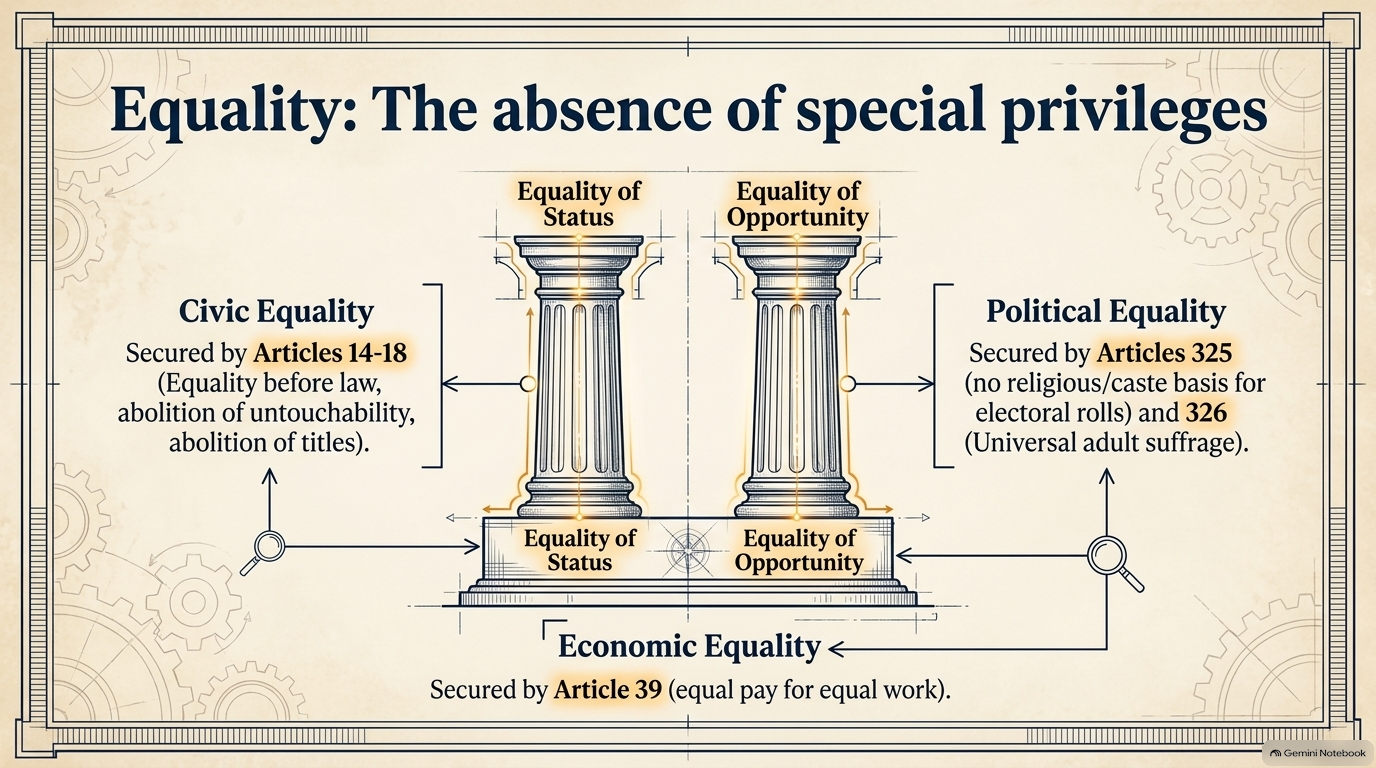
3. Equality
- Definition: The absence of special privileges for any particular class or section of society, alongside the provision of adequate opportunities for all individuals without discrimination.
- Dimensions:
- Civic Equality: Guaranteed under Fundamental Rights (Articles 14–18: equality before law, prohibition of discrimination, equality of opportunity in public employment, abolition of untouchability and titles).
- Political Equality: Universal adult suffrage and non-discrimination in political participation (Articles 325 and 326).
- Economic Equality: Secured via state directives (Article 39 guaranteeing equal livelihoods and equal pay).
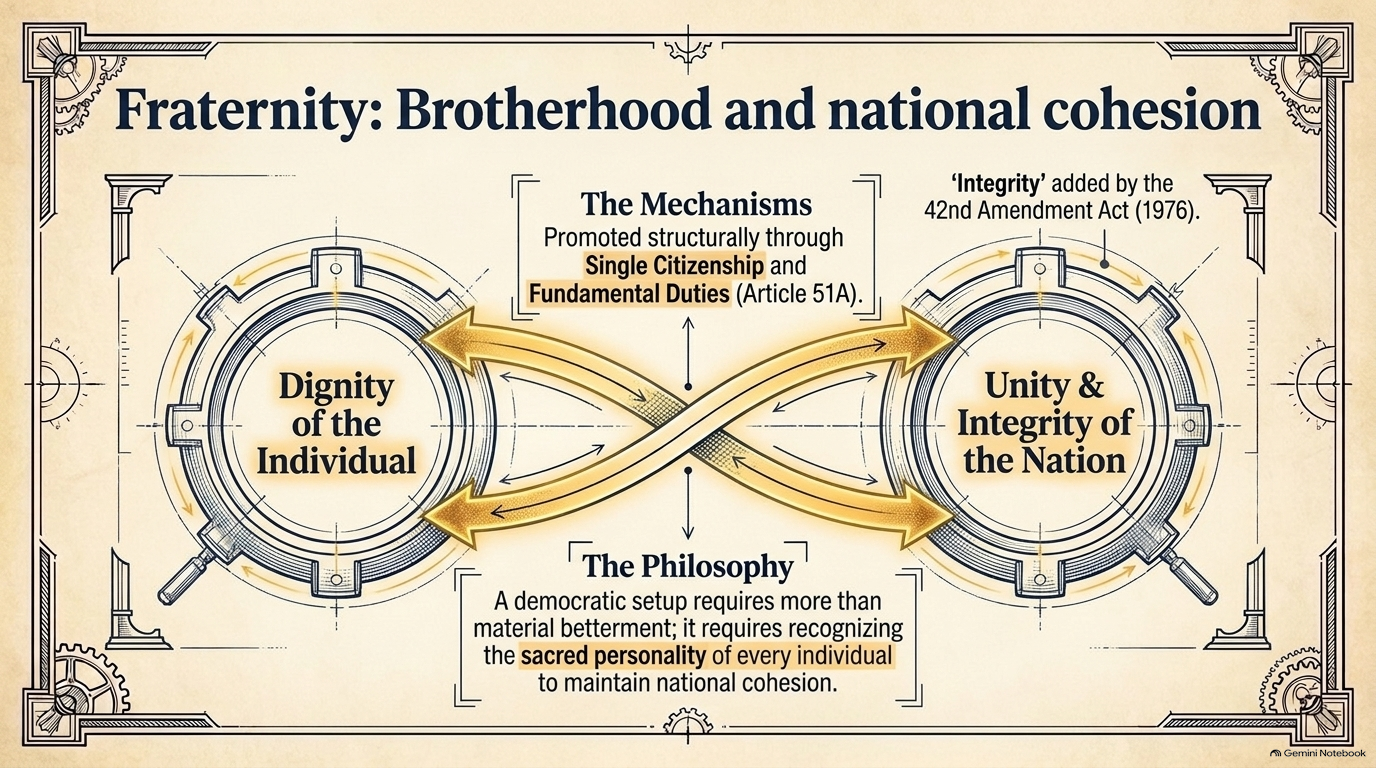
4. Fraternity
- Definition: A unifying sense of common brotherhood that transcends regional, linguistic, religious, or sectional diversities. Promoted structural-level mechanisms like Single Citizenship and duties under Article 51A (Fundamental Duties).
- Twin Guarantees: Fraternity explicitly assures two essential elements:
- Dignity of the Individual: Recognizes that the personality of every citizen is sacred, requiring minimal justiciable rights to ensure material and spiritual well-being.
- Unity and Integrity of the Nation: Preserves the territorial and psychological cohesion of India (“Integrity” was added in 1976).
5. Judicial Status and Landmark Case Law
The legal interpretation of the Preamble’s status, power, and amendability has undergone significant evolution through landmark Supreme Court rulings:
| Case Law & Year | Core Constitutional Issue | Supreme Court Ruling & Key Holdings |
|---|---|---|
| Union of India v. Madan Gopal Kabra (1954) | Source of Constitutional Authority | Recognized that the Constitution derives its legal authority directly from the people of India (Popular Sovereignty). |
| Berubari Union Case (1960) | Implementation of Indo-Pak Agreement (Ref under Art 143(1)) | Held that the Preamble is a “key to open the mind of the makers,” but declared that the Preamble is NOT part of the Constitution. Stated it grants no substantive power to the legislature and cannot be enforced in court. |
| Sajjan Singh v. State of Rajasthan (1965) | Nature and draft of the Preamble | Justice Madholkar noted that the Preamble bears the stamp of “deep deliberation” and “precision,” serving as an “epitome” of the broad features of the Constitution. |
| Golak Nath v. State of Punjab (1967) | Fundamental Rights & Amendments | Justice Hidayatullah observed that the Preamble epitomized the core functioning principles of the Government, calling it the eternal and unalterable “soul of the Constitution.” |
| Bharti Chandra Bhavan v. State of Mysore (1970) | Scope of Rights and Directives | Ruled that the scope of Fundamental Rights and Directive Principles must be interpreted in the light of the objectives enshrined in the Preamble. |
| Kesavananda Bharati v. State of Kerala (1973) | Scope of Parliament’s amending power under Art 368 | Overruled Berubari Union. A historic 13-judge bench held that the Preamble IS an integral part of the Constitution. Chief Justice Sikri emphasized that the constitutional edifice rests upon the basic elements of the Preamble. Establishes that the Preamble can be amended, provided its Basic Structure is preserved. |
| Indira Nehru Gandhi v. Raj Narain (1977) | Election Disputes & Amendments | Reaffirmed that the Preamble can be relied upon to identify and clarify the basic features of the Constitution. |
| Minerva Mills v. Union of India (1980) | Supremacy between Rights & DPSPs | Reaffirmed the Preamble as an integral part of the Constitution. Struck down amendments giving DPSPs absolute primacy over Rights, citing that the Preamble requires a balance between rights and social duties. |
| S.R. Bommai v. Union of India (1994) | Misuse of Art 356 & Federalism | Declared Secularism, as articulated in the Preamble, to be a Basic Feature of the Constitution, defining it as positive equality toward all religions. |
| LIC of India v. Consumer Education & Research Centre (1995) | Validity of insurance policy conditions | Reaffirmed that the Preamble is an integral part of the Constitution, while confirming its non-justiciable character. |
Key Legal Characteristics of the Preamble
- Non-Justiciable: The provisions of the Preamble are not directly enforceable in courts of law. One cannot file a writ petition claiming a direct violation of the Preamble alone.
- Neither Source nor Limitation: The Preamble does not confer independent substantive powers on the executive or legislative branches, nor does it impose explicit legal prohibitions or limitations upon legislative powers.
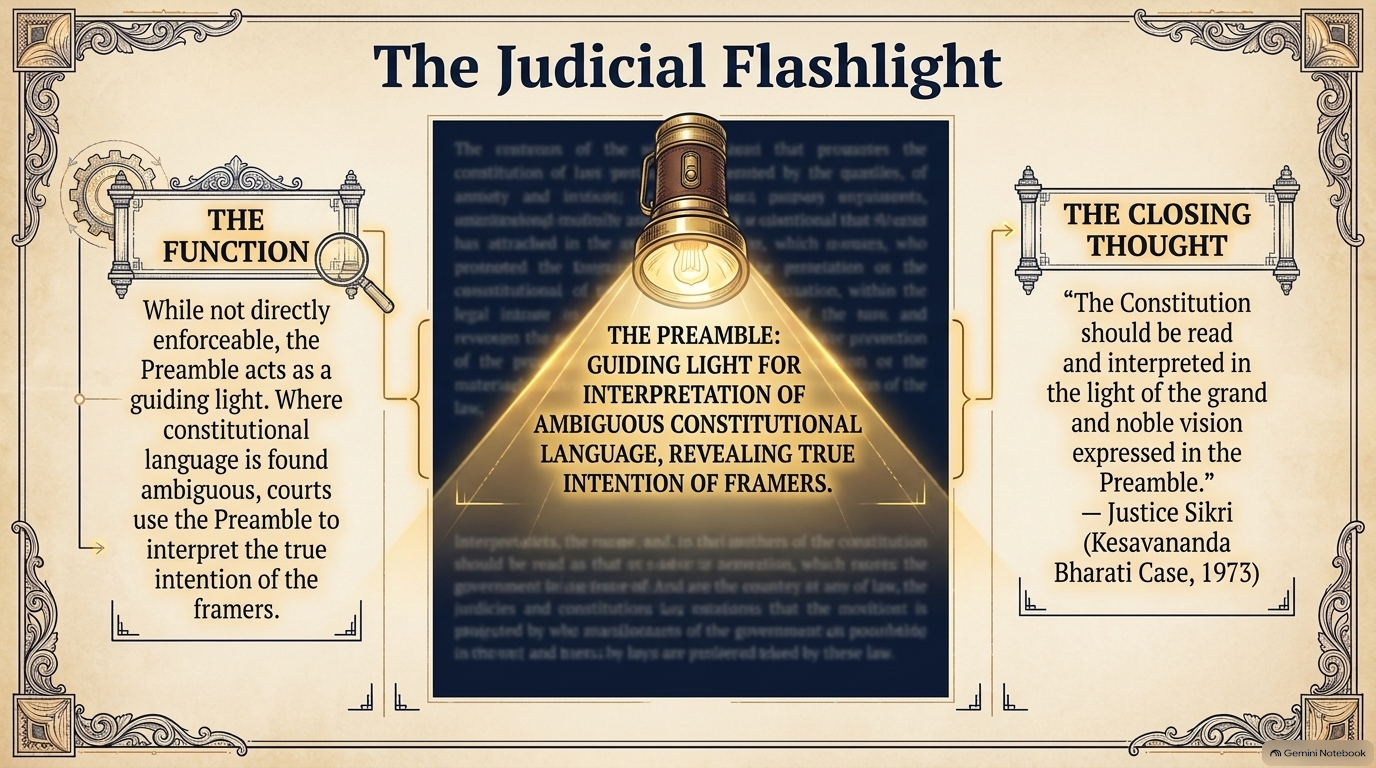
- Interpretive Tool: In cases where statutory or constitutional language is ambiguous, vague, or susceptible to multiple interpretations, the judiciary utilizes the Preamble as a guiding light to discern the intent of the Constitution’s framers.
6. Amendments, Reform Debates, and Criticisms
Amendability Under Article 368
- Kesavananda Bharati Ruling (1973): Established that because the Preamble is part of the Constitution, Parliament can amend it under Article 368.
- Basic Structure Limitation: The amending power is restricted. Parliament cannot alter, destroy, or repeal any basic feature enshrined in the Preamble (e.g., Sovereignty, Democracy, Secularism, Republican nature, Liberty, Equality).
- Procedural Requirement: Amending the Preamble requires a Special Majority under Article 368 (a majority of the total membership of each House and a two-thirds majority of members present and voting).
The 42nd Constitutional Amendment Act, 1976
The Preamble has been amended only once in Indian constitutional history through the 42nd Amendment in 1976:
- Added Terms: Inserted “Socialist” and “Secular” between the words “Sovereign” and “Democratic”.
- Modified Phrase: Substituted “Unity and Integrity of the Nation” for the original phrase “Unity of the Nation”.
ORIGINAL TEXT (1949):
"SOVEREIGN DEMOCRATIC REPUBLIC" | "unity of the Nation"

POST-42ND AMENDMENT (1976):
"SOVEREIGN SOCIALIST SECULAR DEMOCRATIC REPUBLIC" | "unity and integrity of the Nation"
Modern Reform Proposals (Private Member Bills)
Recent legislative proposals have sought further modifications to the Preamble’s text:
- Replacing “SOCIALIST” with the term “EQUITABLE”.
- Expanding “EQUALITY of status and of opportunity” to explicitly include:
- “Equality of status and of opportunity to be born, to be fed, to be educated, to get a job and to be treated with dignity.”
- “Access to information technology and all its implications, irrespective of caste, creed, social status or income.”
- Expanding “FRATERNITY” to include:
- “Assuring the dignity of the individual and the community…”
- “HAPPINESS, assuring a high gross domestic happiness.”
Academic and Legal Criticisms
- Legalistic Complexity: Criticized as a “lawyers’ paradise” due to its legalistic terminology and complex draftsmanship.
- Borrowed Framework: Critics contend it heavily replicates provisions of the colonial Government of India Act 1935 rather than fully reflecting indigenous Indian political traditions.
- Ambiguity: Terms such as “Socialist” and “Secular” are viewed by some jurists as ambiguous, leading to ongoing ideological and legal disputes over their exact operational boundaries.
- Practical Inconsistencies: Gaps between stated ideals (e.g., Social Justice and Equality) and practical reality, where political opportunism, vote-bank consolidation, religious tensions, and economic disparities persist.
7. Comparative Reference Table of Prominent Juristic Descriptions
| Authority / Jurist / Founder | Descriptive Title / Quote Regarding the Preamble |
|---|---|
| N.A. Palkhivala | Called it the “Identity Card of the Constitution.” |
| K.M. Munshi | Termed it the “Political Horoscope of the Constitution” / “horoscope of our sovereign democratic republic.” |
| Dr. B.R. Ambedkar | Described it as the “Soul of the Indian Constitution” containing its core philosophy. |
| Sir Ernest Barker | Described it as the “Key-note” to the Constitution; reproduced it at the beginning of his political theory treatise. |
| Pandit Thakur Das Bhargava | Called it the “most precious part of the Constitution… its soul, its jewel, and its key.” |
| Sir Alladi Krishnaswami Iyer | Stated it expressed “what we had thought or dreamt so long.” |
| Justice M. Hidayatullah | Observed it resembles the U.S. Declaration of Independence, forming a blueprint of political society and a “solemn resolve which nothing but a revolution can alter.” |
| Justice Madholkar (Sajjan Singh Case) | Stated it bore the stamp of “deep deliberation,” was “marked by precision,” and served as an “epitome” of broad constitutional features. |
| Pandit Jawaharlal Nehru | Described its parent text (Objectives Resolution) as “a declaration, a firm resolve, a pledge, an undertaking and for all of us a dedication.” |
| Sardar Vallabhbhai Patel | Stated it established a union based on popular sovereignty, not an alliance between “democracies and dynasties.” |
5 Mind-Bending Facts About the Preamble of the Indian Constitution You Never Learned in School
Every sovereign nation celebrates its founding charter, but few texts embody the philosophical density and deliberate democratic foresight found in the opening passage of the Indian Constitution. Consisting of a mere 143 words in its original 1949 form, it remains the shortest section of the nation’s supreme law, yet it is by far the most intensely debated, cited, and judicially interpreted.
Eminent jurist N.A. Palkhivala famously declared the Preamble to be the “Identity Card of the Constitution,” while constitutional architect K.M. Munshi described it as the “Political Horoscope of our sovereign democratic republic.” Beyond its celebrated prose, however, lies a complex legal landscape shaped by intense parliamentary debates, sharp ideological choices, and dramatic judicial reversals.
Far from being a static preface, the Preamble represents a masterclass in popular sovereignty and democratic open-endedness. Here are five mind-bending legal and historical facts about the opening text that defines the world’s largest democracy.
1. The Preamble Was Enacted Last to Mirror the Final Document
It is a common misconception that a constitution’s introduction is written first to serve as an initial blueprint for the legal machinery that follows. The drafting sequence of the Indian Constitution, however, operated in reverse: the Preamble was formally enacted last.
The core ideas of the Preamble originated in the historic Objectives Resolution, drafted and moved by Jawaharlal Nehru on December 13, 1946, and unanimously adopted by the Constituent Assembly on January 22, 1947. Yet, as the Assembly spent nearly three years debating and refining the intricate articles, schedules, and institutional mechanisms of the Constitution, the formal adoption of the Preamble was intentionally delayed until the very end of the drafting process in October and November 1949.
This sequence was highly strategic. The framers deferred the final vote on the Preamble until November 26, 1949, specifically to ensure that its overarching philosophy aligned seamlessly with the detailed legal provisions finalized across the rest of the text. Drafting Committee member Muhammad Saadulla captured this derivative relationship when explaining the committee’s work to the Assembly:
> “asked only to dress the baby, and the baby was nothing but the Objectives Resolution”
By formalizing the Preamble at the conclusion of their labor, the framers ensured that the opening declaration was not an unexamined, preliminary promise, but an authentic mirror reflecting the fully realized constitutional identity of the republic.
2. Dr. Ambedkar Rejected “Socialist” and “Secular” to Protect Democracy
A prominent feature of today’s Preamble is its description of India as a “Sovereign Socialist Secular Democratic Republic.” Yet, readers examining an original 1949 copy of the Constitution will find that neither “Socialist” nor “Secular” appeared in the text. They were inserted decades later via the 42nd Constitutional Amendment Act, 1976 (alongside the word “Integrity”).
Their omission in 1949 was not an oversight. During the Constituent Assembly debates in 1948 and 1949, members such as K.T. Shah and Brajeshwar Prasad moved explicit amendments proposing to insert “Socialist” and “Secular” into the opening lines. Dr. B.R. Ambedkar, Chairman of the Drafting Committee, firmly objected to these proposals.
Ambedkar’s objection was rooted in a foundational democratic ethos: a constitution should establish frameworks for democratic governance, not lock future generations into a rigid socio-economic ideology. As Dr. Ambedkar articulated on the floor of the Assembly:
> “What should be the policy of the State, how the Society should be organised in its social and economic side are matters which must be decided by the people themselves according to time and circumstances. It cannot be laid down in the Constitution itself, because that is destroying democracy altogether.”
Beyond Ambedkar’s warning against ideological pre-determination, the Assembly recognized that these values were already structurally embedded in the draft. Socialist goals were comprehensively outlined in the Directive Principles of State Policy, while secular guarantees were secured under Articles 25 through 28 (granting freedom of conscience and religion), Articles 29 and 30 (protecting minority rights), and the total abolition of communal electorates. To the framers, adding ideological labels was textually redundant and democratically restrictive.
3. The Legal U-Turn: Is the Preamble Even Part of the Constitution?
Whether the Preamble legally constitutes an actual “part” of the Constitution produced one of the most famous judicial reversals in Indian legal history.
For over a decade following independence, the legal standing of the Preamble remained restricted:
- Berubari Union Case (1960): The Supreme Court ruled that while the Preamble serves as a “key to open the mind of the makers” when statutory text is ambiguous, it is not a part of the Constitution and confers no substantive power upon Parliament or the judiciary.
- Kesavananda Bharati Case (1973): In a monumental shift, a 13-judge bench overruled the Berubari precedent, declaring that the Preamble is an integral part of the Constitution (a doctrine reaffirmed in the 1995 LIC of India case).
The Court’s reversal in 1973 hinged on a key historical fact overlooked in 1960: the procedural record of the Constituent Assembly itself. Unlike preambles in ordinary English statutes, the Indian Preamble was put through the exact same formal enactment procedure as the rest of the draft. On November 26, 1949, the President of the Constituent Assembly put forth the specific motion: “The question is that the Preamble stands part of the Constitution.” The Assembly voted, passed the motion, and formally incorporated it into the document.
| Dimension | Berubari Union Case (1960) | Kesavananda Bharati Case (1973) |
|---|---|---|
| Constitutional Status | Ruled NOT a part of the Constitution | Held to be an INTEGRAL part of the Constitution |
| Procedural Basis | Treated as a general preface external to the text | Recognized as formally voted upon and enacted by the Assembly |
| Legal Authority | Reference tool for understanding framers’ intent only | Forms part of the unalterable Basic Structure of the Constitution |
Through this judicial evolution, the Supreme Court elevated what was once treated as a ceremonial preface into an unalterable constitutional anchor that limits parliamentary amendment power under Article 368.
4. Non-Justiciable, Yet the Soul of Constitutional Interpretation
The operational legal power of the Preamble rests on a fascinating constitutional paradox: it is legally non-justiciable, yet interpretively supreme.
In isolation, the Preamble grants no direct enforcement rights to citizens, confers no legislative power upon Parliament, and imposes no direct prohibition on governmental organs. A citizen cannot file a writ petition in court claiming a standalone violation of the Preamble, as its provisions are non-justiciable and unenforceable on their own.
However, whenever an Article of the Constitution or a statutory law passed by Parliament contains ambiguity, vagueness, or competing meanings, the judiciary turns to the Preamble as its ultimate interpretive compass. Courts treat its stated objectives as the philosophical benchmark against which all laws and constitutional amendments must be evaluated.
Chief Justice S.M. Sikri underscored this interpretive authority in the Kesavananda Bharati ruling, observing:
> “The Preamble was not only very much a part of the Constitution, but was of extreme importance and the Constitution should be read and interpreted in the light of grand and noble vision expressed in the Preamble.”
Though non-justiciable in court on its own, the Preamble functions as the moral and legal lens through which the entire Indian constitutional order is understood and maintained.
5. The Framers Explicitly Voted Down “In the Name of God”
The opening declaration of the Preamble—“We, the People of India”—anchors the Indian republic in popular sovereignty. However, establishing this secular, citizen-centric opening required a deliberate vote in the Constituent Assembly.
On October 17, 1949, Assembly member H.V. Kamath moved a formal amendment proposing that the Preamble open with the divine invocation: “In the name of God.”
The proposed amendment sparked immediate debate. Opponents pointed out that invoking a deity in the foundational text of the state was fundamentally incompatible with the guaranteed freedom of belief, faith, and worship promised to every citizen. They argued that a republic encompassing diverse faiths, beliefs, and non-beliefs must derive its legal validity directly from its citizenry rather than a specific religious invocation.
When the motion was put to a vote, H.V. Kamath’s amendment was decisively defeated by a margin of 68 to 41.
By explicitly voting down an invocation of God, the Constituent Assembly affirmed that political legitimacy and constitutional authority in India emanate not from divine right, external powers, or traditional monarchs, but exclusively from the collective sovereignty of its citizens: “We, the People.”
Conclusion: A Living Philosophy for Contemporary India
The Preamble is far more than an archival text from 1949; it remains a dynamic, living philosophy that continues to shape political and legal discourse in modern India.
Its evolving role is underscored by contemporary debates within Parliament, such as recent Private Member Bills seeking to amend its text—proposing to substitute “SOCIALIST” with “EQUITABLE”, expand the guarantee of equality to include “equality of status and of opportunity to be born, to be fed, to be educated, to get a job and to be treated with dignity,” and introduce explicit references to “gross domestic happiness.”
While the substantive articles of the Constitution supply the operational machinery of governance, that machinery exists solely to fulfill the broader promises framed in 1949: Justice, Liberty, Equality, and Fraternity.
As members of the “People of India” in whom ultimate constitutional sovereignty resides, how are we actively working to fulfill those promises in our contemporary democratic life?

